
Lessons for Gautrain

The Gautrain, one of South Africa’s most efficient forms of formally-regulated public transport, can attribute a significant portion of its success to its public-private partnership (PPP) model.
This PPP was formed when the Gautrain Management Agency awarded Bombela Concession Company the tender to design, build, maintain, operate, and partially fund the project.
The 19-and-a-half-year agreement is due to elapse at the end of March next year, with the Gauteng Provincial Government announcing that the “post-2026 Gautrain will also be procured via a PPP.”
Given Gauteng Transport MEC Kedibone Diale-Tabela’s recent announcement that Gautrain fares will be “more accessible” from March next year, this new PPP will be key to its success.
A good foreign case study for the success of PPPs in affordable public transport is Taiwan’s Mass Rapid Transport (MRT) rail service, which I experienced on a recent trip to Computex in Taipei, the capital city.
Part of what makes the service so efficient is its affordability and the frequency of trains arriving every 1.5 minutes during peak hours.
Infrastructure PPPs in Taiwan, such as the one used to develop the MRT rail service, have been encouraged through government policy for some time.
These partnerships were first incentivised through the Statute for Encouragement of Private Participation in Transportation Infrastructure Projects, enacted in 1994, according to Lee and Li Attorneys.
The Taiwan High Speed Rail system is one of the infrastructure projects the state subsidised following the statute’s enactment.
The Act for Promotion of Private Participation in Infrastructure Projects (PPIP Act) was then enacted in 2001 to create a more conducive environment for their functioning.
Lee and Li Attorneys note that 1,818 PPP contracts were signed between 2002 and November 2020, equating to more than NT$1.856 trillion (R1.1 trillion) in value.
Taking the Taipei MRT train

Using Taipei’s MRT rail service, a PPP governed by the Mass Rapid Transport Act, was quite a shock compared to rail services in South Africa.
Having used South Africa’s Metrorail and Gautrain services, Taipei’s MRT rail service was a significant step-up in service delivery.
For starters, the cost of MRT rail, at NT$30 (R18) to cover just over 11 kilometres, is similar to Metrorail’s, while the service’s efficient operation could be compared to the Gautrain.
Upon entering the station and being greeted by the refreshing feeling of cool air conditioning after intense humidity outside, you must purchase a ticket if you do not have an MRT pass.
This can be done by using the self-service vending machines. In this case, your ticket is a blue token that must be scanned when passing through the turnstiles to grant access to the station.
When buying a ticket, you will also be told about any necessary line switches and what exit to use at your final destination.
You can then proceed to your train. The frequency at which trains arrive depends on the time of day. Fortunately, I was travelling during peak hours, meaning I only had to wait 1.5 minutes.
Unlike train platforms back home, there is physically no way to access the tracks as a commuter, with electronic doors that only open when a train arrives lining either side of the platform.
Once on the train, the experience was a combination of travelling via the Metrorail and Gautrain.
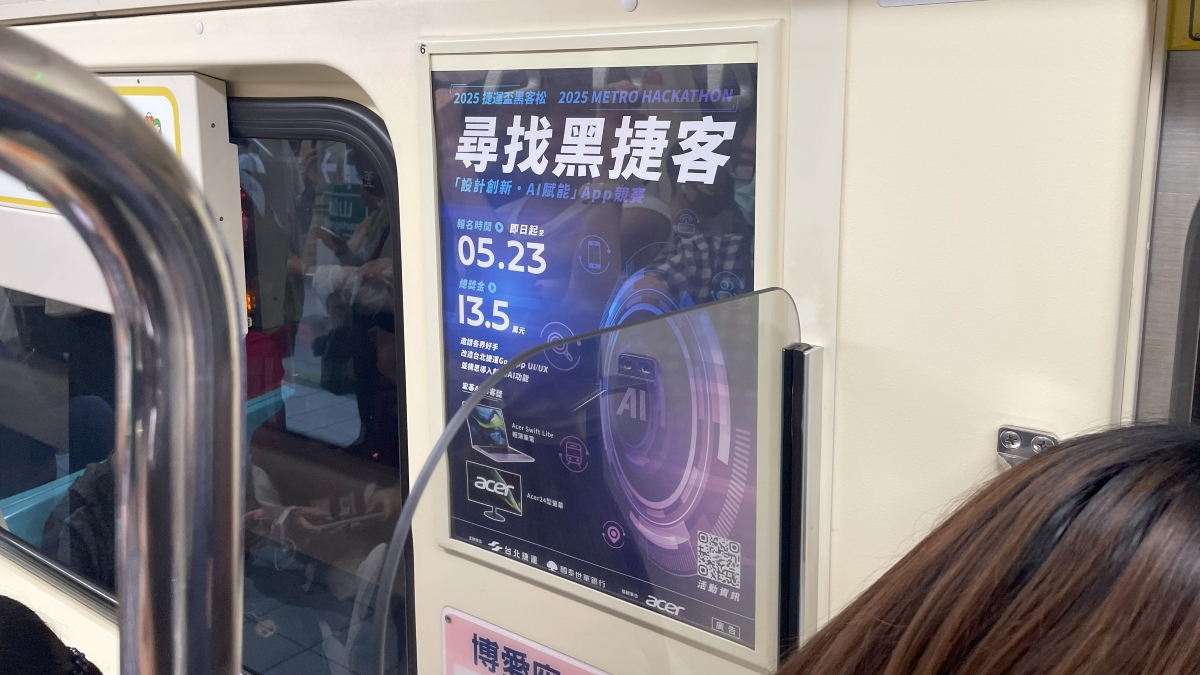
The carriages were jam-packed, but very well maintained, with informative digital signage in Mandarin and English.
While the image above shows a person controlling the train, a Taipei local informed me that the one we were on was fully automated.
After disembarking, you follow the signs to your designated exit and slot the token into the turnstile to leave the station.
Below are images from the commute. Click on the images to expand them.




 Loading ...