
Biggest Windows change in seven years

According to Globalstats Statcounter, Windows 10 has lost its seven-and-a-half-year title as the world’s most used desktop operating system (OS).
The website traffic and usage platform has estimated that Windows 11 surpassed Windows 10 as the most popular version of Microsoft’s OS last month.
As of July 2025, Windows 11 was estimated to be running on 53.51% of Windows PCs, a big jump from 47.98% in June 2025. Windows 10’s market share plunged from 48.76% to 42.88% of Windows PCs.
Considering Windows accounts for around 72% of the desktop OS market, Windows 11 is now also the most popular computer operating system overall.
The change of guard comes just two months before Windows 10 reaches end-of-life, after which the OS will no longer receive updates as standard.
Windows 10 is over a decade old and has undoubtedly been more popular than its predecessor, Windows 8.1.
While the latter certainly improved on the dismal release that was Windows 8, its usage never surpassed the wildly popular Windows 7.
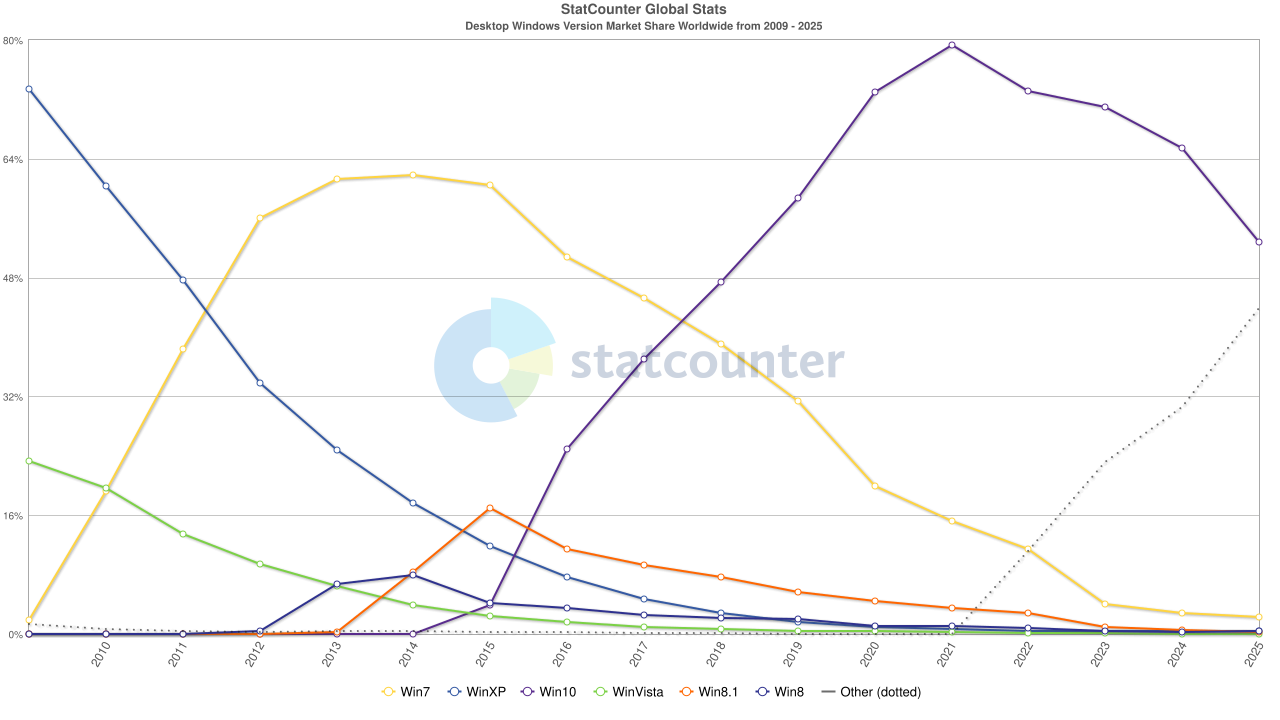
Windows 10 was launched in July 2015. Its users surpassed Windows 7’s by January 2018 — two and a half years after release.
By the time Windows 11 was officially rolled out in October 2021, it was running on nearly 80% of all Windows machines, trumping Windows XP’s peak of roughly 76%.
Among Windows 10’s most prominent features were the return of the Start Menu, virtual desktops, Task View, and improved security measures like Windows Hello.
Not all of its capabilities were well received, however. Neither Microsoft’s Cortana virtual assistant nor the first version of Internet Explorer replacement Edge were loved.
Nonetheless, Windows 10’s seven-and-a-half-year run at the top is noteworthy considering Windows 7 was only the most used OS for slightly more than six years.
Windows 10 initially seemed to represent a significant shift in Microsoft’s OS business model, after a Windows developer evangelist at a major event said it would be the “last version of Windows.”
The software giant created the impression that instead of launching new OS versions every few years, it would offer “Windows-as-a-service” with continuous updates.
While Microsoft has evidently backtracked on that plan, it has largely adopted the model for its Office 365 productivity software.
The graph below from Globalstats Statcounter shows how the market shares of different versions of Windows changed between 2009 and 2025. The dotted line primarily represents Windows 11 users.
Windows 11’s slow burn

Windows 11’s uptake has been slow compared to Windows 10’s. Having launched in October 2021, it took nearly four years to become the top desktop OS.
The slower adoption could potentially be ascribed to two factors. Firstly, the jump from Windows 10 to Windows 11 brings only a few new features and no major visual changes.
With consumers generally being averse to change, there was little incentive to upgrade in the first few years after the OS launched.
Secondly, Windows 11 has demanding system hardware requirements, including compulsory support for Trusted Platform Module (TPM) 2.0.
TPM 2.0 provides hardware-based security for protection against malware, firmware attacks, and unauthorised remote control.
The feature is standard across most CPUs released after 2018. However, many powerful processors from before that time — including Intel i9 and Ryzen Threadripper chips — don’t support it.
Microsoft previously provided a dedicated web page with instructions on bypassing TPM 2.0 requirements for desperate users. This has since been taken down.
Users of PCs that don’t support Windows 11’s requirements can join the Windows 10 extended software update (ESU) programme to receive security updates until October 2026.
The Windows 10 ESU programme is free for users who sync their PCS with OneDrive. Otherwise, they can pay a one-off annual fee of $30 (R532).





 Loading ...