
The South African engineer who helped build a Linux distribution that Mark Shuttleworth sold to BCX

Ross Addis, a veteran engineer at Red Hat, was a central figure in the creation of Impi Linux, a promising variant of the open-source operating system sold to Business Connexion by Mark Shuttleworth.
Bryanston-born and raised, Addis joined the Gauteng Linux User Group (GLUG) in 1999 and soon became its chairman. He was working at Parktown Boys High School at the time, where he had matriculated.
Discussions about a South African distribution were a constant theme at GLUG, but finally became more than a pipe dream in 2001.
Frustrated with only working on Windows at Parktown Boys High, Addis quit his job and joined MIP, a company specialising in insurance software, which is still around today.
At MIP, he still had to work on Windows, but he was given significant latitude and support to pursue his Linux passion projects.
The breakthrough for Impi Linux came when Addis teamed up with Francis Viviers and Andre Coetzee, the CEO of Cubit Accounting.
“Francis built the first software that would become Impi Linux. He built an installer in PHP, as strange as that sounds,” Addis told MyBroadband in a recent interview.
Addis said they had asked themselves what a South African variant of Linux should include to set itself apart from other distributions.
“We asked, ‘What local content could we do that would make it appealing to South Africans and make it easier?’” he explained.
Some of the earliest versions of Impi Linux included drivers for the Sentech MyWireless modem. Sentech launched its fixed wireless access broadband service in 2004 to compete with Telkom’s ADSL.
ADSL was the only residential broadband service at the time, and it had a restrictive 3GB monthly data cap. Sentech MyWireless was uncapped and cheaper, but didn’t deliver the service levels it promised.
In addition to Sentech MyWireless drivers, Addis said Impi also included Coetzee’s Cubit Accounting package.
A Linux by any other name

Regarding the name, Addis said that, as he remembered it, though other founders might disagree, he arrived at it by rearranging the letters of MIP.
He explained that MIP had been instrumental in Impi’s initial success because the company had given him full access to its PR and marketing agency to promote it.
This helped propel the distribution onto the international stage and differentiate it from other niche community projects.
However, his Zulu friends joked about why they had named a Linux distribution “War Linux”, when the open-source movement was about community and sharing.
Addis recalled that “Ubuntu” was one of the names considered. However, Desmond Tutu constantly referenced the concept of ubuntu in his talks at the time, and they didn’t want to seem unoriginal.
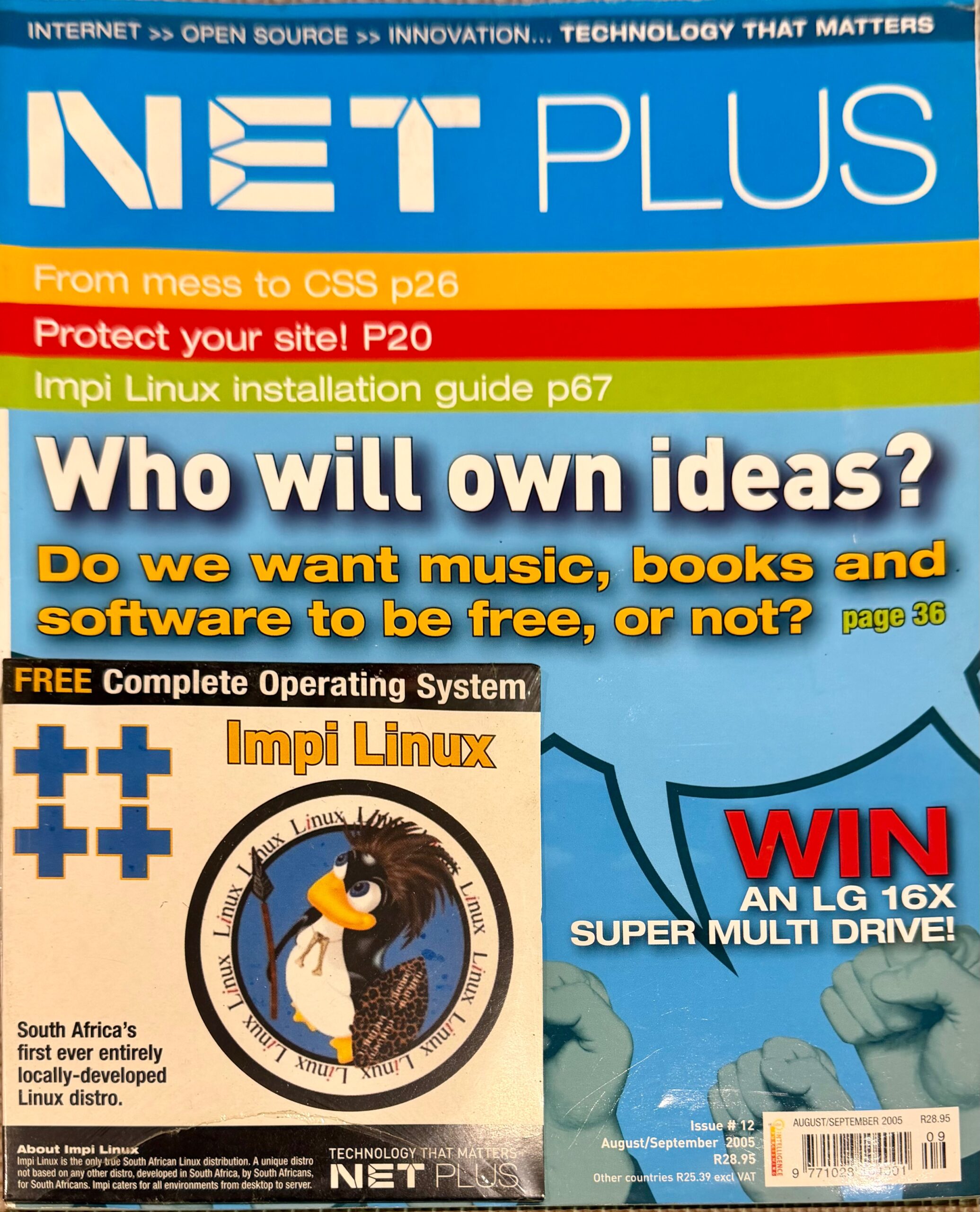
Impi Linux gained momentum in 2005 when it was rebuilt from scratch, moving away from its Debian roots to become a fully independent distribution.
“The 2005 release was written from scratch. No Debian, nothing. It was Linux from scratch. That’s what Francis mainly did,” Addis said.
This was also when they made their first sale. To the well-known book store chain Exclusive Books, no less, for an operating system to power its point of sale systems.
Addis said Exclusives was seeking a stable, secure Linux to replace the operating systems on its existing computers, which students frequently tampered with during night shifts.
The new version of Impi was “self-healing”, a kind of proto–immutable distribution, which is exactly what Exclusive Books was looking for.
Addis explained that the system would automatically rebuild itself on every reboot to maintain a consistent, secure operational state.
“We sold it for R15,000, and they used it until 2023. I mean, that’s return on investment through the roof,” Addis stated.
He said the reason Exclusives could maintain it for so long was because they had made it incredibly easy to customise this version of Impi Linux.
Mark Shuttleworth enters the ring

Impi’s profile grew further when Mark Shuttleworth’s HBD Venture Capital invested in the company, leading to the formation of a formal board and a push for large-scale government adoption.
Gary Fortuin had also joined the company as a shareholder by this point. He would become managing director upon HBD’s entry as the majority shareholder.
Jonathan Carter was also involved. In 2020, Carter became the first South African elected as the Debian Project Lead.
HBD’s Impi Linux deal was announced in September 2005, with Shuttleworth set to have a 65% stake in the business, which was 7% held by Khuselo Investments.
Khuselo was controlled by Eddie Funde, the late former chairman of the South African Broadcasting Corporation, and Pumla Radebe, the former chairwoman of Johannesburg City Parks.
A further 20% had been earmarked for an empowerment trust to distribute shares to black employees over time.
“The reason we had to have a board and be structured was because there was a massive transversal tender for Linux desktops,” Addis said when asked about the shift toward corporate governance.
Impi Linux eventually won the tender, which allowed government departments to procure the local distribution through the State Information Technology Agency (SITA).
However, this didn’t turn Impi into the success they had all hoped for. Individual departments still had to choose Linux over Windows and could then use the transversal contract to procure it.
During this time, Addis was involved in Linux migrations at the Department of Science and Technology and the Presidential National Commission.
He said the experience gave him practical insight into the challenges and successes of deploying Linux at a national level.
The final versions of Impi Linux shifted away from building a “from scratch” distribution to becoming an Ubuntu-based variant, which Addis felt lacked the unique differentiator of the earlier releases.
“The very last version of Impi was actually a reskinned Ubuntu 7.04. They sent a copy to Mark Shuttleworth, and he was very unimpressed,” Addis recalled.
Selling to Business Connexion

In 2009, the landscape shifted as Shuttleworth sold his assets in South Africa and moved his entire R4.27-billion fortune overseas.
Shuttleworth had grown frustrated with South Africa’s exchange control regulations, which made it onerous and costly to build the multinational open-source software empire he was hoping to establish.
Rather than constantly battling the Reserve Bank and taxman, Shuttleworth resolved to move his wealth out of the country, which famously led to a R250-million tax penalty.
Shuttleworth sold Impi Linux to Business Connexion (later acquired by Telkom and rebranded to BCX) as part of his exit from South Africa for what was reported as a “bargain basement price”.
Viviers didn’t join Business Connexion, and Addis said he saw the writing on the wall. He remained at BCX as Head of Service Delivery for FOSS for 4 months before joining Siemens.
In April 2009, BCX closed its open source specialist division and retired Impi Linux. The company said the promised open-source boom was not forthcoming and that it could no longer justify the unit.
“The intellectual property had left the room. It was never going to work because the technical might behind Impi and what we were doing had left,” Addis told MyBroadband.
After more than four years at Siemens, Addis joined Red Hat in 2013 as a Senior Solution Architect, where he has worked ever since. Addis is now a senior specialist architect for Red Hat Enterprise Linux.
“I didn’t realise it at the time, but we were actually asking a question: Is there a place in this world, or South Africa, for a South African Linux distribution?” said Addis.
“Even if we eventually worked out the answer was no, it was a worthwhile thing to ask.”
More photos of Impi Linux’s early years







 Loading ...