
Small South African town where horses roam free and residents make their own fuel

The small town of Greyton in the Western Cape, situated at the foot of the Riviersonderend mountain range, is using biomass digesters to convert waste into fuel.
Through the Greyton Transition Town (GTT) initiative, the town has been rolling out biomass digesters in residents’ homes on a small, localised scale.
These can convert waste, including organic kitchen waste, garden refuse, and animal manure like cow and chicken dung, into sustainable biofuel.
Before the town’s establishment in 1854, the region was home to the Hassequas Khoikhoi tribe, which had established its kraals near the Gobos River.
The tribes had many thousands of sheep and cattle, which was the primary reason Ensign Schriver of the Castle of Good Hope was sent here in the 1600s.
Schriver was sent to barter with the tribe’s headman, Captain Stoffel Koekson, and the wealth he generated from the subsequent deals helped him move his people to Boschmanskloof.
In 1793, the tribal lands Koekson’s people had previously inhabited were given to Dutchman Marthinus Theunissen, who built a homestead on his farm, Weltevreden.
However, Theunissen did not remain there long due to ongoing disputes with his neighbours over boundaries and wandering cattle in Boschmanskloof and Genadendal.
Two wealthy brothers from the Cloete family in Constantia were among the property’s subsequent owners.
In 1846, Englishman Herbert Vigne bought Weltevreden, where he established a freehold agricultural village in 1854.
He kept two small portions of the land for himself and formally declared the rest of the farm community land.
Vigne named the village “Greyton” after Sir George Grey, who was serving as the Governor of the Cape at the time.
Today, the town resembles a blend of Victorian-era and Cape Vernacular architecture. It is a hotspot for mountain biking and trail running, with numerous restaurants and a flourishing art scene.
Converting waste to biofuel

The town embarked on the Greyton Transition Town (GTT) project in mid-2011, aimed at transforming itself into a resilient and sustainable community.
“GTT started in mid-2011 when a group of local people met to consider the challenge of increasing fuel costs and the corresponding rise in the cost of living,” the project’s management said.
“We saw transitioning as a means of inspiring the community of Greyton to come together to meet these challenges and to build a resilient, sustainable village.”
Part of the project included the Community Sustainable Housing Programme, through which residents were involved in the design and construction of their homes.
GTT’s management said the homes would be built using a self-sufficiency approach that included biomass digesters, greywater systems, renewable energy, and natural building.
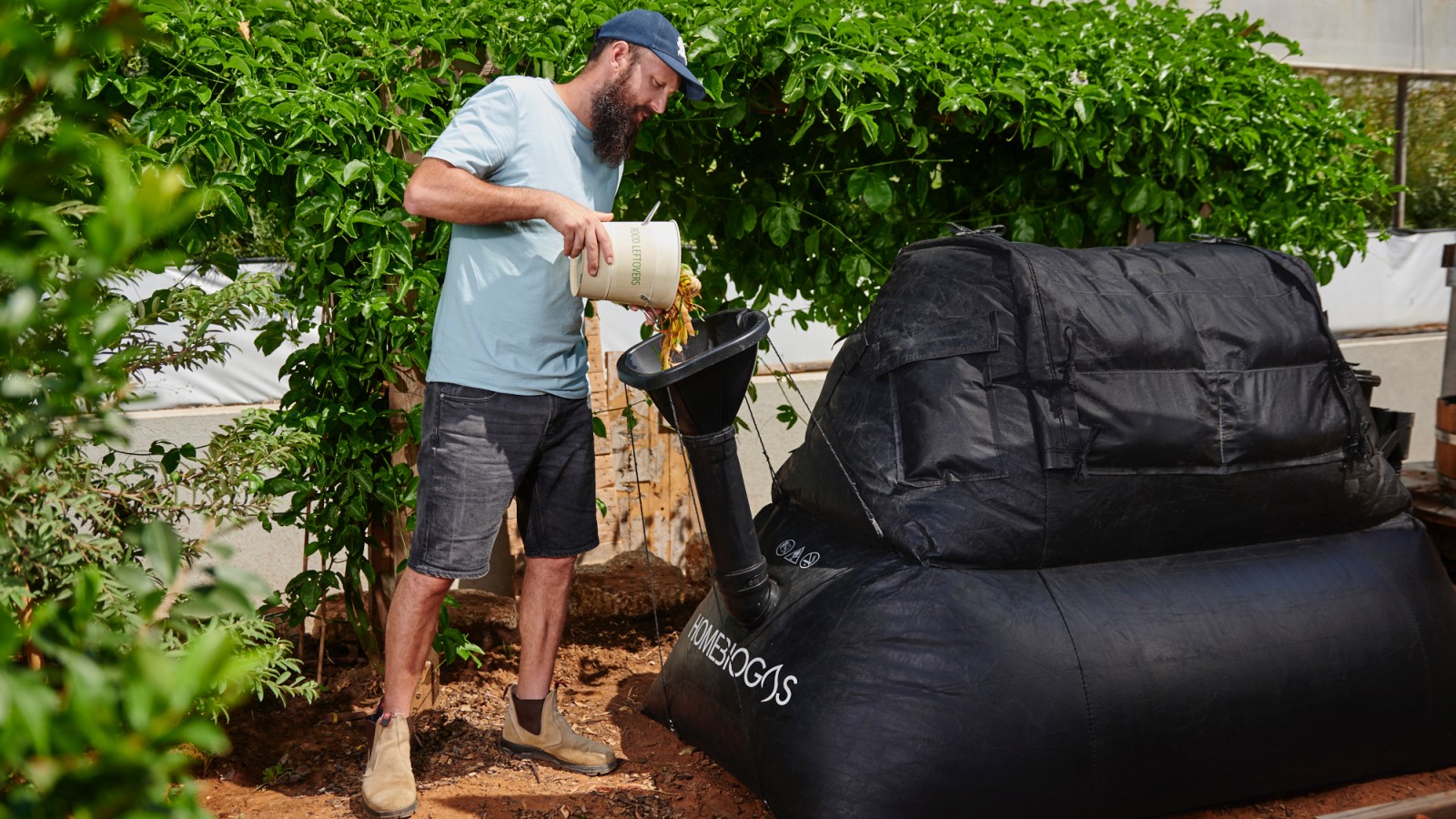
Biomass digesters, or biodigesters, process organic kitchen waste, garden refuse, animal manure, and wastewater in a sealed, oxygen-free container.
Through anaerobic digestion, bacteria break down the biodegradable materials. This happens in four phases: hydrolysis, acidogenesis, acetogenesis, and lastly, methanogenesis.
The final stage produces a gas mixture of methane and carbon dioxide. The gas is methane-rich and combustible.
Therefore, it can be piped directly into stoves for cooking, used for heating, or burned in generators to generate electricity.
The gas produced can be further refined by removing the carbon dioxide and other impurities to create renewable natural gas, which is effectively pipeline-quality methane that can fuel vehicles.
The process produces a byproduct, solid and liquid residues called “digestate”, which is nitrogen-rich and an effective organic soil fertiliser that can be used in the community’s shared gardens.
Biomass Digesters convert waste to fuel



Photos of Greyton town in the Western Cape




 Loading ...