
MultiChoice board shareholding surprise

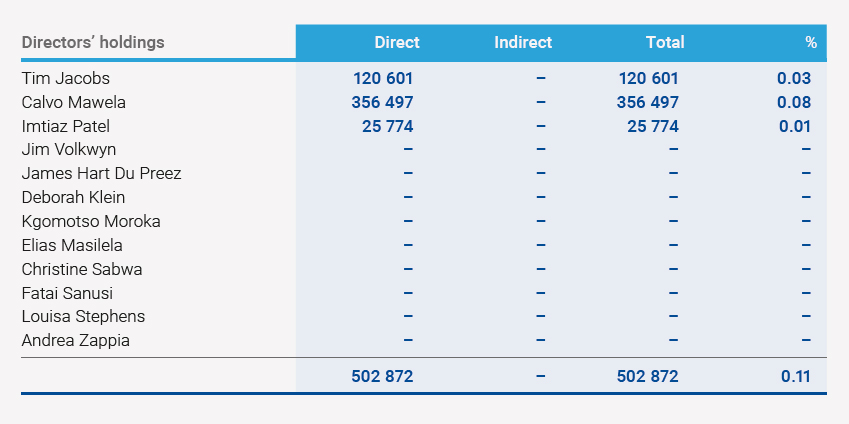
MultiChoice’s latest annual report revealed that, apart from executives who received shares, not a single director owned shares in the company.
Its financial statements further revealed that MultiChoice directors have been selling shares, while not a single director has bought shares over the last few years.
This is concerning as one of the core functions of a board is to ensure the interests of the company’s shareholders are served.
They should serve as a voice for shareholders and ensure the company’s strategic direction and decision-making align with shareholder interests.
However, directors are less likely to think like shareholders and act in their best interest if they are not shareholders themselves.
In such cases, they may align their views with personal gain, such as getting high director fees or ensuring their directorship is safe.
This is why Warren Buffett, widely regarded as the most successful investor globally, demands that all directors have skin in the game.
He transformed Berkshire Hathaway from a struggling textile manufacturer into a conglomerate holding company.
It achieved tremendous success. If you had invested $100 in Berkshire Hathaway in 1978, you would have over $400,000 today.
Buffett’s success is based on his strong ethical corporate governance, with management teams prioritising the long-term interests of shareholders over short-term gains.
At the centre of Berkshire Hathaway is the board, chaired by Buffett. What sets this board apart from most other companies is ‘skin in the game’.
There is not a single board member who does not own a significant interest in Berkshire Hathaway. Even more important — they used their own money to buy the shares.
This is not a coincidence. It is by design. Any candidate should own Berkshire stock representing a substantial portion of their investment portfolio for at least three years.
Berkshire Hathaway also does not pay its directors much. It is a fraction of what South African directors at big companies get paid.
This policy makes it easy to ensure the directors prioritise the long-term interests of shareholders over short-term gains.
It also prevents shenanigans such as directors paying themselves exorbitant fees, inflating executives’ salaries, or other strange arrangements.
MultiChoice’s performance and director pay
MultiChoice has made headlines for reporting huge losses, becoming technically insolvent, and for its questionable director payments.
The broadcaster’s loss for the year increased from R2.9 billion to R4.1 billion due to losing subscribers.
It suffered a 9% decline in active subscribers, including a 13% decline in the Rest of Africa business and a 5% decline in South Africa.
Even more concerning is that MultiChoice became technically insolvent, with negative equity of R1.07 billion.
This poor performance did not prevent the company from paying its directors handsomely over the past financial year.
The company’s chief executive, Calvo Mawela, was paid R53 million, and its CFO, Tim Jacobs, received a pay package of R28.9 million.
The company also paid its non-executive directors a combined R66 million for the year, including R46 million to its chairman.
Industry players raised questions about Mawela’s pay package and his high living costs on company expenses in Dubai.
Some stakeholders also questioned paying chairman Imtiaz Patel $2.509 million over the last financial year.
Business Live reported that the disparities between board member remuneration and consultancy arrangements raised eyebrows.
One analyst said shareholders need to pay close attention to these board consultancy arrangements as they can potentially erode proper oversight.
The analyst added that board consultancy arrangements have the potential to plunge the company into a corporate governance crisis.
“The amounts paid to some board members and the former chair seem exorbitant,” he said.
It raised questions about whether the MultiChoice board looked after the interests of shareholders or those of directors and executives.
The tables below show MultiChoice directors’ holdings in the company and whether they bought or sold shares.
It should be noted that Mawela, Jacobs, and Patel did not buy their shares in MultiChoice. They received them as part of incentive schemes.

MultiChoice explains
MultiChoice defended the situation, saying shareholders differ in their views on whether directors should hold shares in a company.
“Some regard shareholdings by independent non-executive directors as problematic, as they perceive such holdings as negatively impacting independence,” it said.
It added that it changes for executive directors this is different, where shareholders typically prefer them to have “skin in the game”.
“To encourage individual shareholding in MultiChoice and to align with shareholders’ interests, our remuneration policy requires all members of the executive committee to comply with minimum shareholding requirements (MSR),” it said.
The CEO is required to hold three times the value of his annual salary in shares. Calvo Mawela holds 4.54 times his annual salary in shares.
For the CFO, the requirement is twice his annual salary. Tim Jacobs holds 2.67 times his annual salary in shares.
“Neither Mawela nor Jacobs have sold any shares since MultiChoice’s listing,” the company said.
“The fact that they have increased their shareholding well past the minimum requirements shows that they have faith in the company’s strategy and future.”


 Loading ...