
DStv prices versus inflation

MultiChoice increases DStv’s pricing annually, and its claims of lower-than-inflation increases have held for DStv Premium, Compact Plus, and Compact over the past ten years.
DStv’s latest price hike took effect on 1 April 2024, with subscription fees across its pay-TV catalogue rising by 3.1% to 7.8% over the previous year.
Premium subscribers have been paying R50 more per month since that date. They received a 5.7% price hike from R879 to R929.
DStv Compact Plus customers were hit with an above-inflationary increase for the 2024/25 financial year, with their monthly subscription fee increasing by 6.9% from R579 to R619.
South African residents on the Compact plan received the smallest increase of the three, at 4.5%, with the monthly fee increasing from R449 to R469.
MultiChoice CFO Tim Jacobs previously said the company has endeavoured to implement sub-inflation increases for several years.
“For many years, especially in South Africa, we have priced our products at less than half of inflation. We’ve been concerned and watching the consumer’s wallet,” he said.
However, DStv has been under significant pressure in recent years, losing customers and its owner, MultiChoice, going technically insolvent.
MultiChoice’s financial results for the year ended 31 March 2024 revealed it suffered a R4.1 billion loss and became technically insolvent.
Its assets dropped to R43.9 billion, while liabilities increased to R45 billion, leaving it with a negative equity of R1.07 billion.
The same results revealed that the broadcaster had lost roughly 1.6 million subscribers during the financial year.
As of 31 March 2024, DStv’s active subscribers had fallen to 15.7 million, 1.6 million fewer than the 17.3 million it reported a year earlier. This represents a 9% decline in active DStv subscribers.
MultiChoice said the significant subscriber losses it reported for 2023/24 were primarily due to losses in the Rest of Africa rather than in South Africa.
“The group’s 9% decline in active subscribers was mainly due to a 13% decline in the Rest of Africa business as mass-market customers in countries like Nigeria,” it said.
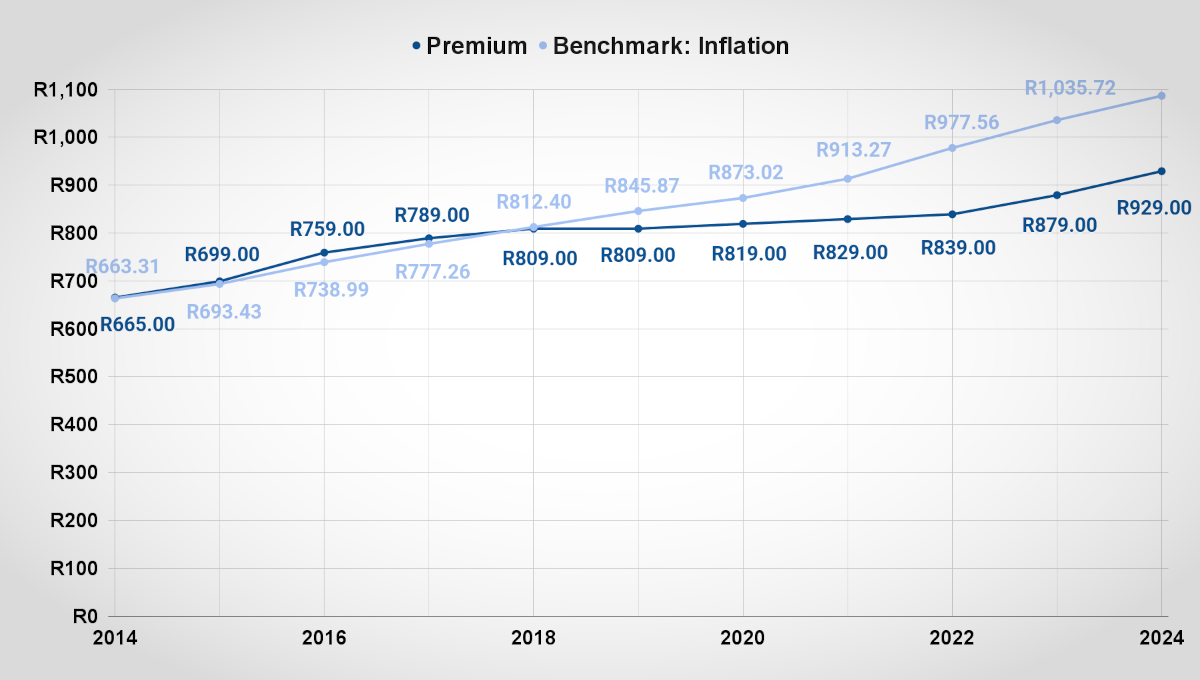
MyBroadband compared the pricing of DStv’s three most expensive packages to benchmark inflation from 2014 to 2024. Premium customers’ subscription fee increases have been significantly lower than inflation since 2019.
The charts below show how the price increases of DStv Premium, Compact Plus, and Compact compare relative to inflation.
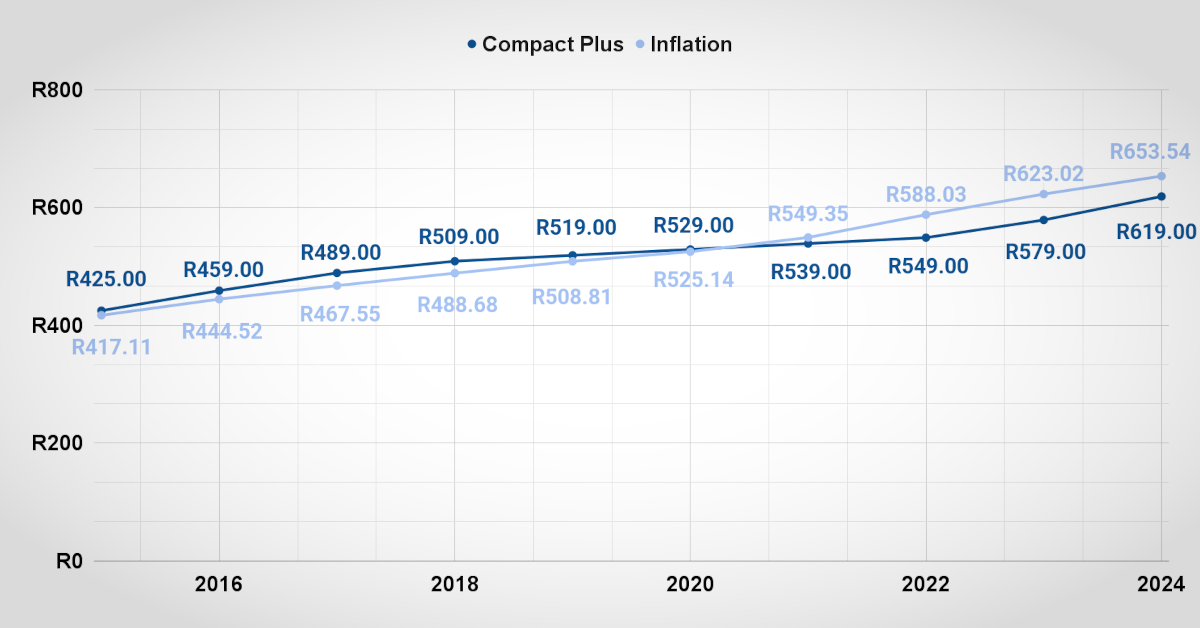
It should be noted that DStv Compact Plus only launched in 2014. Therefore, we compared its prices to inflation from 2015, using 2014’s average annual inflation rate as the benchmark.
We did the same for DStv Premium and DStv Compact; however, we could compare prices for these from 2014, using 2013’s price and average inflation rate as the benchmark.
DStv Premium inflation benchmark — 2014 to 2024
From 2015 to 2017, DStv Premium’s prices were generally higher than the inflation benchmark. However, its prices only slightly exceeded the benchmark, with the biggest difference being R20.01 in 2016.
DStv Premium prices have been lower than the inflation benchmark since 2018, with the gap widening significantly each year. In 2023, its prices were R157 less than the calculated benchmark.
DStv Compact Plus inflation benchmark — 2015 to 2024
As DStv Compact Plus only launched in 2014, we used that price for our benchmark calculations from 2015 to 2024.
From 2014 to 2020, DStv Compact Plus prices were higher than the calculated inflation benchmark. However, like with DStv Premium, the price differences were slight, with the most significant being R21.45 in 2015.
Prices have remained lower than the inflation benchmark each year from 2021 to 2024.
DStv Compact inflation benchmark — 2014 to 2024
South African residents on DStv’s Compact package paid more than the inflation benchmark from 2014 to 2021, with DStv’s price increase for the plan dropping below inflation in 2022.
Since 2022, DStv Compact customers in South Africa have paid less than the calculated inflation benchmark, although only slightly.


 Loading ...