
SuperSport at 30
![[FILE TOO LARGE DO NOT USE]](https://mybroadband.co.za/news/wp-content/uploads/2025/02/supersport-broadcasting-1.jpg)
MultiChoice’s SuperSport launched 30 years ago and has grown into a sports broadcasting powerhouse covering momentous sports events, including the Springboks’ 2007, 2019, and 2023 World Cup wins.
With MultiChoice’s roots in M-Net, its sports broadcasts were branded M-Net SuperSport since around 1988. However, SuperSport launched as a standalone 24-hour channel in 1995.
“We’ve brought you every triumph, every tear, and every unforgettable moment that has defined our nation’s sporting history,” said SuperSport.
Reflecting on SuperSport’s 30-year journey, CEO Rendani Ramovha said the sports broadcaster’s success is a testament to the power of sport to unite and inspire South Africans.
“This anniversary is not just a celebration of our history, but a profound thank you to the fans who have made us who we are,” said Ramovha.
“Your passion fuels our purpose, and we are committed to continuing to tell the stories that matter most.”
SuperSport began as an M-Net channel offering 12 hours of daily programming and held the live broadcasting rights to the Currie Cup rugby tournament.
According to MultiChoice, SuperSport’s popularity grew strongly in 1993, when it became known as the “Channel of Champions.”
The broadcaster, then M-Net, expanded its sports offering in 1994, making SuperSport a 12-hour-a-day channel broadcast in nations across the continent.
In 1995, M-Net divided its operations, and MultiChoice was formed to oversee various aspects of its broadcasts, including subscriber management, signal distribution, and cellphone operations.
That same year, MultiChoice established offices in various African countries, including Namibia, Botswana, Nigeria, Kenya, and Zimbabwe.
Around this time, MultiChoice launched its satellite TV service, DStv, and SuperSport was one of the key channels carried on the service.
By this time, SuperSport had become a standalone, 24-hour-a-day channel. By the late 1990s, DStv’s channel capacity had grown, allowing MultiChoice to launch sister channel SuperSport 2 to cope with scheduling clashes.
Its coverage and DStv’s capacity grew further into the early 2000s, and by that time SuperSport had expanded to four channels, each carrying a mix of sports.
Today, MultiChoice’s SuperSport spans 20 channels on DStv, including dedicated channels for sports like Rugby, Cricket, various football tournaments, golf, and motorsport.
“SuperSport is, and will always be, Your World of Champions. Thank you for being part of our incredible journey,” says MultiChoice.
SuperSport’s milestones over the past 30 years are summarised below.
1995 — M-Net SuperSport becomes a standalone SuperSport channel

When MultiChoice formed to oversee M-Net’s subscriber management, signal distribution, and cellphone operations, SuperSport became a standalone 24-hour-a-day channel.
MultiChoice’s introduction of digital technology in Africa with the launch of DStv supported the SuperSport channel, enabling it to reach remote regions while delivering exceptional quality.
SuperSport was around for the Springboks’ first Rugby World Cup win in 1995. However, it wasn’t the host broadcaster — an honour held by the South African Broadcasting Corporation (SABC) at the time.
SuperSport has been involved in the ongoing celebration and commemoration of the event through various broadcasts and other associated content.
The channel’s focus was largely on major South African and international sports rights, including Rugby Union, Cricket, football, and other big-ticket sports events like boxing.
Late-1990s — MultiChoice launches SuperSport 2

While the exact date isn’t clear, DStv’s capacity grew larger in the late 1990s, enabling SuperSport to launch a second channel on the platform to address scheduling clashes.
SuperSport 2’s role changed over time. It initially served as an overflow channel when SuperSport 1 couldn’t carry everything. It showed a mix of sports, depending on what was happening at the time.
By the early 2000s, SuperSport 2 increasingly carried international football events and became associated with the English Premier League, UEFA competitions, and other major football events.
When it wasn’t broadcasting football, SuperSport 2 often aired cricket series, tennis tournaments, and other global events.
Early to mid-2000s — SuperSport expands to full, numbered channel suite

SuperSport began expanding further in the early to mid-2000s, when it launched a full suite of channels occupying several channels in the DStv catalogue.
At the time, SuperSport 1 prioritised rugby union events, SuperSport 2 remained focused on international football, SuperSport 3 primarily aired cricket events, and SuperSport 4 served as an overflow channel.
It also had SuperSport 5 broadcasting niche or secondary sports like tennis, athletics, and cycling, as well as SuperSport Blitz and Maximo, among other specialist channels.
The numbered channels occupied DStv’s channels from 201 to 205, while Blitz, Maximo, and other specialist channels were assigned higher numbers.
2007 — SuperSport broadcasts the Springboks’ second Rugby World Cup victory
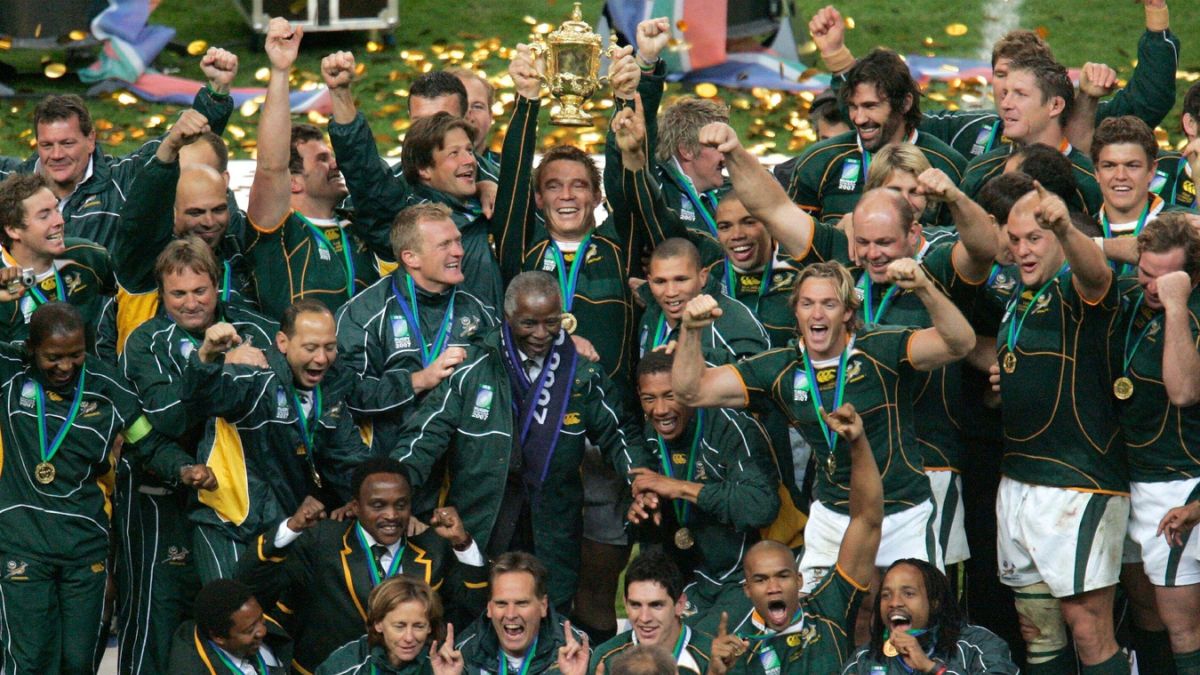
SuperSport held the rights to broadcast the 2007 Rugby World Cup in France, making it the exclusive pay-TV broadcaster of the tournament in much of sub-Saharan Africa.
The Springboks won the tournament, beating England in the final through a defensive masterclass that secured the team’s second World Cup titles.
SuperSport carried the entire tournament live, with extensive studio shows, highlights, and repeats.
2009 — MultiChoice launches 24-hour SuperSport HD channel

SuperSport launched a 24-hour-a-day high-definition (HD) channel on DStv in late 2009, its first HD channel offering.
It launched SuperSport HD on 26 December 2009, coinciding with the start of the Boxing Day cricket test match against England. Customers then required DStv’s HD PVR decoder to watch the HD channel.
While the channel was SuperSports’ first venture into HD content, it was the second HD channel on the DStv bouquet, following the earlier launch of M-Net HD.
2018 — All SuperSport channels go HD on DStv

In late 2017, SuperSport announced that its entire sports channel offering in South Africa would transition to HD (1080i) in 2018.
These included SuperSport Blitz, SuperSport 1 to SuperSport 8, and SuperSport 11. However, it was later announced that SuperSport 9 and Maximo, the remaining standard definition channels, would follow in mid-2018.
2019 — SuperSport starts streaming and covers the Springboks’ third Rugby World Cup title

SuperSport held exclusive pay-TV rights to broadcast the 2019 Rugby World Cup, hosted by Japan, in sub-Saharan Africa.
While the SABC was allowed to air some matches, SuperSport was the only broadcaster to carry all 48 live matches.
Fans could watch all matches live in 1080i on DStv Premium and in 1080p through the DStv Now streaming platform.
It was another memorable Rugby World Cup tournament for Springbok fans, with the national team winning its third title and scoring its first tries in a World Cup Final.
2022 — SuperSport’s first 4k broadcast

In September 2022, DStv announced that it would broadcast the 2022 FIFA World Cup on Supersport in 4K resolution, marking a big step up from 1080i/1080p.
4K UHD (2160p) offers four times more pixels and provides a far sharper image with more detail.
To watch the content in 4K, customers had to be DStv Premium subscribers and have the DStv Explora Ultra decoder or DStv Streama.
2023 — SuperSports broadcasts the Springboks’ record-breaking fourth Rugby World Cup victory

The Springboks made rugby union history in 2023, becoming the first nation to win four World Cup titles. It was also the team’s second consecutive title win — something only Australia and New Zealand had achieved.
SuperSport once again held exclusive pay-TV rights to broadcast the tournament in sub-Saharan Africa. However, the SABC was also allowed to broadcast some matches.
SuperSport broadcast all 48 matches live through its satellite TV and streaming services and ran a 24-hour channel dedicated to the Rugby World Cup so fans could follow all the action.
South Africa beat New Zealand’s All Blacks in a nail-biting final, with the Springboks winning 12-11.





 Loading ...