
How SA’s supercomputer champs won

For the second year in a row, South Africa has won the International Supercomputing Conference (ISC) Student Cluster Competition, defending our title as world supercomputing champions.
The ISC ’14 Student Cluster Competition (SCC) was held on 23–25 June 2014 in Leipzig, Germany and saw 11 teams from around the world competing for the crown.
However, while team South Africa may have caused an upset when it won the SCC last year, we did not send the same team back to Leipzig to defend our title.
Our team was selected by the Centre for High Performance Computing (CHPC) at the Council for Scientific and Industrial Research (CSIR) through a national competition in which many universities compete.
The following students made it into the CHPC team: Eugene de Beste (UWC), Nicole Thomas (UWC), Saeed Natha (UWC), Warren Jacobus (UWC), Pieter Malan (SU), Ellen Nxala (UFH), Kevin Beyers (NMMU), and Hardus Bodenstein (NWU).
As part of their prize for winning the CHPC’s national competition, the team of 8 students (which includes 2 reserves) travelled to Dell’s headquarters and the Texas Advanced Computing Centre at the University of Texas in Austin.
There the team received a tour of the facilities and access to experts who could answer their questions about various aspects of supercomputing.
Dell sponsored both trips and also sponsored the equipment the team needed to compete in the ISC ’14 SCC.
Winning the ISC ’14 SCC
To win the ISC’s Student Cluster competition, teams had to run a number of benchmarks on their clusters (and have them perform well), while keeping their power consumption below 3 kilowatts (kW).
Teams are also faced with a surprise task on the third day, and have to impress judges during an interview.
On day 1, the benchmarks were LINPACK, and High Performance Computing Challenge (HPCC); and on day 2 teams ran OpenFOAM, Quantum Espresso, and High Performance Conjugate Gradient (HPCG).
On the third day of the competition, teams had to run the Gadget benchmark and face the surprise task.
“The surprise task on day 3 was a new concept for the competition,” David Macleod from the CSIR told MyBroadband.
Normally the teams have a power budget of 3kW and must complete tasks while trying to achieve the best performance.
For the surprise task this was flipped.
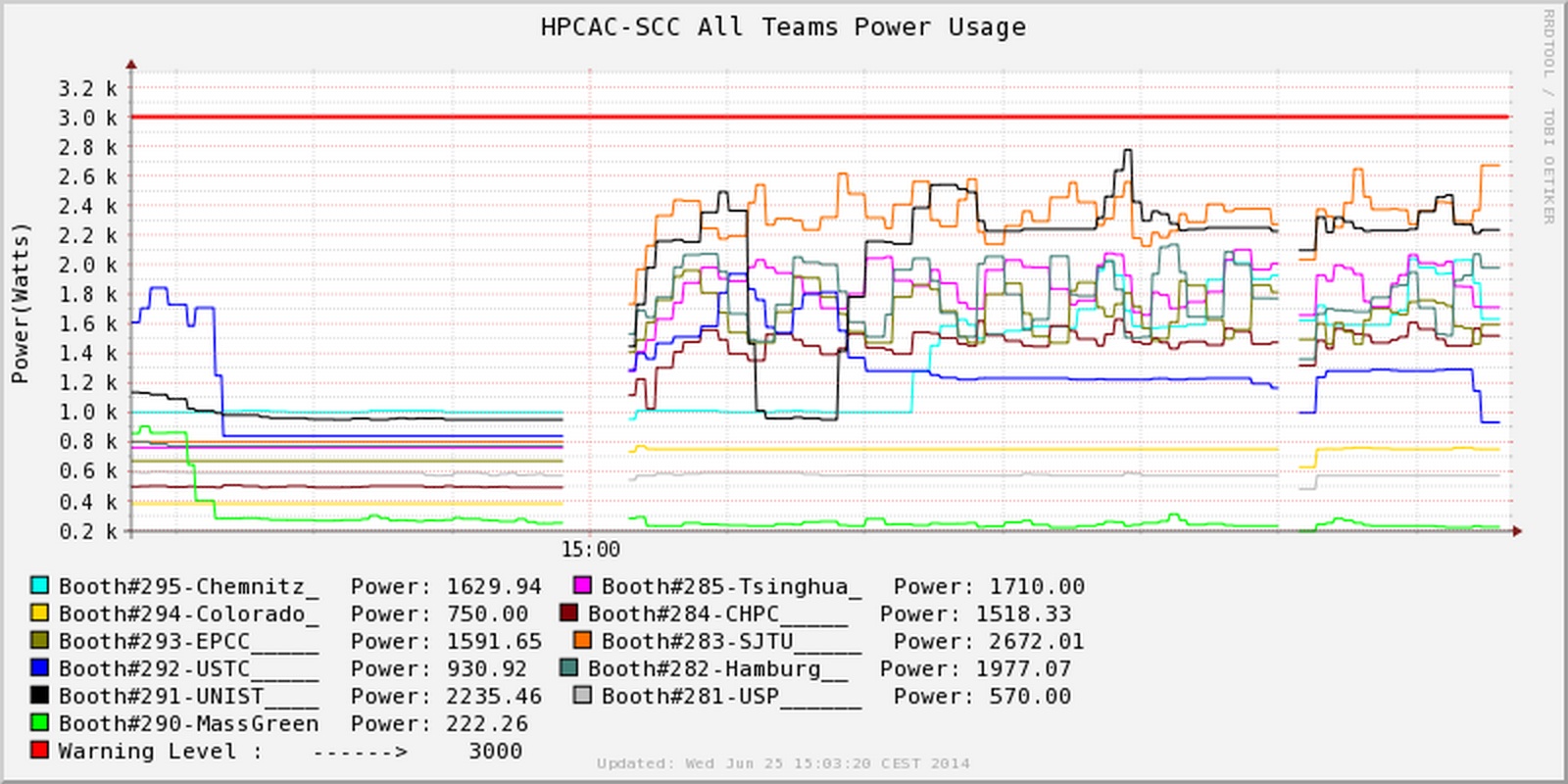
ISC 14 SCC surprise task start, power consumption over time
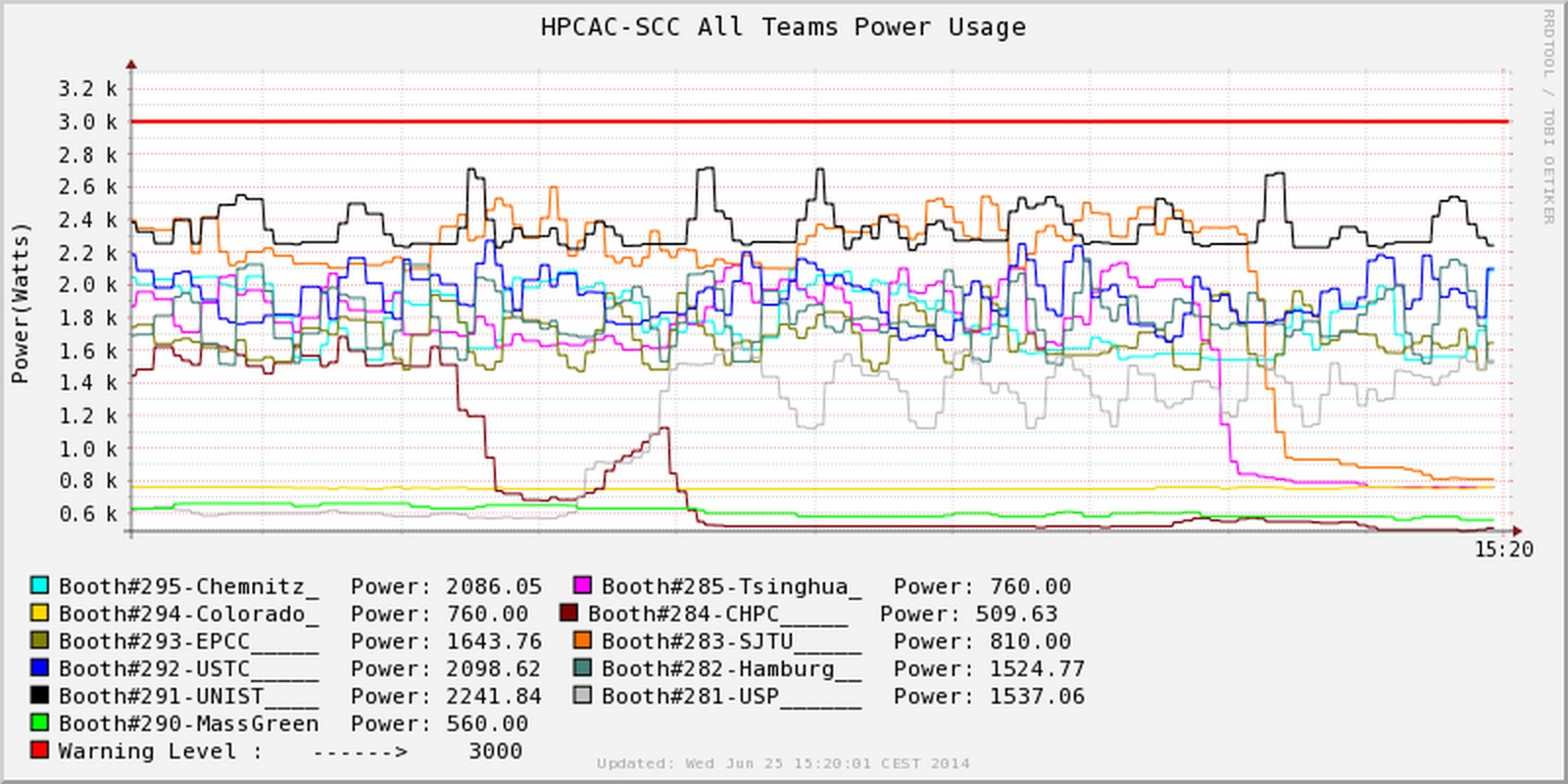
ISC14 SCC surprise task end, power consumption over time
Instead of a power budget, teams had a performance budget and a 20 minute window in which they had to complete a task with the lowest peak power consumption.
“Another nice aspect about this challenge was that everyone has to complete the task at the same time,” Macleod said. “This meant that everyone could see how all the clusters were performing.”
Being able to see how teams were performing relative to one another in real time was especially satisfying for the CHPC team, Macleod said.
The above graph shows the different teams’ power consumption over time during the surprise challenge.
“What you normally expect to see is that the higher the power consumption, the better the performance,” Macleod said.
“For most of the competition our power consumption was well below the 3kW limit so it didn’t look like we were doing very well,” he explained. “Then came the surprise task.”
From the start of the surprise task, team South Africa’s power consumption was the lowest and it was therefore expected that their run would be the longest and they would complete the task last.
“To everyone’s surprise we not only used the least power but also finished the task first,” Macleod said.
“Finishing the job first didn’t mean anything for that task, but it showed to everyone that just because our power consumption had been low throughout most of the competition it didn’t mean we were doing badly. It was at that point I realised that we had a shot at winning again so I told the team they had to ace the interview,” Macleod said.
Macleod reported that the team did really well in the interview and impressed the judges with their cluster’s design, their knowledge, and how well they worked together as a team.
In the end, the CHPC cluster was well balanced and very power efficient compared to the other clusters in the field that day, Macleod said.
More SA science achievement news
Holy petaFLOPS! South Africa wins supercomputing crown again
South Africa discovers triple black hole system: SKA
SA-based scientist first African to receive international award
Great South African inventions
Photo of the winners by Sabine Diedering








 Loading ...