
Quantum computing experiment leads to breakthrough
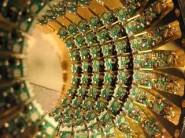
The latest excitement in quantum mechanics is over a tiny crystal in a laboratory in Boulder, Colorado, that Sydney University’s Michael Biercuk created with fellow experimental physicists from the United States and South Africa.
It holds within it the possibility of doing calculations that all the world’s computers harnessed together would not have the power to do.
The crystal, less than 1 millimetre across, is made up of just 300 atoms, and has more interacting elements than any other programmable quantum simulator.
“The breakthrough is not that just 300 atoms are involved (because) the community routinely does experiments with single atoms,” Biercuk said. “The breakthrough is that we have a controlled system with enough interacting quantum particles that the computational capacity of the system is larger than the most powerful supercomputer.”
Tests show this quantum simulator is the first to surpass the critical threshold of 30-40 particles where today’s most advanced supercomputers choke. It could potentially do sums beyond the capability of a desktop notionally the size of the known universe.
“No classical computer could do what this simulator has the potential to do,” Biercuk said.
Alas, the buzz is just within the quantum mechanics community. The simulator is only good for analyzing magnetism and with all its supporting technology takes up a whole room so there will not be a home version from Dell in the foreseeable future.
Biercuk, co-author of the paper in the latest edition of the journal Nature detailing the first test results, sees lab work eventually giving way to less specialized work.
“In the next several years we hope to be able to perform specialized calculations that are actually impossible on any supercomputer,” he said. “Finding a more general use, and performing ‘useful’ calculations, will likely occur in the next 10-20 years.”
The crystal at the core of the simulator is a pancake of 300 beryllium ions kept in place by a magnetic field and housed in a smartphone sized device called a Penning trap. Microwave and laser pulses rearrange the atoms inside the trap, their interaction mimicking the quantum behaviour of materials that otherwise would be too difficult to study in a laboratory.
The setup at Boulder’s National Institute of Standards and Technology is complex and expensive but the computing power is mind-boggling – a whopping 80 orders of magnitude (a number with 80 zeroes behind it) larger than current computers.
The problem with this is that because the quantum processor has the power to outperform any existing computer, who knows whether it is coming up with the right answers?
“Once the system provides an answer, there’s no straightforward way to know the answer is correct,” Beircuk admitted. “That’s why we’ve been performing benchmarking experiments, confirming the system performance for very simple problems that are easily checked.”






 Loading ...