
TV licence security problem fixed

The SABC has told MyBroadband that it has fixed a potentially serious security issue on its TV licence payment site that was preventing customers from paying.
It confirms that there was a “challenge with the payment website” and that it has now been resolved, with the website no longer being blocked by user browsers on mobile or desktop.
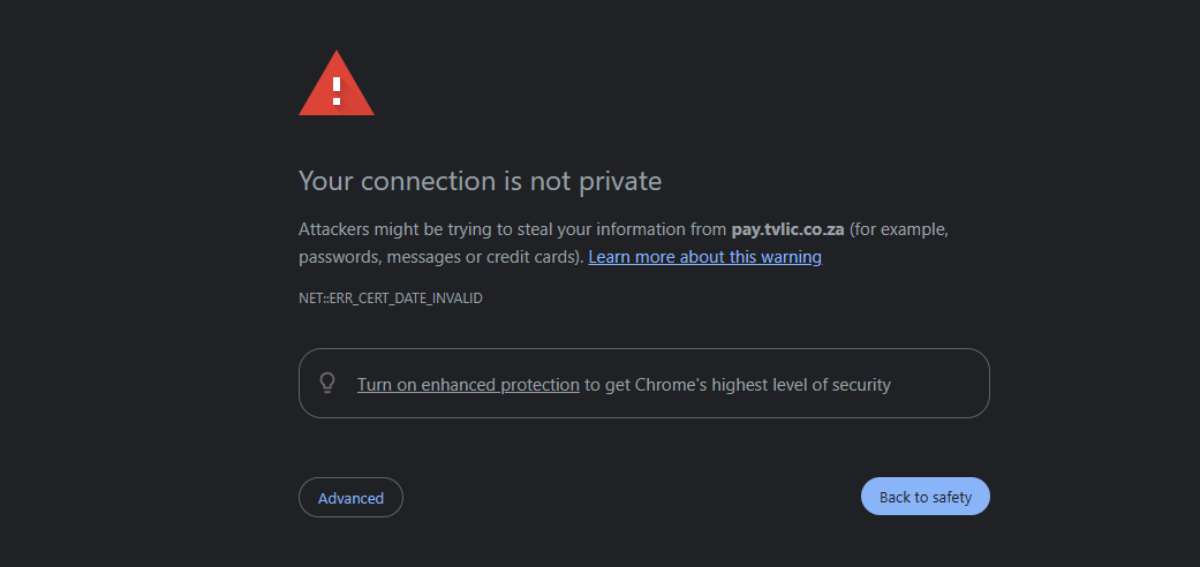
MyBroadband was alerted earlier this week that the website the SABC uses to allow customers to pay TV licences no longer had a valid Transport Layer Security (TLS) certificate.
We found that the website’s TLS certificate had expired the previous Sunday and had been left without a valid licence for 4 days. As soon as we reached the site, our browser blocked it as “untrusted.”
While the site was not secure, customers would have also been met with warnings when they reached the website, as modern Internet browsers automatically block webpages without these certificates.
“This can erode users’ trust and deter visitors from continuing to the site, potentially leading to a loss of traffic and credibility,” security certificate vendor Sectigo explained.
While the website could still be accessed using the “Advanced” options that some browsers include after blocking these pages, the majority of users would have simply clicked away.
The other major problem is that an expired TLS certificate could mean that banking and payment facilitation partners begin rejecting money transactions between users and the site.
In particular, the SABC has a partnership with South African payment processing service Pay@, announced earlier this year to handle licence payments.
Pay@ is unable to process payments between bank accounts and the website unless the site has a valid TLS certificate, as it must comply with the Payment Card Industry Data Security Standard (PCI DSS).
The PCI DSS is an industry-wide standard for any firm handling card data and is mandated by the biggest card companies in the world, including Mastercard, Visa and American Express.
Specifically, PCI DSS requirement 4.1 states that payment services must use strong cryptography (TLS 1.2 or higher) to protect cardholder data during transactions over public networks.
This means that as long as the website’s TLS certificate was not up to date, no TV licence payments could be processed on the official portal. It also exposes users to cyber threats from criminals.
“We would like to apologise for the inconvenience this may have caused and thank everyone who has continued to make TV licence fee payments through alternative platforms,” the SABC said.
Alternatives include paying licences on the major banking apps, paying at certain ATMs, including Absa, Standard Bank, and FNB, or paying at retailers like Shoprite and Pick n Pay in person.
Customers can also pay in person at Post Office branches or regional SABC offices.
Millions refuse to pay TV licences
Over 86% of SABC TV licence holders avoided paying their licences to the national broadcaster in 2024 alone, a problem that continues to represent a financial chasm for the SABC.
TV licence payments are a cornerstone of the SABC’s existing funding model, and continued non-payment contributed to the company’s most recent annual financial loss of R253.3 million.
That year, the broadcaster reported that it billed its customers for R4.9 billion in TV licence fees, but only expected to collect R758 million, or about 15.47% of what it was owed.
Minister of Communications and Digital Technology Solly Malatsi is currently working on sweeping changes to the SABC’s funding model following his rejection of the long-awaited SABC Bill in 2025.
The latest is that the minister had contracted South African ICT research and advisory firm BMI TechKnowledge to help develop a new funding model for the embattled state broadcaster.
“This is a major milestone in our efforts to secure the public broadcaster’s future and mandate to serve millions of South Africans,” Malatsi said at the time.


 Loading ...