
Beware 200,000 new malicious programs daily

Kaspersky Lab has released its annual Kaspersky Security Bulletin, which provides their overall malware and cyber-threat statistics for 2012. The data analyzed in the report was obtained using the Kaspersky Security Network (KSN).
The 2012 report revealed significant growth of Mac-specific malware and an explosive growth in the number of threats targeting the Android platform. Overall, Kaspersky Lab’s products detected and blocked more than 1.5 billion web-based attacks in 2012 and more than 3 billion infected files.
At the present time Kaspersky Lab detects and blocks more than 200,000 new malicious programs every day, a significant increase from the first half of 2012, when 125,000 malicious programs were detected and blocked each day on average.
“What 2012 has shown is the strong inclination of cyber-criminals to steal data from all devices used by consumers and businesses, be it a PC, Mac, smartphone or tablet,” said Costin Raiu, Director of Global Research & Analysis Team Kaspersky Lab.
“We are also observing a strong increase in the overall number of threats, affecting all popular software environments.”

Costin Raiu
Quick facts from the 2012 Kaspersky Security Bulletin
In 2012, Kaspersky Lab’s products blocked more than 1.5 billion web-based attacks throughout the year, which is 1.7 times greater than the total amount of web-based attacks in 2011.
Kaspersky Lab successfully blocked more than 3 billion local infections on users’ computers in 2012. In total, 2.7 million unique modifications of malware and potentially unwanted programs attempting to launch on users’ computers were detected during these incidents.
In 2012, 99% of all mobile malware detected by Kaspersky Lab was designed for the Android platform. Kaspersky Lab identified more than 35,000 malicious Android programs for the year, which is about six times more than in 2011.

Distribution of mobile malware by platform in 2012
Mac OS X malware continues to increase as Kaspersky Lab’s antivirus experts created 30% more signatures to detect various Mac Trojans this year compared to 2011.

Number of new antivirus signatures created each year to detect Mac OS X malware
Oracle Java was the most popular vulnerable application targeted by cybercriminals in 2012. The application accounted for 50% of all detected exploit-based attacks targeting vulnerabilities. Adobe Reader ranked second and accounted for 28% of all incidents.
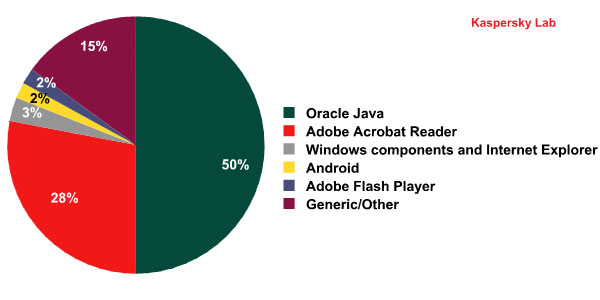
Applications containing vulnerabilities targeted by web exploits in 2012
Related articles
Websites defaced, not hacked: Sita
Most common SSH passwords revealed
Beware saving passwords in your browser


 Loading ...