New Mitsubishi Pajero

New Mitsubishi Pajero revealed (and pencilled in for SA)

The new Mitsubishi Pajero has finally been revealed, switching to a ladder-frame chassis and poised to eventually replace the Pajero Sport in South Africa…

- Pajero reborn after 5-year pause
- Switches to ladder-frame chassis
- Single-turbo 2.4-litre turbodiesel

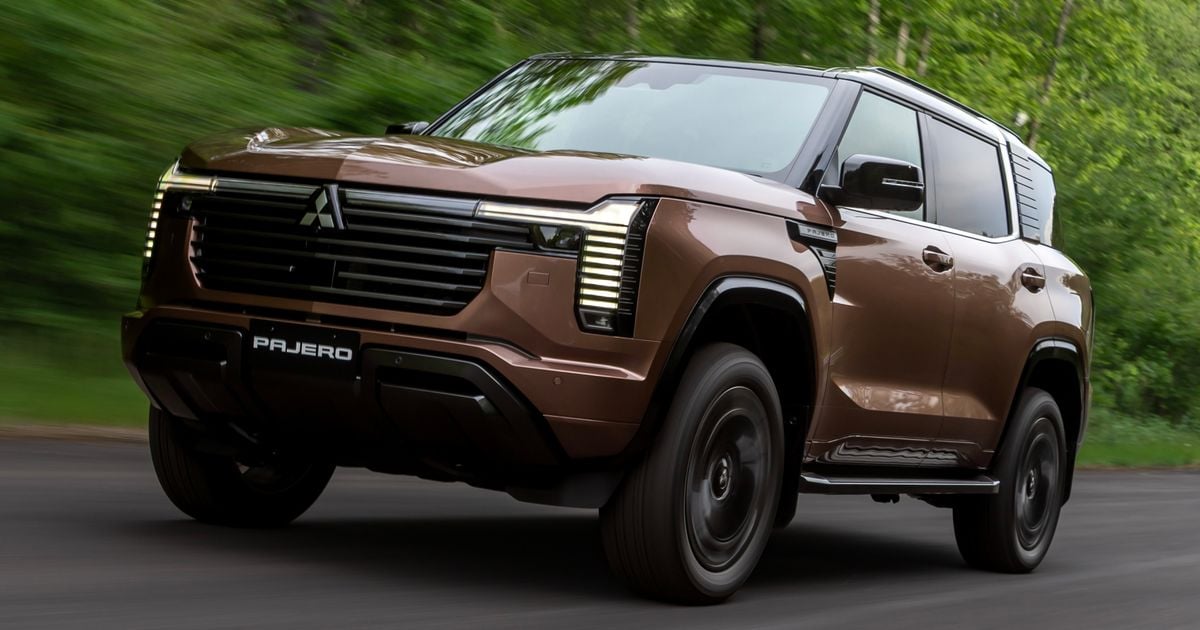
After a 5-year hiatus, the Mitsubishi Pajero is back. The Japanese brand’s SUV has switched to a thoroughly updated version of the Triton‘s ladder-frame chassis (as opposed to a monocoque body with a built-in frame) and is poised to replace the Pajero Sport as well.

And, based on last year’s comments from Mitsubishi Motors South Africa, the 5th-generation Pajero – set to be offered in 3-row, 7-seater form – is very much on the cards for Mzansi. Though local launch timing has yet to be confirmed, we’d speculate the newcomer will arrive at some point in 2027.

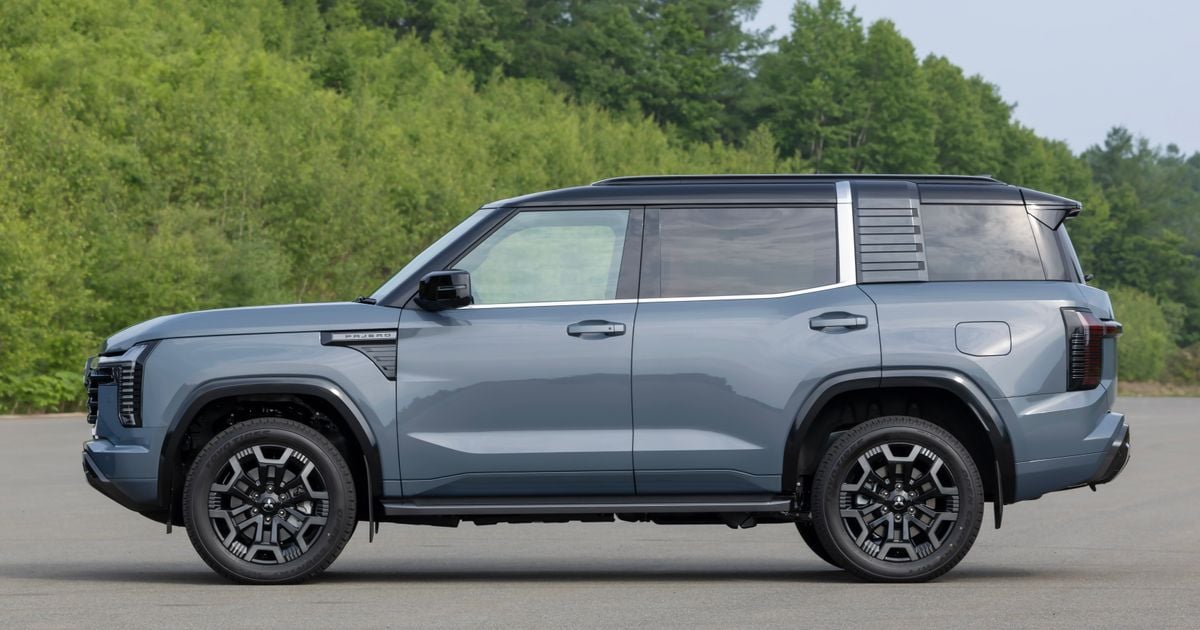
Billed as Mitsubishi’s “new-generation flagship model”, the fresh-faced Pajero will be produced in Thailand alongside the Triton. The newcomer measures 4 920 mm from front to back, making it around 95 mm longer than the outgoing Pajero Sport. Its width comes in at 1 925 mm, while the front and rear tracks measure 1 630 mm (and the wheelbase some 2 870 mm).

When equipped with 20-inch alloys wheels, the ground clearance is 230 mm. Mitsubishi quotes an approach angle of 30.4 degrees, a breakover angle of 22.6 degrees and a departure angle of 25.8 degrees. The company promises the new model’s “highly rigid” ladder frame and “long-travel suspension” will help deliver “outstanding performance over challenging terrain”.


1788335668350.png

1788335688089.png

1788335701544.png

1788335717045.png

1788335733523.png

1788335761110.png
 
2027 Mitsubishi Pajero revealed and confirmed for South Africa

Following a teaser campaign, Mitsubishi has officially whipped the wraps off the new Pajero, with the Japanese automaker’s local arm confirming the brand’s new flagship SUV has been earmarked for the SA market.

Introduced in 2006, the previous-generation Mitsubishi Pajero was discontinued in 2021 after a production run of 15 years. Following a five-year hiatus, the ‘Pajero’ nameplate has officially returned, with Mitsubishi unveiling the new, fifth-generation Pajero.

Underpinned by the same ladder-frame chassis as the Triton bakkie, the new Pajero measures 4 920 mm in length and 1 925 mm in width – dimensions comparable to the Ford Everest. Mitsubishi’s seven-seater flagship SUV stands 66 mm taller than its Blue Oval rival, at 1 910 vs 1 844 mm. The new Pajero’s front and rear tracks measure 1 630 mm, with the wheelbase spanning 2 870 mm. The latest Pajero sports a ground clearance of 230 mm, and 30.4-degree approach, 22.6-degree breakover, and 22.6-degree departure angles. Mitsubishi claims a front/rear weight distribution of 52:48.

The new Pajero employs a “specially developed” 2.4-litre, four-cylinder turbodiesel engine producing 150 kW and 480 N.m of torque. As such, the Pajero’s new single-turbo engine is as powerful as the twin-turbocharged 2.4-litre unit available with the Triton Bi-Turbo and 10 N.m torquier. However, the brand has said that “select specifications” will be endowed with 470 N.m.

Compared to the most powerful Triton, which is equipped with a six-speed automatic transmission, the Pajero adopts an eight-speed automatic gearbox. The Pajero’s “newly developed” transmission, replete with low-range transfer case, is paired with Mitsubishi’s Super Select-II four-wheel-drive system. The latter setup features 2H, 4H, 4HLc, and 4LLc drivetrain settings. In addition, seven selectable drive modes are available: Normal, Eco, Gravel, Sand, Mud, Rock, and Snow.

The new Pajero also includes the firm’s S-AWC vehicle dynamics control system, which integrates active yaw control (AYC), active stability control, and traction control. AYC controls torque distribution between the left and right wheels through the front brakes

New Mitsubishi Pajero confirmed for SA

Mitsubishi South Africa has confirmed the new Pajero will arrive in SA by the end of 2027.

 
Mitsubishi Pajero returns as diesel-powered Land Cruiser rival

New flagship has body-on-frame chassis, chunky looks and seven seats

The Mitsubishi Pajero has returned as a hardcore 4x4 to rival the Toyota Land Cruiser.

Previously known as the Shogun in the UK, the new model remains faithful to its predecessors in prioritising all-terrain capability. For example, it retains a body-on-frame construction, which is typically better at dealing with the rough demands of off-roading. Mitsubishi said it prioritised “off-road comfort” and capabilities, balancing this with refinement while on Tarmac.

Its boxy design recalls the short-wheelbase Pajeros that conquered the Paris-Dakar Rally through the 1980s, ’90s and ’00s, but it forgoes the boot-mounted spare tyre that had previously been a signature feature of the model. Its high ride height and chunky tyres give 230mm of ground clearance, and its maximum approach and departure angles are 30.4deg and 25.8deg respectively.

Power comes from a new development of the 2.4-litre diesel engine used in the Mitsubishi L200 pick-up, putting out 201bhp and 354lb ft. This is delivered to all four wheels through a new eight-speed automatic gearbox. It also has Mitsubishi’s Active Yaw Control system – as first introduced on the Lancer Evolution V – which varies the distribution of torque between the left- and right-hand wheels to improve agility or stability as required.

Inside, the new Pajero is significantly more richly appointed than its predecessors, reflecting its repositioning as Mitsubishi’s flagship. Most surfaces are lined with leather, and it can seat up to seven people across its three rows. It also gets three-zone climate control and ventilated seats, and its Yamaha sound system is capable of cancelling out road noise transmitted to the cabin.

The Pajero will be launched first in Thailand, where it is built, and it is due in Australia and Japan by March 2027.

It remains to be seen whether it will be imported into the UK, but being launched in right-hand-drive form suggests that it is possible. It could serve as a halo model for Mitsubishi, attracting attention to the brand following its relaunch here earlier this year.

 
Top
Sign up to the MyBroadband newsletter
X