


-
- News
-
Categories
- 5G
- ADSL
- AI
- Banking
- Black Friday
- Broadband
- Broadcasting
- Business
- Business Telecoms
- Cellular
- Cloud and Hosting
- Columns
- Cryptocurrency
- Energy
- Enterprise
- Fibre
- Gadgets
- Gaming
- Government
- Hardware
- Industry News
- Internet
- Internet of Things
- Investing
- IT Services
- Motoring
- Reviews
- Science
- Security
- Smartphones
- Software
- Technology
- Telecoms
- Trending
- Wireless
- Press Office
- Forum
- Industry News
- What's Next
- Company hub
- Speed Test
- About us
- Advertise with us
- Contact
- Careers
-
Join the MyBroadband community
South Africa’s biggest forum. Discuss, discover, and connect with thousands of members.
-
Question of the Day: What do you think of DStv's new packages?
You are using an out of date browser. It may not display this or other websites correctly.
You should upgrade or use an alternative browser.
You should upgrade or use an alternative browser.
2019 Renault K-ZE (Kwid EV)
- Thread starter HAL 9000
- Start date
FiestaST
Honorary Master
FiestaST
Honorary Master

mellatyadak
New Member
- Joined
- Jun 19, 2026
- Messages
- 2
- Reaction score
- 0
The Dacia Spring is an excellent choice for drivers who want an affordable, practical, and modern electric car for daily use. Its compact size makes it perfect for city driving, easy parking, and stress-free commuting, while the fully electric powertrain helps reduce fuel costs and maintenance expenses compared with a traditional petrol car. For buyers looking to enter the world of electric mobility without spending a fortune, the Spring stands out as one of the most accessible and budget-friendly options on the market.
Beyond its attractive price, the Dacia Spring offers exactly what many everyday drivers need: simplicity, efficiency, and low running costs. It is ideal for urban lifestyles, short trips, and regular errands, delivering quiet operation and a smooth driving experience. With its practical interior, useful cargo space, and modern design, the Spring is a smart purchase for anyone who values economy, convenience, and environmentally friendly driving in one compact package.
Beyond its attractive price, the Dacia Spring offers exactly what many everyday drivers need: simplicity, efficiency, and low running costs. It is ideal for urban lifestyles, short trips, and regular errands, delivering quiet operation and a smooth driving experience. With its practical interior, useful cargo space, and modern design, the Spring is a smart purchase for anyone who values economy, convenience, and environmentally friendly driving in one compact package.
FiestaST
Honorary Master
ChatGPT is that you? 

ArmatageShanks
Honorary Master
Nah, just a spare parts dealer, probably with some GPT assistance though.ChatGPT is that you?
FiestaST
Honorary Master

HAL 9000
Honorary Master
- Joined
- May 27, 2008
- Messages
- 22,123
- Reaction score
- 25,774
Are CHEAP EVs getting good? NEW Dacia Spring Revealed! - Electrifying
The 2027 Dacia Spring is arriving this September with a bigger footprint. Here is what you need to know about the new model.
The latest version of the Dacia Spring marks a significant step forward for the brand. We take a look at the increased size of this electric vehicle compared to the previous model, assessing how the dimensions impact its overall presence on the road.
Inside, the focus shifts to the Journey Trim, which brings a 10.1-inch touchscreen and wireless Apple CarPlay into the mix. We also evaluate the updated car interior and connectivity options like remote vehicle tracking.
While the 2027 Dacia Spring promises improved conditions for drivers, we discuss the potential challenges, including a slower pace of performance, to help you decide if it fits your needs.
FiestaST
Honorary Master
FiestaST
Honorary Master
FiestaST
Honorary Master
The new Dacia Spring is fatter, wider… and will still cost less than £18,000
Dacia’s baby EV has grown up, but it’s still cheap, and it still looks ace
This is the new – like, really all-new – Dacia Spring, one of Top Gear’s favourite baby electric cars. Only this little baby has grown up, getting a bit fatter, wider and faster in the process.
That’s because this really all-new Spring now sits on the same set of bones that make up the brilliant Renault 5, Renault 4 and Alpine A290 hot hatch. Yes, platform code enthusiasts, the Spring now sits on the RG-EV Small platform. Yay!
While this brings very obvious benefits in terms of proven, award-winning technology, it also brings a very obvious weight penalty: where the Spring used to comfortably sit under one tonne, it's now 1,212kg. More than 200kg heavier than before. Insert the obligatory ‘big breakfast’ gags here.
And yet, it’s more efficient than before, Dacia claiming 4.9mpkwh from its teeny (but bigger) 27.5kWh LFP battery. More powerful too, the electric motor now coughing up nearly eighty electric horsepowers versus the 64 it could sneeze out in the last gen car.
Dacia’s baby EV has grown up, but it’s still cheap, and it still looks ace
This is the new – like, really all-new – Dacia Spring, one of Top Gear’s favourite baby electric cars. Only this little baby has grown up, getting a bit fatter, wider and faster in the process.
That’s because this really all-new Spring now sits on the same set of bones that make up the brilliant Renault 5, Renault 4 and Alpine A290 hot hatch. Yes, platform code enthusiasts, the Spring now sits on the RG-EV Small platform. Yay!
While this brings very obvious benefits in terms of proven, award-winning technology, it also brings a very obvious weight penalty: where the Spring used to comfortably sit under one tonne, it's now 1,212kg. More than 200kg heavier than before. Insert the obligatory ‘big breakfast’ gags here.
And yet, it’s more efficient than before, Dacia claiming 4.9mpkwh from its teeny (but bigger) 27.5kWh LFP battery. More powerful too, the electric motor now coughing up nearly eighty electric horsepowers versus the 64 it could sneeze out in the last gen car.
FiestaST
Honorary Master
FiestaST
Honorary Master
FiestaST
Honorary Master
FiestaST
Honorary Master
What Car? first look at the new Spring
FiestaST
Honorary Master
Second-gen Dacia Spring exposes the absurdity of modern electric cars
For the last ten years at least, mainstream carmakers have insisted that saving the planet means building two-and-a-half-tonne, leather-lined electric dreadnoughts that cost as much as a small terraced house in Yorkshire. Showrooms are packed to the rafters with SUVs each having three displays across the dashboard, artificial motor hums, and tri-motor powertrains capable of going from zero to sixty faster than a classic supercar.
But if you look out the window, the real world is completely different. Real people are stuck in bumper-to-bumper traffic, dodging potholes, hunting for a parking space that hasn't been pinched by a delivery van, and watching their household budgets get squeezed until there's nothing left.
Dacia has been the undisputed world champion of pure pragmatism since its rebirth under Renault wings. When the Romanian outfit launched the original Spring back in 2021, the motoring snobs smirked. It was essentially a re-engineered, China-built budget runabout riding on spindly bicycle tires, with interior doors that shut with the tinny "clang" of an empty biscuit tin and a 44-horsepower motor timed to sixty with a desk calendar.
Surprisingly, despite all those drawbacks, over 210,000 European buyers voted with their bank accounts across five years. Why? Because the rest of the industry got busy pricing normal families out of personal mobility, and Dacia offered an electric runabout that cost less on a monthly finance deal than taking your partner out for a decent steak dinner and a couple of craft pints. It was flawed, narrow, and very basic, but it was honest to its back teeth.
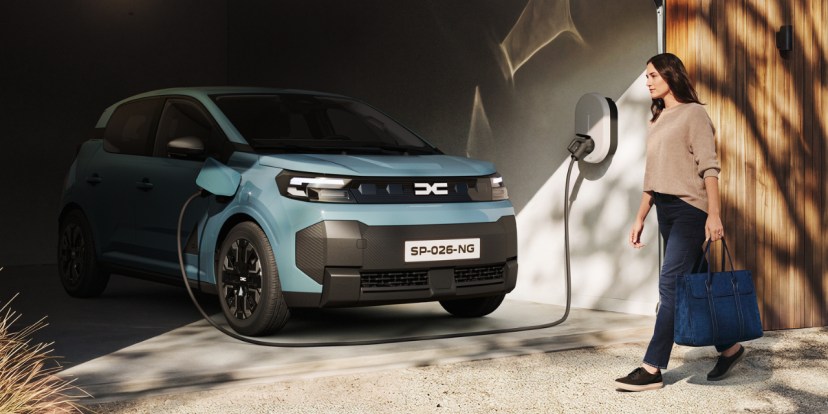
And today, Dacia has pulled the wraps off the second-generation Spring. And it is a colossal shift. Instead of lazily warming over the old car's Dongfeng-derived bones, Renault Group went back to the drawing board and cooked up this all-new Mk2 in 16 months - the fastest vehicle concept-to-production sprint in the conglomerate's modern history.
The Spring has packed its bags, fled its Chinese assembly line, and moved production onto European soil at the Novo Mesto factory in Slovenia. It rides on Renault Group's purpose-built RG-EV small architecture (the very same AmpR Small platform underpinning the retro-chic Renault Twingo E-Tech and the Renault 5), giving it an entirely fresh mechanical lease on life.
 www.arenaev.com
For the last ten years at least, mainstream carmakers have insisted that saving the planet means building two-and-a-half-tonne, leather-lined electric dreadnoughts that cost as much as a small terraced house in Yorkshire. Showrooms are packed to the rafters with SUVs each having three displays across the dashboard, artificial motor hums, and tri-motor powertrains capable of going from zero to sixty faster than a classic supercar.
But if you look out the window, the real world is completely different. Real people are stuck in bumper-to-bumper traffic, dodging potholes, hunting for a parking space that hasn't been pinched by a delivery van, and watching their household budgets get squeezed until there's nothing left.
Dacia has been the undisputed world champion of pure pragmatism since its rebirth under Renault wings. When the Romanian outfit launched the original Spring back in 2021, the motoring snobs smirked. It was essentially a re-engineered, China-built budget runabout riding on spindly bicycle tires, with interior doors that shut with the tinny "clang" of an empty biscuit tin and a 44-horsepower motor timed to sixty with a desk calendar.
Surprisingly, despite all those drawbacks, over 210,000 European buyers voted with their bank accounts across five years. Why? Because the rest of the industry got busy pricing normal families out of personal mobility, and Dacia offered an electric runabout that cost less on a monthly finance deal than taking your partner out for a decent steak dinner and a couple of craft pints. It was flawed, narrow, and very basic, but it was honest to its back teeth.
And today, Dacia has pulled the wraps off the second-generation Spring. And it is a colossal shift. Instead of lazily warming over the old car's Dongfeng-derived bones, Renault Group went back to the drawing board and cooked up this all-new Mk2 in 16 months - the fastest vehicle concept-to-production sprint in the conglomerate's modern history.
The Spring has packed its bags, fled its Chinese assembly line, and moved production onto European soil at the Novo Mesto factory in Slovenia. It rides on Renault Group's purpose-built RG-EV small architecture (the very same AmpR Small platform underpinning the retro-chic Renault Twingo E-Tech and the Renault 5), giving it an entirely fresh mechanical lease on life.
Second-gen Dacia Spring exposes the absurdity of modern electric cars
Dacia’s second-generation Spring trades its flimsy budget origins for a wider European platform and genuine urban utility, proving that sensible engineering and sub-{{£18}}k price beat bloated electric excess every time.
www.arenaev.com