Crypto holders check their wallets after $6.3bn Binance heist

satanboy

Psychonaut seven
Joined
Sep 13, 2007
Messages
115,134
Reaction score
32,998
Location
Paper to Pixels
1793347362086.png


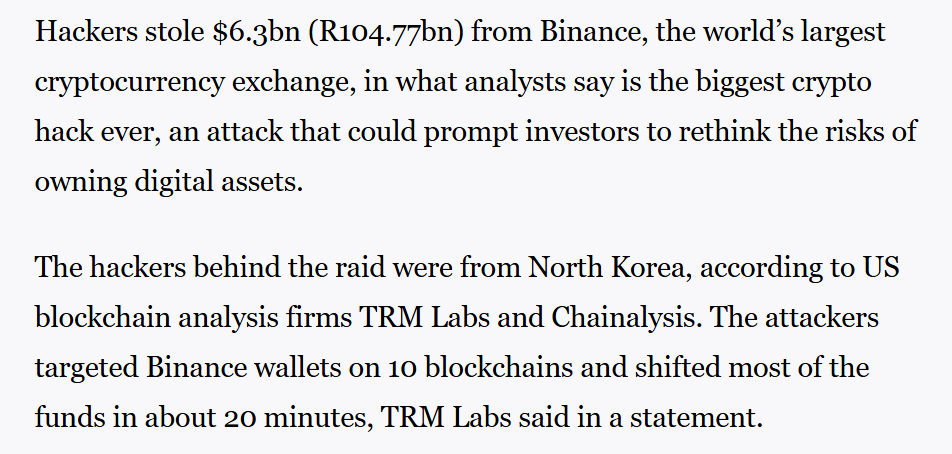
Crypto holders check their wallets after $6.3bn Binance heist​


Screenshot-2026-10-30-100335.png


Binance links $6.3 billion crypto theft to compromised DevOps laptop - Bleeping Computer

1793382212855.png

Binance, the world's largest crypto exchange, has linked the theft of about $6.3 billion in cryptocurrency to a DevOps engineer's compromised laptop.

The crypto exchange said the access let attackers submit unauthorized withdrawal transactions after they accessed a service container, and it hasn't yet found evidence of a leaked wallet private key.

"To be clear: the attacker did not simply use one engineer's permissions, and this was not a single 'one-click' action. It involved a more complex attack process. Our investigation has not attributed responsibility to any individual," Binance Co-CEO Richard Teng said.

Binance also said it "uncovered additional points of breach" but was "still gathering the facts, and will share more directly as we have them."

The company confirmed the breach in a statement shared with BleepingComputer on Thursday and reassured customers that their funds were safe.

"Binance will cover all losses from the SAFU fund and the company's funds. User funds are safe. We will also publish an updated Proof of Reserves once the remediation is complete," it said.

Since the attack, Binance has suspended deposits and withdrawals while it conducts security checks, revoked authorizations for the affected address, and is working with blockchain intelligence partners and law enforcement to trace and recover the stolen funds.


Freezing cryptocurrency prevents it from being transferred, but recovering the funds requires a separate legal process, according to Ari Redbord, global head of policy at blockchain intelligence firm TRM Labs and a former U.S. federal prosecutor and Treasury official.
“A freeze stops the money from moving, and recovery follows through legal process,” Redbord told CNBC.
Redbord said law enforcement typically obtains a court order or seizure warrant before working with stablecoin issuers to release or reissue assets and return them to their rightful owners.
“Stablecoins are the most recoverable asset class in crypto because the issuer controls the token contract,” he said. “Tether and Circle can freeze, burn and reissue, which allows frozen USDT and USDC to be returned to a victim.”
But recovering bitcoin and ether is more challenging because they have no issuer that can directly freeze the assets. Instead, investigators must trace funds through exchanges and other crypto services where they can potentially be intercepted, added Redbord.
 

Binance hack exposes unsolvable crypto risk​

Binance outlined details of the hack and its mitigation efforts in a series of X posts starting Thursday evening. The exchange and its co-founders pledged to make good on all losses, and temporarily suspended withdrawals while sorting through the fallout.

However, for an industry that has at times seemed on the brink of institutional acceptance, the incident is a stark reminder that the basic task of securing people’s money is a challenge that crypto firms have yet to master.

Unlike traditional Wall Street exchanges, platforms such as Binance serve as both trading venues and custodians of investor funds. That makes them ripe targets for attackers armed with increasingly advanced infiltration technology in the age of artificial intelligence.

“A cyberattack of this level is a matter of when, not if, particularly alongside the rise of AI,” said Andy Ward, a longtime cybersecurity expert in charge of international business at Absolute Security. “Cyber threats are becoming more sophisticated and widespread as ever, and it is likely only a matter of time before an even larger hack, with even greater financial fallout, makes headlines.”

The issue is potentially existential for crypto firms that have been trying desperately to become mainstream.

The industry has been pushing everything from tokenized stocks to perpetual futures as replacements for longstanding instruments of regular financial markets. For critics who have warned the onslaught is happening too fast for technology and regulation to keep up, this week’s incident provides fresh evidence.

 
I don’t think it’s always just a “you didn’t do something stupid” and got hacked.

Some of these attacks are years in the making and given the amount probably included physical and social engineering, supply chain enumeration and more. It wasn’t a drive by attack.
 

Binance customers withdrew $3.64bn (£2.72bn) of assets from the world's largest cryptocurrency exchange as it reopened on Sunday following a record hack last week.

The firm suspended all transactions in the wake of the incident, which impacted $6.3bn worth of digital assets.

Major organisations, including the US Federal Bureau of Investigation (FBI), have accused North Korea of being responsible for the cyber-attack, which is said to be the largest hack in history.

The company said it has covered around 95% of the assets stolen in the breach, but that the remaining amount may take longer to source. Binance has repeatedly said it would cover all of the losses linked to the attack.

"Between 06:00 and 15:30 [GMT] on November 1, we processed $4.649 billion in withdrawals and $1.01 billion in deposits, resulting in a net outflow of approximately $3.64 billion," Binance posted on X.

There was an "initial spike" in withdrawals, which later declined and "are stabilising as expected", it added.

Sunday's net withdrawals account for just over 2% of the $171bn of assets under its management, said Binance.
 
Unbelievable to me that someone would leave their money with a company whose founder went to jail for money laundering due to their questionable and lacking business practises and dodging every reasonable tickbox every step of the way.
 
Top
Sign up to the MyBroadband newsletter
X