


-
- News
-
Categories
- 5G
- ADSL
- AI
- Banking
- Black Friday
- Broadband
- Broadcasting
- Business
- Business Telecoms
- Cellular
- Cloud and Hosting
- Columns
- Cryptocurrency
- Energy
- Enterprise
- Fibre
- Gadgets
- Gaming
- Government
- Hardware
- Industry News
- Internet
- Internet of Things
- Investing
- IT Services
- Motoring
- Reviews
- Science
- Security
- Smartphones
- Software
- Technology
- Telecoms
- Trending
- Wireless
- Press Office
- Forum
- Industry News
- What's Next
- Company hub
- Speed Test
- About us
- Advertise with us
- Contact
- Careers
-
Join the MyBroadband community
South Africa’s biggest forum. Discuss, discover, and connect with thousands of members.
-
Question of the Day: Have you had to buy RAM, SSDs, or a new PC since the prices skyrocketed?
- Forums
- General discussions
- Motoring and Transportation: Cars, Bikes and Plane
- General Motoring News and Reviews
You are using an out of date browser. It may not display this or other websites correctly.
You should upgrade or use an alternative browser.
You should upgrade or use an alternative browser.
2021 Mercedes-Benz EQS
- Thread starter FiestaST
- Start date
FiestaST
Honorary Master
FiestaST
Honorary Master
The new Mercedes EQS is a luxury pebble with a whopping 575 miles of range
Forget the horsepower wars, for now is the time of the Range Wars
This is the new Mercedes-Benz EQS. It is a very expensive, oversized pebble masquerading as a tech-laden luxury saloon, and wearing its 450+ outfit, claims a mahoosive 575 miles of range.
That’s… more. More than the outgoing Mercedes-Benz EQS could manage (a paltry 481 miles, pah), more than the BMW iX3’s significant 500 miles, more than the new Volvo EX60 Twin Motor’s 503 miles, and a tickle more than the BMW i3’s 562-mile range.
Which makes it the rangiest electric car of them all. Mercedes said it has overhauled and updated more than a quarter of the EQS’s parts to beat the BMW, even if they’re in vastly different segments. What with one being a very smooth stone, and the other a shark.
There’s now 800-volt tech that enables a 350kW hose to add just under 200 miles of range in 10 minutes, better brake regen, (optional) steer-by-wire and a yoke-like steering wheel, brighter headlights able to scorch the retinas of puny human cars six football pitches away, and – distressingly – ‘cloud-based damper regulation’. We’ll come back to that.
FiestaST
Honorary Master
Nick O'Leary first look at the updated EQS
FiestaST
Honorary Master
FiestaST
Honorary Master
FiestaST
Honorary Master
FiestaST
Honorary Master
Refreshed Mercedes-Benz EQS gets a big battery and a spaceship steering wheel - will it save its future?
A major update for the Mercedes-Benz EQS was unveiled today, bringing more power, a much bigger battery, and a very strange steering wheel. This is the final big change for the model before it eventually stops being a separate line and joins the S-Class family.
One of the wildest changes involves how you control the car. You can now choose a "yoke" instead of a standard round wheel. It looks like the steering controls in a jet or a spaceship. This system uses steer-by-wire technology - there is no metal rod connecting the yoke to the front wheels. Instead, computers send signals to electric motors, which then turn the wheels. At low speeds, the steering ratio is 4:1. This means you only have to turn the yoke a little bit to make a sharp corner. If you think a yoke is too weird, Mercedes still offers a normal old-fashioned steering.
Mercedes put a huge 122 kWh battery pack in most versions of the new EQS. The EQS 450+ is the star of the show. It can travel up to 926 km on a full battery. That is a massive distance for any electric car on the road today. The base model, known as the EQS 400, gets a slightly smaller 112 kWh battery, but Mercedes expects that most buyers will likely want the bigger pack to help them travel between cities without any stress.
Since the new EQS uses an 800V system, if you find a powerful enough charger, the car can take in 350 kW of energy. This allows the battery to add 320 km of driving range in just 10 minutes. To do this, the car's software tricks the battery. It acts like two smaller batteries charging at the same time. This keeps the battery cool and helps it fill up quickly.
Mercedes-Benz offers four different versions of this car. The EQS 400 starts the lineup with 270 kW of power - about 362 horsepower. The next up is the 450+ with 300 kW and 505 Nm of torque. If you want more speed, the EQS 500 4Matic gives you 350 kW. The fastest version is the EQS 580 4Matic. It delivers 430 kW and 800 Nm of torque. All these models use a two-speed transmission. The first gear helps the car launch quickly, and the second gear keeps the motors efficient when you are driving at high speeds on the highway.

 www.arenaev.com
A major update for the Mercedes-Benz EQS was unveiled today, bringing more power, a much bigger battery, and a very strange steering wheel. This is the final big change for the model before it eventually stops being a separate line and joins the S-Class family.
One of the wildest changes involves how you control the car. You can now choose a "yoke" instead of a standard round wheel. It looks like the steering controls in a jet or a spaceship. This system uses steer-by-wire technology - there is no metal rod connecting the yoke to the front wheels. Instead, computers send signals to electric motors, which then turn the wheels. At low speeds, the steering ratio is 4:1. This means you only have to turn the yoke a little bit to make a sharp corner. If you think a yoke is too weird, Mercedes still offers a normal old-fashioned steering.
Mercedes put a huge 122 kWh battery pack in most versions of the new EQS. The EQS 450+ is the star of the show. It can travel up to 926 km on a full battery. That is a massive distance for any electric car on the road today. The base model, known as the EQS 400, gets a slightly smaller 112 kWh battery, but Mercedes expects that most buyers will likely want the bigger pack to help them travel between cities without any stress.
Since the new EQS uses an 800V system, if you find a powerful enough charger, the car can take in 350 kW of energy. This allows the battery to add 320 km of driving range in just 10 minutes. To do this, the car's software tricks the battery. It acts like two smaller batteries charging at the same time. This keeps the battery cool and helps it fill up quickly.
Mercedes-Benz offers four different versions of this car. The EQS 400 starts the lineup with 270 kW of power - about 362 horsepower. The next up is the 450+ with 300 kW and 505 Nm of torque. If you want more speed, the EQS 500 4Matic gives you 350 kW. The fastest version is the EQS 580 4Matic. It delivers 430 kW and 800 Nm of torque. All these models use a two-speed transmission. The first gear helps the car launch quickly, and the second gear keeps the motors efficient when you are driving at high speeds on the highway.
Refreshed Mercedes-Benz EQS gets a big battery and a spaceship steering wheel - will it save its future?
Mercedes-Benz updates the EQS with a futuristic yoke steering wheel, a massive battery, and faster charging to help it compete in the luxury electric car market.
www.arenaev.com
FiestaST
Honorary Master
FiestaST
Honorary Master
FiestaST
Honorary Master
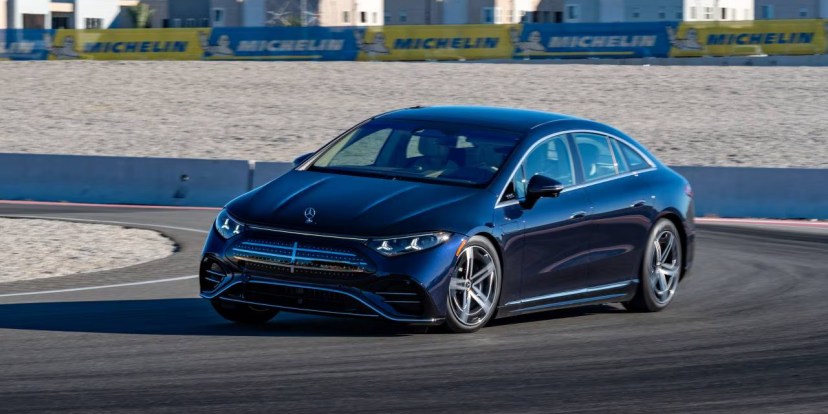
The 2027 Mercedes-Benz EQS 450+ fixed its biggest flaws and became a 539-mile cruiser
Most EV owners have experienced the dashboard predicting plenty of range, only for a steady motorway climb to chew through the battery twice as fast as promised. We've got used to doing mental math on the fly, subtracting twenty percent from whatever number the brochure promised just to stay out of trouble. When an automaker claims its flagship luxo-barge can cross a small country without touching a plug, the natural reaction is to doubt and wait for independent road testers to run the battery flat.
That's why the latest evaluation from the testing team at Edmunds is worth paying attention to. They took a 2027 Mercedes-Benz EQS 450+ out on their standard range loop and drove it until it covered 867 km on a single charge. That crushes the official EPA estimate of 752 km by 116 km. That single run made the updated EQS 450+ the longest-range electric sedan Edmunds has ever tested, pushing past the Lucid Air and claiming second place overall on their all-time leaderboard. The only vehicle that has ever gone farther in their testing is the Cadillac Escalade IQ, a huge truck that achieves its distance by having a battery pack the size of a small studio apartment.
Plenty of range tests involve hopping on an empty interstate, locking the cruise control at a steady speed, and praying for a tailwind. Edmunds takes a much more realistic approach that mirrors how people actually use their cars during a normal week. They run a predetermined route across Southern California using a 60% to 40% split between city streets and highway stretches, working out to an average speed of 64 km/h. They set the automatic climate control to a comfortable {{72ºF}}, toggle the car into its Eco drive mode, and set the regenerative braking to its strongest recovery setting.
Under those conditions, the big Mercedes proved very frugal with its electrons - the EQS 450+ consumed just 26.9 kWh of electricity for every 161 km of travel, beating the official EPA consumption rating of 28 kWh. Back when the same team tested the 2025 model, it needed 29.1 kWh to cover the same distance. That improvement comes down to a slightly larger 122 kWh battery pack - stepped up from the old 118 kWh unit - with new internal cell chemistry that loses less energy to heat.
 www.arenaev.com
Most EV owners have experienced the dashboard predicting plenty of range, only for a steady motorway climb to chew through the battery twice as fast as promised. We've got used to doing mental math on the fly, subtracting twenty percent from whatever number the brochure promised just to stay out of trouble. When an automaker claims its flagship luxo-barge can cross a small country without touching a plug, the natural reaction is to doubt and wait for independent road testers to run the battery flat.
That's why the latest evaluation from the testing team at Edmunds is worth paying attention to. They took a 2027 Mercedes-Benz EQS 450+ out on their standard range loop and drove it until it covered 867 km on a single charge. That crushes the official EPA estimate of 752 km by 116 km. That single run made the updated EQS 450+ the longest-range electric sedan Edmunds has ever tested, pushing past the Lucid Air and claiming second place overall on their all-time leaderboard. The only vehicle that has ever gone farther in their testing is the Cadillac Escalade IQ, a huge truck that achieves its distance by having a battery pack the size of a small studio apartment.
Plenty of range tests involve hopping on an empty interstate, locking the cruise control at a steady speed, and praying for a tailwind. Edmunds takes a much more realistic approach that mirrors how people actually use their cars during a normal week. They run a predetermined route across Southern California using a 60% to 40% split between city streets and highway stretches, working out to an average speed of 64 km/h. They set the automatic climate control to a comfortable {{72ºF}}, toggle the car into its Eco drive mode, and set the regenerative braking to its strongest recovery setting.
Under those conditions, the big Mercedes proved very frugal with its electrons - the EQS 450+ consumed just 26.9 kWh of electricity for every 161 km of travel, beating the official EPA consumption rating of 28 kWh. Back when the same team tested the 2025 model, it needed 29.1 kWh to cover the same distance. That improvement comes down to a slightly larger 122 kWh battery pack - stepped up from the old 118 kWh unit - with new internal cell chemistry that loses less energy to heat.
The 2027 Mercedes-Benz EQS 450+ fixed its biggest flaws and became a 539-mile cruiser
The updated 2027 Mercedes-Benz EQS 450+ delivered a record-breaking {{539 miles}} of real-world range and nearly doubled its fast-charging speed in independent testing.
www.arenaev.com