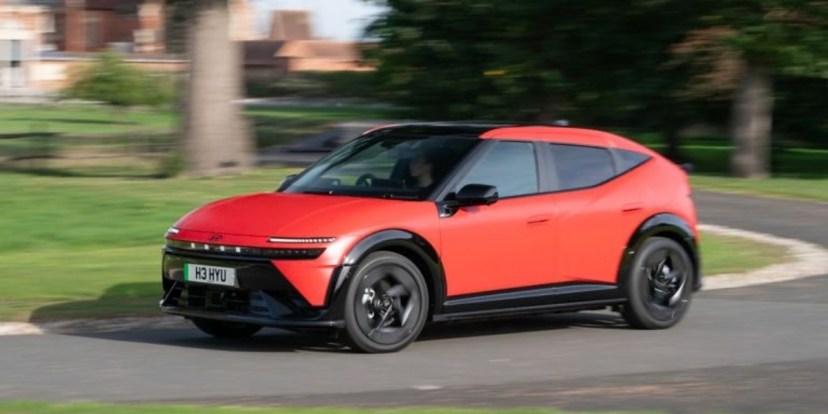
The new Hyundai IONIQ 3 goes on sale in UK, production kicks off in Turkiye
The electric vehicle transition used to feel like an exclusive club with entry needing a second mortgage. Real enthusiasts, who appreciate the joy of a sorted chassis and modest dimensions, were largely left out in the cold. But this year has been different, with more and more truly affordable EVs finally arriving in the showrooms. Hyundai is one of the brands that decided it was about time to give people what they've been asking for all along - an aerodynamic, pixel-infused hatchback.
Thanks to securing Band 1 qualification under the UK government's Electric Car Grant, every variant of the new IONIQ 3 benefits from a full €4,400 deduction straight off the top. That slashes the on-the-road price for the Advance 42 kWh model down from €26,084 to €21,687. Even if you step up to the big-battery Advance 61 kWh model, you are looking at €25,791 instead of €30,189.
Existing reservation holders who originally signed up for a modest €1,800 factory saving are automatically bumped up to the full grant, and monthly personal contract purchase deals kick off at €416 per month with an identical €416 deposit over 48 months at 8.9% APR representative. In an era where a moderately optioned petrol supermini casually goes for twenty-five grand, that is a bargain.
Hyundai has cleverly resisted the temptation to build yet another blob-shaped pseudo-crossover. Instead, the design team sculpted what they call an "Aero Hatch," courtesy of their latest "Art of Steel" styling philosophy. It cuts a strikingly low, razor-sharp silhouette with a raked windscreen, clean surfacing, and an integrated rear ducktail spoiler. The end result is a drag coefficient of 0.263 - slippery enough to cut through head-winds without guzzling precious electrons.
Despite measuring a tidy 4,155 mm in overall length, 1,800 mm in width, and standing 1,505 mm tall, Hyundai's engineers managed to pull the front and rear axles apart to create a generous 2,680 mm wheelbase. That wheelbase gives five adults genuine room, with rear legroom that punches well above the standards in this class. The trunk swallows an impressive 441 l of cargo. That volume is cleverly split between a 322 l upper deck and a sunken 119 l "Megabox" compartment hidden under the floor - the ideal hiding spot for muddy charging cables, hiking boots, or a week's worth of groceries.
For comparison, the VW ID.3 Neo is 4,265 mm long, it has a smaller 385 l trunk, but it starts north of €41,000 with equivalent range. The MG4 EV - long celebrated as Britain's reigning budget EV darling - measures 4,287 mm with a 2,705 mm wheelbase, but has only 363 l of luggage volume and starts near €31,700. The stylish Renault Megane E-Tech stretches to 4,200 mm with a 440 l boot, but demands at least €39,900 to play. Even BYD’s quirky Dolphin measures a longer 4,290 mm while squeezing out only 345 l of trunk space for around €30,500 to €35,000. The IONIQ 3 either matches or embarrasses the class establishment while undercutting them on price.
Hyundai’s all-new IONIQ 3 delivers class-leading range, clever packaging and grant-backed pricing that makes it genuinely affordable.

www.arenaev.com