WiMax & Microwave towers?

  • Thread starter Thread starter Fudzy
  • Start date Start date
dude, thats huge!! I would rather suspect something similat to the Vodacom/MTN towers...but I don't know. Maybe somebody else can help...
 
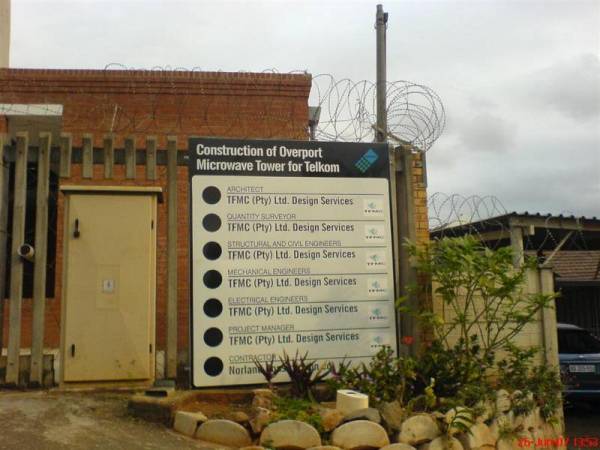
my friend works for Norland Construction, he built that tower. from what i could understand, there are lots of the exact same tower dotted all around the country and are like a microwave grid. That one talks to the one on the hill next to fields hill. (kloof)
 
DVB-H on top

I cannot accurately determine the colour ot the top section. If it is Orange, then the top section is a DVB-H transmitter by Multichoice. Other ones I have seen is at the Multichoice head office in Randburg and there is also one on the mountain between Krugersdorp and Roodepoort (Little Falls). There are several other dishes on the side, usually for point to point SDH microwave backhaul.
 
The top section (5 panels stacked vertically) is UHF TV BTW.
 
my friend works for Norland Construction, he built that tower. from what i could understand, there are lots of the exact same tower dotted all around the country and are like a microwave grid. That one talks to the one on the hill next to fields hill. (kloof)

Telkom introduced a digital microwave network back in the 1980's to replace the older analogue technology, which could handle only 1920 simulataneous voice channels or 1 TV channel, hence the need for new kit from SEL and GTE was made under license at STC (Standard Telephone & Cables) in Boksburg (part of Altech). The new microwave network replaced the older with 34 Megabit & 140 Megabit/s systems, which Eskom and Transtel also used
Also new overhead and underground fiberoptic (34 Mb/s, 140 Mb/s & 565 Mb/s) systems from Siemens and STC UK were dispatched from STC Boksburg, these also made under license mainly for the then SA Posts & Telecommunications now TELKOM.
In th 1980's was also when the older analogue British MU & Siemens exhanges were replaced with Teltech E10 and Siemens EWSD (DE3 to DE5 digital exchanges with Sunninghill Park, Jhb as the first digital exchange to go live in 1983.
See Figure 7.1 from this PDF from Siemens Education website which shows the interfaces between the subscribers and ISDN subs to the Line Trunk Groups

This was all back in 1987-89
 
Why is this in the WiMax thread???

A big tower does not=better experience.....

Just like an upsized McToilet....
 
Telkom introduced a digital microwave network back in the 1980's to replace the older analogue technology, which could handle only 1920 simulataneous voice channels or 1 TV channel, hence the need for new kit from SEL and GTE was made under license at STC (Standard Telephone & Cables) in Boksburg (part of Altech). The new microwave network replaced the older with 34 Megabit & 140 Megabit/s systems, which Eskom and Transtel also used
Also new overhead and underground fiberoptic (34 Mb/s, 140 Mb/s & 565 Mb/s) systems from Siemens and STC UK were dispatched from STC Boksburg, these also made under license mainly for the then SA Posts & Telecommunications now TELKOM.

In th 1980's was also when the older analogue British MU & Siemens exhanges were replaced with Teltech E10 and Siemens EWSD (DE3 to DE5 digital exchanges with Sunninghill Park, Jhb as the first digital exchange to go live in 1983.
See Figure 7.1 from this PDF from Siemens Education website which shows the interfaces between the subscribers and ISDN subs to the Line Trunk Groups

This was all back in 1987-89

Actually, the Teltech E10 was first known as the SA128E and was a CIT-Alcatel E10 adapted to the Dept. of P & T's requirements and manufactured by Teltech, a joint venture between Alcatel-CIT and STC South Africa (part of Altech).

The first digital exchange to be commissioned in South Africa was the Pretoria SA128E in October 1981. Since then, these exchanges have been replaced by a later technology version, and have reverted to the E10 name (the 1000 E10 MM) with major software upgrades every few years by what is today Alcatel-Lucent. All this is of course legacy technology but, together with Siemens, still constitutes today's voice switching network.
 
Top
Sign up to the MyBroadband newsletter
X