
Iconic South African company’s value increased by R54 billion in three weeks

Sasol, one of South Africa’s most iconic companies, saw its market cap increase from R81 billion to R135 billion in three weeks.
This is mainly due to the conflict in the Middle East, which drove oil prices from around $65 per barrel to over $100 per barrel in two weeks.
The link between Sasol’s share price and Brent crude oil is one of the most consistent correlations on the Johannesburg Stock Exchange (JSE).
While Sasol produces a wide range of chemicals, its primary identity in investors’ eyes is that of an integrated energy company.
This dates back to 1950, when Sasol was founded with the primary goal of creating liquid fuel from coal. The reason was to create energy security, as South Africa has massive coal reserves but almost no crude oil.
In 1955, the first Sasol plant began production. This was the first time oil from coal was produced at a commercial scale.
The 1973 global oil crisis and increasing international isolation due to apartheid made domestic fuel production a critical priority.
In 1979, Sasol transitioned from a state-owned entity to a public company, listing on the Johannesburg Stock Exchange.
After 1994, Sasol had to compete in a global market and move away from its total reliance on coal.
It became a diversified global chemicals and energy company with a range of products, including petrol, gas, specialised chemicals, and high-tech electronics.
It provides the market with petrol, diesel, jet fuel, natural gas, lubricants and oils, polymers, solvents, fertilisers, explosives, and many more products.
Sasol is also scaling up production of lower-carbon alternatives to meet global sustainability and green targets.
However, its prospects are still closely tied to global oil prices, and the Sasol share price typically moves in line with crude oil.
Sasol share price increase
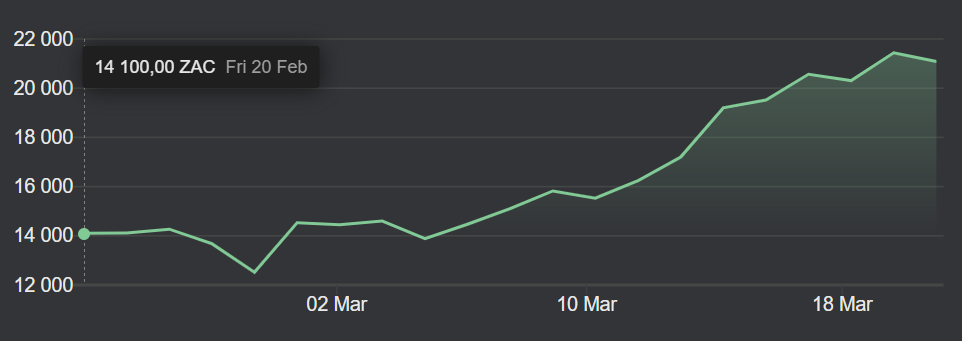
The conflict in Iran, which escalated following United States and Israeli air strikes which started on 28 February 2026, has caused severe disruptions in the global oil market.
The impact included an immediate price surge and a strategic chokehold on supply, which resulted in global economic ripples.
Oil prices surged by 10% to 13% within the first 48 hours and climbed above $115 per barrel by mid-March 2026.
This caused havoc on the South African equity market, with resource stocks seeing huge swings from one day to the next.
One JSE-listed company which benefited from the conflict and subsequent crude oil price increase is Sasol.
On 26 February 2026, the Sasol share price closed at R125. On Thursday, 19 March 2026, it closed 71% higher at R214.
On mid-day on Friday, 20 March 2026, it was trading slightly lower at R208 per share. However, it is still an increase of 66% from three weeks ago.
Sasol’s market capitalisation increased from R81 billion to R135 billion over this period, which means the company’s value rose by R54 billion.
This is good news for Sasol shareholders, who have had a rocky ride with the company over the last five years.
Analyst opinion about Sasol as an investment

Jean Pierre Verster, founder and CEO of Protea Capital Management, said that if oil prices and the exchange rate remain at current levels, Sasol will make a lot of money.
“The increase could translate into R50 per share in this financial year to R100 in the next financial year,” he said. “If the oil price stays here, Sasol is very cheap.”
However, Verster does not think the oil price will remain at its current level, which will affect the Sasol share price.
“I am itching to short Sasol. My issue with the company is the terminal value, which is looking five or ten years ahead,” he said.
He said the Secunda operations lack significant terminal value due to deteriorating coal quality and looming gas supply issues from Mozambique.
“Sasol’s United States operations are not that great, and they don’t necessarily benefit from higher LNG prices because they use it as an input rather than selling it,” he said.
Alex Duys, Chief Investment Officer at Umthombo Wealth, shared Verster’s view on the long-term outlook for Sasol.
“Sasol is more of a trader stock as investors cannot easily take a long-term view on the company,” he said.
He also sees Sasol as being very cheap on a short-term basis, but added that it is impossible to know where it will go in the long term.


 Loading ...