
Capitec is different

South Africa’s fastest-growing listed bank, Capitec, has set itself apart from the traditional Big Four in many more ways than simply offering low-fee bank accounts.
In the 25 years since it was listed on the JSE in 1999, Capitec’s share price and market capitalisation have surged thanks to impressive growth.
From the outset, co-founder and original CEO Michiel le Roux aimed to disrupt the bank status quo by delivering basic banking services to the masses of unbanked South Africans.
According to its latest financial results, Capitec has 24.1 million customers, which is around double that of Standard Bank, the next largest bank by customers in South Africa.
Le Roux and his successors achieved this by charging a low fixed monthly fee for a bank account, offering loans to lower-income, high-risk South Africans, and reaching customers in less urbanised areas.
Over the past few months, the bank has also held the title of South Africa’s most valuable bank for short periods, dethroning FirstRand with a market cap above R400 billion.
This is an astounding achievement, especially when considering the difference in total income and assets under management between the two banks.
FirstRand’s total income in the 2025 financial year was R135.7 billion, while Capitec’s was R35.8 billion. FirstRand has around R2.6 trillion in assets under management, compared to Capitec’s R239 billion.
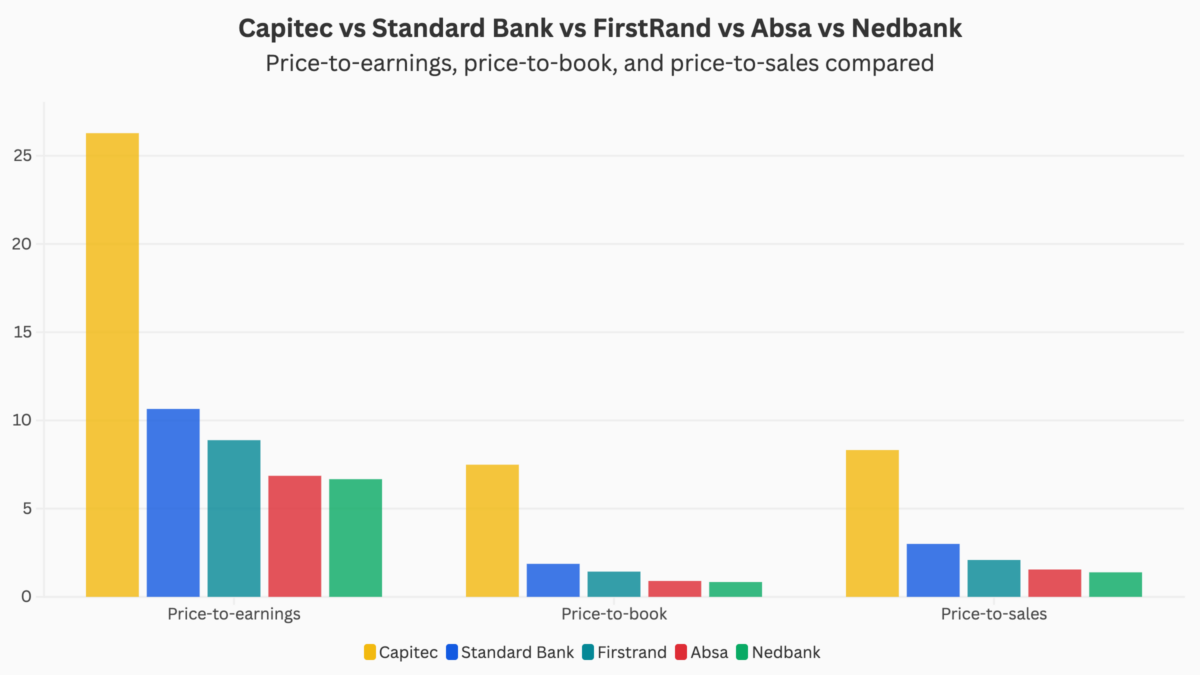
According to the conventional investment metrics — price-to-earnings (P/E), price-to-sales (P/S), and price-to-book (P/B) ratios — Capitec is overvalued.
The higher these ratios are relative to the typical average for companies in the same industry, the more likely a company is to be overvalued.
Capitec’s P/E is 26.28, compared with 10.65 for Standard Bank, 8.88 for FirstRand, 6.86 for Absa, and 6.67 for Nedbank.
Its P/B is 7.49 — among the highest for any company in the world. For comparison, the other major South African banks’ P/B ratios vary between 0.84 to 7.49.
Furthermore, its P/S is 8.32, compared to ratios varying from 1.39 to 3.00 for the Big Four banks. The graph below compares the P/E, P/B, and P/S ratios of the five largest banks in South Africa.
Capitec the Tesla of South African bank stocks
Stanlib head of systematic solutions Rademeyer Vermaak believes that Capitec’s overvaluation can be partially attributed to its earnings profile differing significantly from the other banks.
Due to its digital-first focus, it consumes much less capital than conventional banks with branch-first operating models.
One example of how this has saved Capitec money is that it can employ far fewer staff. Its 16,935 employees work out to one staff member for every 1,423 customers.
For comparison, FirstRand has 40,194 employees in South Africa, serving roughly 10 million customers. That’s one staff member for every 249 customers.
While it has many more branches than the Big Four, its extensive digital capabilities enable it to operate in smaller footprints and with fewer staff, reducing operational costs.
Vermaak told Bloomberg that investors should almost think of Capitec as a combination of a tech stock and a bank. “Tech stocks need to be pricier because of that growth factor,” he said.
Some investment experts apply the same reasoning to Tesla. Tesla’s market cap of roughly $1.5 trillion is worth the combined values of the world’s top 10 competing carmakers despite making and selling only fraction of their vehicles.
Tesla evangelists maintain that the company’s inherent value is far greater due to the valuable cutting-edge technological research operations and intellectual property it has behind closed doors.
Less reliant on interest-based income

Old Mutual Wealth research analyst Tasneem Samodien has also explained that Capitec’s earnings profile relies much less on interest-based income.
Samodien said that traditional banks generated most of their revenue from net interest income from loans and deposits, which can fluctuate greatly depending on prevailing interest rates.
Post the 2008 financial crisis, traditional banks have turned to alternative revenue streams such as insurance, wealth management, and trading to reduce their risk to interest rates.
However, non-interest revenue still only accounts for 20% to 30% of total revenue with the Big Four banks. The other product categories are also reliant on economic growth.
In Capitec’s latest financial year ending February 2025, its non-interest income was R23.925 billion, while net interest income before impairments was R18.171 billion.
That means nearly 57% of Capitec’s income came from non-interest income. The vast majority of this was from net transactions and commission fees, including charges for value-added services.
While Capitec’s monthly fixed fees are lower than the Big Four, its transactional fees are now similar to those of the incumbents, as evidenced in pricing analyses by the Solidarity Research Institute.
Capitec’s strong non-interest income is a core reason why its share price comes at a premium, as it should deliver more predictable revenue with higher profit margins.


 Loading ...