Little system I built last week...

Looks like a rack mount case? Where'd you get it? Price?

Nice system. Bet it makes a hell of a racket ;)
 
Can't even play Crysis properly. What's the use?

Just 1 question. Why those GPU's?

The mining sim is probably both VRAM and GPU-intensive, so they needed 12GB VRAM which the Quadro K6000 comes with. Whatever they're using probably isn't OpenCL-accelerated either, must be relying on CUDA for something.
 
Last edited:
Nice system. I guess it will be simulating underground development?

What was the previous system it replaced?
 
Can't even play Crysis properly. What's the use?


The mining sim is probably both VRAM and GPU-intensive, so they needed 12GB VRAM which the Quadro K6000 comes with. Whatever they're using probably isn't OpenCL-accelerated either, must be relying on CUDA for something.

All the new cards have CUDA. It still doesn't make sense. VRAM is outdated. It's a stop-gap from ages ago. Seems like BS to me. I would like to be taught something new. You pay more for Quadro cards now with little real benefit.
 
All the new cards have CUDA. It still doesn't make sense. VRAM is outdated. It's a stop-gap from ages ago. Seems like BS to me. I would like to be taught something new. You pay more for Quadro cards now with little real benefit.

It is very clear that you are null and void of CAD and DCC. The average GeForce user will only understand the difference of Quadro vs GeForce in the practice.

This link (PDF) will give you a basic technical brief.

All in all the Quadro is made to compute and render at required overheads to put it short. Why don't you ask why the E5-2687W has so much cache in relation to your outdated VRAM remark?
 
Found these interesting
http://www.thefakingof.net/2012/02/...-nvidia-graphics-card-with-cuda-acceleration/

http://www.techpowerup.com/forums/threads/unlocking-the-690-to-a-quadro-k5000.181682/

What differentiates Quadro from GeForce is that GeForce usually has its dual precision floating point performance severely limited, e.g. to 1/4 or 1/8 of that of the Quadro/Tesla GPUs. This limitation is purely artificial and imposed on solely to differentiate the gamer/enthusiast segment from the professional segment. Lower DP performance makes GeForce boards bad candidates for stuff like scientific or engineering computing and those are markets where money streams from. Also Quadros (arguably) have more display channels and faster RAMDACs which allows them to drive more and higher resolution screens, a sort of setup perceived as professional for CAD/CAM work.

https://stackoverflow.com/questions/10532978/difference-between-nvidia-quadro-and-geforce-cards
As Jason Morgan has pointed out, there are tricks that can unlock some of the disabled features in GeForce to bring them in par with Quadro. Those usually involves soldering and voids the warranty on the card. Since HPC puts lots of stress on the hardware and malfunctions occur more frequently that one would like them to, I would advise against using cheap tricks.
 
Whats the coax connection for ?
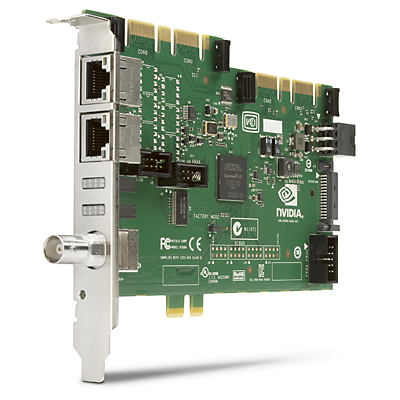
Given that its next to the network ports, its probably for fiber optic connections.

Edit: Wait, its not. I've clearly never seen a Quadro Sync card before. http://www.nvidia.com/object/quadro-sync.html

c04289030.jpg


All the new cards have CUDA. It still doesn't make sense. VRAM is outdated. It's a stop-gap from ages ago. Seems like BS to me. I would like to be taught something new. You pay more for Quadro cards now with little real benefit.

In AMD's example, they do literally ship people the exact same cards as the FirePro lineup and they don't gimp double-precision performance (at least, they never used to before Bonaire/Hawaii GCN). But for both AMD and Nvidia, you're paying for the insane levels of driver support. Driver engineers from both companies work double-time to make sure that they are free of bugs and issues and they are continually testing and evaluating their software with commercial applications to make sure they work properly. The main difference between a consumer GPU and a FirePro/Quadro/Tesla is the drivers.

CUDA is another example. Sure, it works the same way, but CUDA employed in a professional environment on a Quadro turns out results that are guaranteed to have no errors and are bug-free. All that double-precision math? Guaranteed to be free of bugs and defects. If there were any to be found, you can imagine the kind of scramble that happens in Nvidia's driver team to get a stable fix out and working. Often, driver teams from both companies and the ones from Intel's labs will work together on a fix that might impact them all.

As for VRAM, 3D simulations with textures consume a lot of memory, far more than what the average modded Skyrim can manage to suck up. You need to be able to have enough memory available for the kinds of projects that people using CAD, Photoshop, Premiere Pro and similar programs on a professional card will run and a bog standard Titan Black with 6GB of VRAM is not going to cut it for a lot of specific use-cases. There are people inside Mercedes-Benz who run a 8K render of one of their engines and then run a simulation of their design to see how it would work at the same time, without closing other projects, for example. AMD uses their own FirePro cards to do chip design at a microscopic level.

For all of these things you just can't rely on GPUs designed for 3D gaming and for the most part, its all down to the drivers.

[video=youtube;U5Npt1BSF04]https://www.youtube.com/watch?v=U5Npt1BSF04[/video]
 
Last edited:
Sorry. Correct. Mining sim.
They are going to create a VR system.
Not sure on the Sync card interface.
System runs quite. Had a few times where I had to make sure that the system was working.
Was huge fun to build.
System was a special build server chassis. Cost was round R370 000.
 
Now that's one sweet build. Super fun building boxes like these.
 
Top
Sign up to the MyBroadband newsletter
X