Movie Club Edition One: Vertigo - SPOILERS

RanzB

Honorary Master
Joined
Jul 4, 2007
Messages
31,343
Reaction score
16,860
Location
Durban
The discussion starts 9th March 2015.
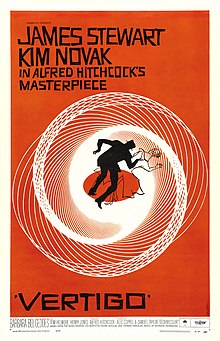

Vertigo is a 1958 American psychological thriller film directed and produced by Alfred Hitchcock. The story was based on the 1954 novel D'entre les morts by Boileau-Narcejac. The screenplay was written by Alec Coppel and Samuel A. Taylor.

The film stars James Stewart as former police detective John "Scottie" Ferguson. Scottie is forced into early retirement because an incident in the line of duty has caused him to develop acrophobia (an extreme fear of heights) and vertigo (a sensation of false, rotational movement). Scottie is hired by an acquaintance, Gavin Elster, as a private investigator to follow Gavin's wife Madeleine (Kim Novak), who is behaving strangely.

220px-Vertigomovie_restoration.jpg


**A review is encouraged, and a star review out of 5 is preferred over a /10 score.

0 - Couldn't finish it was so bad
1- Horrible
2 - Very Bad
2.5 -OK <- just to be in the middle
3 - Good/Very Good
4- Excellent
5 - Perfect
 
Last edited:
Just over two hours but it actually went by so quick. I'm not that much of a Hitchcock fan but he does bring that across that suspensful moments quite unexpectedly which makes Stewart and Novak work so well on screen. Overall I enjoyed it.

Acting, directorship and general feel has Hitchcock written all over it. A solid 8.5/10
 
I was surprised how much I liked it. First thing that I noticed was the level of acting. Obviously not the kind of stuff we see today, but in context I think it was very good.

Throughout the movie I couldn't for the life of me figure out what his Vertigo had to do with the movie, until the big reveal. Completely unexpected. I even called my wife into the room and explained the whole movie to her, just to show her the twist. She still thinks that there is something wrong with me for watching a 57 year old movie.

The score was typical hitchcock, and really played well on your emotions.

A couple of weird scenes where the lighting and things changed, and I thought there was something wrong with the video. For example, when they are in the book store and the old guy are telling them about the chick in the portrait, it gets darker and darker, and when they leave they stand talking outside the shop for a while. You can actually see the lights go on afterwards. Don't know if that was meant to be like that, but I thought it very weird.

A solid 4/5 for me.
 
Lol I noticed the lighting in the bookstore last night as well, it's possible that it could have been the copy we were using as well.
Oh I see there's a whole thread discussing the lighting in that scene so I guess it's a thing:
https://groups.google.com/forum/m/#!topic/alt.movies.hitchcock/A3U2_bpbNXI

Yeh, first I thought it was the copy, but when they were standing outside, the light just went on... can't remember what was being said in that moment, and haven't read your link yet, but could be the old "light bulb of realization going on"? :D
 
Also 4/5 for me.

First thing I noticed was how film-making in general has changed over the years. In Vertigo you see a very patient approach, with Scottie following the 'wife' for such a long time, with almost no dialogue at all. It helps emphasise his growing obsession with her, but it's something you likely won't see in many movies these days.

Novak played the dual role quite well, having a fleeting air that had Scottie question his own sanity at one point.

I also liked how the film went the full circle. I was waiting for him to realise the ruse, but didn't think it would play out the way it did. Makes you feel sorry for the characters involved. He gets his victory (over Acrophobia), but loses so much in the process.
 
Yeh, first I thought it was the copy, but when they were standing outside, the light just went on... can't remember what was being said in that moment, and haven't read your link yet, but could be the old "light bulb of realization going on"? :D

The effects were very interesting to me, especially in light of my previous comment about how film-making has changed. That zooming shot he used to illustrate Scottie's acrophobia was a cinematic first. Hitchcock actually wanted to use it in an earlier film but the technology wasn't available at the time.
 
As Ebert said: "Give the movie its day in court"

To start with, the movie is gorgeous. Hitchcock certainly knew his composition. Consider the rule of thirds and use of leading lines:

B0rWyhL.jpg


yLlDL3k.jpg


Technically, this film is a masterpiece. The way Hitchcock moves his camera adds layer and layers of dread, whether it's seeing Scotty follow Madeline, or watching Madeline at the edge of the bay. We know that she will jump in, almost purely down to the way Hitchcock has shot every preceding scene. Of course, the amazing score helps out every chance it can.


The use of colours and objects to convey emotion and reveal themes is inspired, with the use of flowers an especially deft touch. The bouquet that is Madeline, Scotty telling Judy that she's only a fraction of Madeline when he buys her a single flower.

The leads are superb, both Stewart and Novak perfect in their roles. Stewart gives a great performance but it's Novak who should be getting more acclaim. Haughty but fragile as Madeline, broken but cheeky as Judy. She manages to give a performance that draws immense sympathy and bring so much meaning to simply lines. She marries the script with her line reading perfectly when she tosses out lines about cruel stepfathers and in the next breath telling Scotty she had to give it up by 17, but it's impossible not to hope that she doesn't fall too far in Scotty when we know exactly what will be in store for her if she does.

However, as much as I loved different aspects of the film as separate entities, the movie as a whole left me a bit cold. At the end I wasn't rooting for either Judy or Scotty. How could I? One is a fraud and the other a madman. Scotty turns out to be almost as deranged as Elster, and Judy was part of a murder. It feels like the movie tries too hard to be clever, and wants us to sympathise with one or the other, or both. But I couldn't. I think this is one of the first movies I fell in love with at the beginning, then fell more and more out of love with toward the end.

My rating is three and half stars.
 
^good show mate

If I have to think about the things I didn't like...

Some of the effects were just too corny, with the different coloured screens as he he was dreaming (can't remember the situation now), but that was a little too much. Not sure I understand the relevance of his friend, midge. Never tied into the story at all.
 
^good show mate

If I have to think about the things I didn't like...

Some of the effects were just too corny, with the different coloured screens as he he was dreaming (can't remember the situation now), but that was a little too much. Not sure I understand the relevance of his friend, midge. Never tied into the story at all.

Well, some allowances have to be made when we consider that it was made in 1958 and effects available are vastly inferior to what we're used to now.

Midge to me represents the more pragmatic and practical, but also the more restrictive environment those things can bring.
 
I would have liked a bit more information on him and Midge's relationship. I agree that she represents the more stable presence in Scottie's life, but who was she actually?

She was always on the fringes of the story, although that does fit quite well with how Scottie treated her.
 
Well, some allowances have to be made when we consider that it was made in 1958 and effects available are vastly inferior to what we're used to now.

Midge to me represents the more pragmatic and practical, but also the more restrictive environment those things can bring.

I understand the restrictions from yesterday year, but I think that scene could've been done differently.

I actually liked the Midge character, cheery chirpy, good looking :) but almost only there to help some thoughts to be brought across, that couldn't be done by the main characters. In my opinion of course.
 
I would have liked a bit more information on him and Midge's relationship. I agree that she represents the more stable presence in Scottie's life, but who was she actually?

She was always on the fringes of the story, although that does fit quite well with how Scottie treated her.


Went to college together, were engaged for a while, she broke it off and it seems they have a platonic relationship where she plays the role of the mother.


I understand the restrictions from yesterday year, but I think that scene could've been done differently.

I actually liked the Midge character, cheery chirpy, good looking :) but almost only there to help some thoughts to be brought across, that couldn't be done by the main characters. In my opinion of course.

I also liked her. I think she's there to show us that even from the start, Scotty doesn't want the practical. They make it clear that she broke off the engagement, but from the relationship I'd guess it's because Midge realises that she isn't who Scotty really wants.

To be honest though, that first scene with them together was so clunky with exposition it was a bit cringey.
 
My take on Midge is that she represents one spectrum of the same woman who repeats in several characters. In fact it's quite obvious, since she paints herself as Carlotta in one scene. It's quite telling that Midge disappears from the movie after the hospital, when Scottie really descends into irrationality, as she's the most rational character in the film.

This time of watching through I was struck by how much the first half of the movie is just a very elaborate setup for the second half, which is the point of the whole movie. Hitchcock contrived a fairly nonsensical premise to get to the point where the relationship between Judy and Scottie could have the context of the merging of identities and psycho-sexual obsessiveness with her appearance.

The movie becomes towards the end a very dark, naked exploration of fetishization, male objectified control and really a form of confessional for Hitchcock. But it really isn't a simplistic form of symbolism - if you try to use easy relationships between symbols (Judy's brooch = something, for instance), it falls apart because it deliberately seems to self-contradict, which is why I guess it's such an unsettling, compelling movie.

This interview gives a lot of insight into Hitchcock's meaning in the final part of the movie, and particularly the hotel scene (lest anyone should say I'm reading too much into it all):
[video=youtube;Oc2s9uSXWKM]https://www.youtube.com/watch?v=Oc2s9uSXWKM[/video]

It's one of my favourite movies and I'm hesitant to give it a score at all.
 
4 - Excellent (really enjoyed it)

As a previous poster mentioned already, the sparsity of dialogue and quiet moments work really well to convey the mental states of the protagonists. The colours and other effects could have been dialled back a bit...the scoring carries a lot of the weight of what Hitchcock is trying to depict. Sometimes the combination of on-screen dizzying effects and the crescendo of music is a bit overwhelming (though you could say they achieve the unsettling, discomforting effect they were designed for).

One thing that puzzled me (and I haven't had time to Google for an answer) - did the disappearance from the hotel while he was following her get explained?

with the use of flowers an especially deft touch. The bouquet that is Madeline, Scotty telling Judy that she's only a fraction of Madeline when he buys her a single flower.
- good spot, Randy.
 
"went to college together" but I though he looked twice her age :)

here's my 2c:

Vertigo gets 4/5. perhaps it would have got 5/5 in it's day.

I thoroughly enjoyed Vertigo especially twist after twist at the end, although if it’s based on a book that has very little to do with Hitchcock. A two-hour movie must have been quite unusual in those days.

There was a noticeable lack of dialogue in the beginning of the movie, showing that words are not always needed to make a point.

I found two particular techniques very effective:
One where the cameraman zooms in and out from the top of the building down to the ground. He does it again down the stairwell in the bell tower. It made me feel a bit dizzy.

The second was the shot from above the bell tower after Madeleine (supposedly) falls to her death. The tower is in the foreground, on the right Scotty can be seen leaving by the front door and on the left, just a hint of the police who we assume are removing the body.

But, ooooooooooh, dat music, it was a killer so I kept turning the volume down.

I missed Hitchcock’s cameo. Did anybody see it?

Oh, and I have a question - how did Midge know about the picture in the museum?
 
Top
Sign up to the MyBroadband newsletter
X