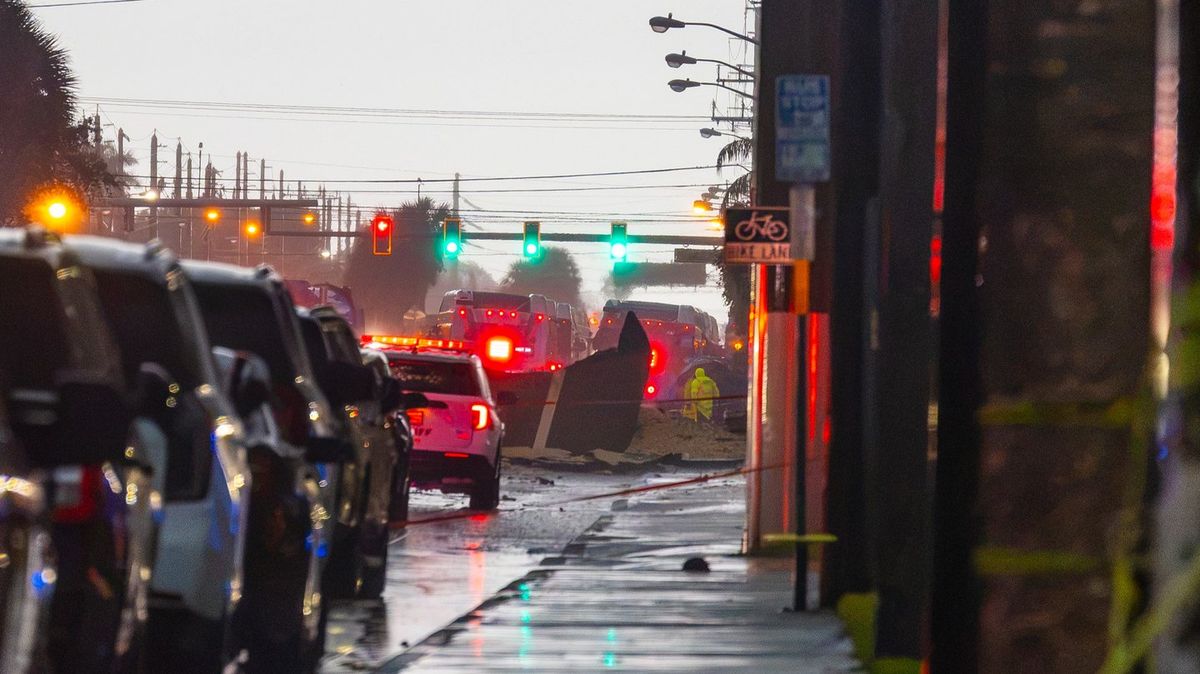
'Like a missile coming down' - Nine killed in fiery Florida jet crash

Not to soon. Too irrelevant.

In this case the young female copilot had very little to do with the crash. Also, people act like 1300 hours is some week 1 rookie pilot. 1300 is a lot of flight hours. She def wasn't a Mickey mouse pilot.
It's relative and depends what those hours were on. 1000 hours on small piston aircraft is not the same as 1000 hours on jets.
 
Long post worth the read. I have a close friend who flies private jets. He flew Lear 60 for over 15 years and now flies a Gulfstream. This is a copy and paste of his response to me asking him if he thought Ice was the issue.

“We always fly in ridiculous cold temperatures.”

“Usually you get the bad ice when the temperatures are like 0 to negative 20. Believe it or not, there's a point where it gets too cold for ice. At negative 40, you pretty much can't get ice. Besides that, the airplane is equipped with hot wings and hot tail.”

“I flew the Lear 60 for like 15 years. It's a no joke airplane and probably the most dangerous airplane I've ever flown. It has a super critical wing. The airflow has to be perfect. When it gets into rough air and turbulence, it will easily stall. It has stalled on me at 41,000 feet just because we got into some turbulence. (On the way to Palm Beach as a matter of fact. ) we recovered and got her flying again around 30,000 ft. Scary

But here's the problem. This airplane has a terrible coffin corner. (At high altitudes) what that means is, you fly in a really narrow window where if you lose 20 knots, it stalls. And if you gain 20 knots, it goes into overspeed. The air goes supersonic over the wing and it goes into a high speed stall, or worse, a Mach tuck.

So if you stall, the normal recovery is to push the yoke forward to lower the nose and gain air speed again. At low altitude, you can push really hard and recover quickly. But in the 60... if you push hard, it will gain air speed and go into a high speed stall, it doesn't take much. It's very sensitive. The 60 has super short wings that don't make much lift. So then you high speed stall, and the computer is yelling at you... OVERSPEED! So then you pull back and enter a low speed stall. And you go back and forth trying to keep it in the air speed window.

This whole thing is pretty scary. And you should recover basically by using your finger tips using super small corrections. You can't over do it. If you try to muscle the recovery, she gets mad and will become unrecoverable. If she enters a mach tuck. You're done.”

“I taught the Lear 60 to other pilots and mentored them. I told them... this airplane has a soul and it's trying to kill you. Do not ever try to top the weather. Don't go over a thunderstorm. Go around it. If it means a half hour longer, then do it. Going over the thunderstorm will go into turbulence that you might not recover from.

These pilots went right over a thunderstorm. I think it stalled which caused them to drop down into the thunderstorm and ended up in mach tuck. They picked up so much speed that it ripped off the horizontal stabilizer. At that point... chuck Yeager can't fix it.

These same pilots did something similar a couple months ago. ATC got mad at them. They poked the bear one too many times.

This is not a beginner airplane. The Gulfstream would never do this. It has HUGE margins of error and won't stall like that. But then again... it's got HUGE wings. It's a pussy cat.

The Gulfstream is like driving a 4 wheeler. The Lear 60 is like riding a uni cycle.”


Grok, Can you describe the terms he uses "coffin corner" and "mach tuck"? Those are unfamiliar to me.

Coffin corner (also called Q corner or the aerodynamic ceiling) is the high-altitude region where an aircraft’s low-speed stall limit and high-speed Mach limit get very close together—or even meet.⁠ (Skybrary)

At high altitudes the air is thin. To generate enough lift, the wing needs a higher true airspeed, so the indicated stall speed rises. At the same time, the aircraft is already flying close to the speed of sound (its critical Mach number), so the maximum allowable speed is limited. The gap between “too slow” (stall) and “too fast” (Mach effects) shrinks dramatically. In extreme cases it can be only a few knots. Turbulence, a turn, or a small speed change can push the plane into a stall on the low side or into Mach buffet/tuck on the high side.⁠ (Aerocorner)

In the pilot’s account of the Learjet 60, that margin was described as roughly 20 knots: lose 20 knots and you stall; gain 20 knots and you risk overspeed and Mach tuck.

Mach tuck is the nose-down pitching moment that appears as an aircraft accelerates toward or past its critical Mach number.⁠ (Wikipedia)

Air flowing over the wing can reach local supersonic speeds and form shock waves even while the airplane itself is still subsonic. As speed increases, those shock waves move aft, shifting the wing’s center of pressure rearward. This creates a strong nose-down (tucking) tendency. If it progresses, the aircraft can enter a steep dive, and elevator authority can decrease, making recovery harder.⁠ (Skybrary)

In short: coffin corner is the narrow high-altitude speed band where you’re simultaneously close to stalling and to the Mach limit; Mach tuck is the nose-down pitch that can occur on the fast side of that band. The Learjet pilot was highlighting how little margin exists in that regime and how turbulence can quickly push an aircraft outside it.
Why fly so high at 41000 feet then? Sounds like a death wish waiting to happen.
 
1000 , 5000, 20000 doesn't matter. She did her no 1 job at the time in her post: flight comms.

And she did it well.
I merely pointed out that not all hours are equal. Comms are only part of your job as pilot-monitoring, which includes monitoring the pilot-flying's actions and the aircraft, including flight path and weather avoidance.

Can go on, but that'll just open another can of worms, which I think is unnecessary at this stage without more factual info.
 
Why fly so high at 41000 feet then? Sounds like a death wish waiting to happen.

Unlike piston and propeller driven aircraft, jet engines are actually better at high altitude. They are both more fuel efficient, and fly faster in thin air. The main constraints are hull integrity due to cabin pressurisation, and the crossover point between maximum speed and stall speed (called coffin corner). The upper limit is defined for calm air and smooth flight, which was not the case in this event. The limits are also more conservative for commercial (paying passenger) aircraft than private executive jets.

Edit: Yes:
So the 20 knot buffer is a design feature?

In the case of turbulence and icing, the maximum speed and altitude are severely limited. As noted elsewhere, overspeed in a swept wing jet leads to something called Mach tuck, where the control surfaces cannot maintain level flight, and the aircraft can enter an uncontrollable dive. Apparently lowering the landing gear is a last resort to slow the descent (listed in the instruction manual). All of this will be looked at in the NTSB investigation.
 
Last edited:
So the 20 knot buffer is a design feature?
He was just using an example. The margin changes depending how close you are to coffin corner. It's not as scary as they try and make it if you just fly at a normal cruize altitude with a big enough buffer to your max altitude. Should be many videos on coffin corner on YT.
 
He was just using an example. The margin changes depending how close you are to coffin corner. It's not as scary as they try and make it if you just fly at a normal cruize altitude with a big enough buffer to your max altitude. Should be many videos on coffin corner on YT.
Sounds like coffin corner is 41000 feet.
 
Sounds like coffin corner is 41000 feet.
It's not a fixed number and you won't be flying right at coffin corner intentionally. It depends on weight, temp, pressure, and aircraft of course.

On the 777 for eg. you can burn over 100 tons of fuel on a long haul. Your max alt can start at 32000' and end at 40000' and you perform step climbs to higher altitudes as you get lighter. You don't really wanna fly closer than 500-1000' of your max in case turb hits and your speed starts fluctuating > overspeed/airspeed low situations.
 
Sounds like coffin corner is 41000 feet.
AI Overview

The coffin corner (or Q corner) is the extreme high-altitude condition where an aircraft's low-speed stall speed and its high-speed critical Mach limit (overspeed/shockwave buffet) get dangerously close together because the air is thin.

The Learjet 60 and Coffin Corner

• The Operating Window: In a mid-to-high altitude cruise—typically around Mach 0.76 to 0.81 at upper levels like 35,000 to 41,000 feet—the Learjet 60 operates in a very narrow band of safe airspeeds.
• The Squeeze:
• Low-Speed Limit: If the aircraft slows down too much, the angle of attack increases, causing a low-speed aerodynamic stall.
• High-Speed Limit: If the aircraft speeds up too much, local airflow over the wings reaches the speed of sound (critical Mach number), creating shock waves, Mach buffet, and pitch instability.
• How Icing and Weather Make It Worse: Accumulating ice on the wings disrupts airflow, raises the stall speed, and narrows the safe envelope even further. If pitot tubes freeze or give erratic readings, pilots can easily misjudge their true airspeed, leading to a catastrophic loss of control or a high-altitude upset.

See also:

1793781982868.png
 
Apparently lowering the landing gear is a last resort to slow the descent (listed in the instruction manual). All of this will be looked at in the NTSB investigation.

I saw this and was surprised. Apparently don't expect the gear to be there/intact when terra firma comes calling. I would have guessed wings level and thrust to idle would have been best bet. Spoilers in this type of upset a no-no.
 

11/1/26 Learjet 60 Palm Beach CO., FL - Flight Safety Detectives​

On 11/01/26 a Learjet 60 Reg. N722BD crashed in Palm Beach County, FL. This analysis is intended for pilots, A&P mechanics, aviation professionals and aviation enthusiasts.

John Goglia and Greg Feith will discuss the known facts about this accident.

1793798498412.png

Click / Tap on image above to play the YT video.
 

Florida Learjet Crash: The Tail Question & Unfair Pilot Blame - Ask the Captain & Captain Steeeve​

Captain Steeeve and Kennedy Steve break down Sunday’s Learjet crash in Florida, including one of the biggest questions surrounding the accident: did part of the tail separate before impact, and what would that mean?

They also address the conversation surrounding the female co-pilot, why people are getting it wrong, and why hearing someone on the radio doesn’t tell you who was flying the airplane.

With the investigation still developing, they discuss the difference between asking questions and jumping to conclusions.

 
What an absolute plank. She managed to communicate until impact. I've been in a terrifying situation (proper terrifying, thinking that's the end of the road) and the best I could get out was something I can only describe as a loud sigh.
There's a forum user here that said the same and how one must not panic
 
Top
Sign up to the MyBroadband newsletter
X