The kA rating on circuit breakers are more applicable to inductive loads.
But it has been stated here, it is the rated maximum short circuit current the circuit breaker can safely break without exploding.
The actual short circuit current of the circuit will depend on wire size and length
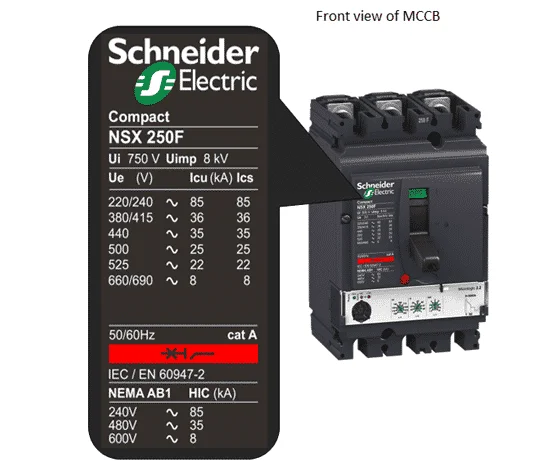
A circuit breaker has 2 principle safety ratings, maximum voltage and breaking capacity in kilo amps at a given voltage.
It should also be noted that many circuit breakers don't give the kA rating at maximum voltage.
1000v @ 6kA for such a tiny breaker is quite unlikely, it is all about energy, so a 1000V @ 6000 amps for even a really short duration is a lot of energy for such a small device to absorb and not explode.
Keeping in mind that 1 joule = 1 ampere * 1 volt * 1 second.
The only way realistically to achieve 6kA @ 1000v is being able to disconnect incredible quickly.
So working back from a realistic amount of energy to dissipate you can figure out how quickly the breaker would need to disconnect to not blow apart given the energy.
I'm not really inclined to spend the next hour doing the calculations and pouring over the spec sheets, but I would be very careful just quoting numbers randomly from a circuit breaker.
Physics doesn't care about your circuit breaker specs, there is a certain amount of joules and it needs to go somewhere.
Given the size of the breaker there is a hard limit to how much of that energy it can dissipate, so it all comes down to how quickly it can disconnect the load.




 .
. 


