11-year-old selling cryptographically-secure passwords online

A dictionary brute force will crack your password in seconds.

With that said, decrypting her method will be a bit more difficult but still crackable.

A password like this

"this is my password"

will take forever with a brute force. Most likely a septillion combinations.
 
Um. I have a word list that has 982,963,904 words and is only 13gb.

Okay fair enough, it's not necessary to create a new dictionary to keep all the combinations as you can generate them on the fly but to attack 25 422 605 913 456 636 373 066 491 006 976 possible combinations is not only going to take a few seconds.
 
A password like this

"this is my password"

will take forever with a brute force. Most likely a septillion combinations.

"this is my psasword" is probably better.... #WheresYourDictionaryNow
 
Okay fair enough, it's not necessary to create a new dictionary to keep all the combinations as you can generate them on the fly but to attack 25 422 605 913 456 636 373 066 491 006 976 possible combinations is not only going to take a few seconds.

Care to show the reference material or cryptography journal with the math for that particular estimation?
 
So i just checked a common passphrase i use and it would take 1.4040 x 10^14 Years
 
A password like this

"this is my password"

will take forever with a brute force. Most likely a septillion combinations.
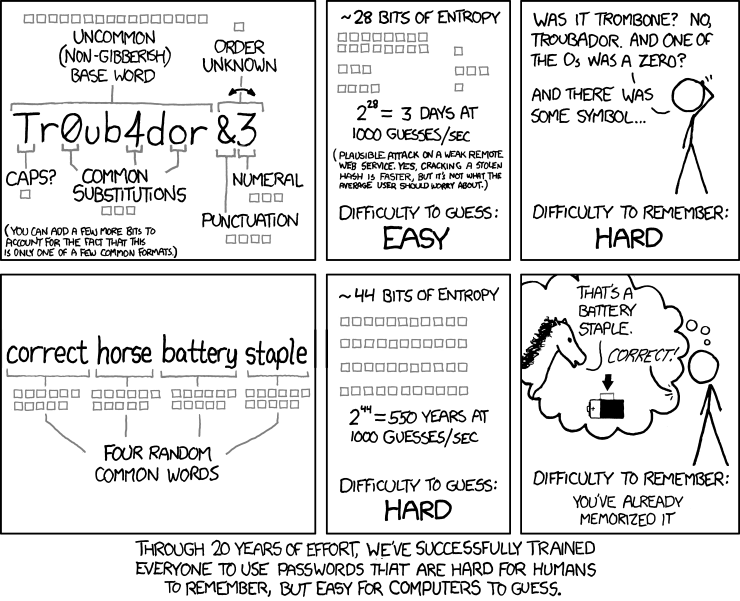
This. Just generate a few easy to remember words and it will take longer to crack than any of these schemes that actually make your life harder...

password_strength.png
 
Care to show the reference material or cryptography journal with the math for that particular estimation?

That calculation was based on the number of words in the Oxford dictionary. According to the article, she uses Diceware for her words. That list contains 7776 words. 7776 ^ 6 = 221 073 919 720 733 357 899 776 or 2.2107392e+23 possible combinations if you allow for words to repeat. If you only allow unique words it is 7776*7775*7774*7773*7772*7771 which gives 2.2064778e+23 possible combinations.
 
A password like this

"this is my password"

will take forever with a brute force. Most likely a septillion combinations.

This. Just generate a few easy to remember words and it will take longer to crack than any of these schemes that actually make your life harder...

password_strength.png

And you can generate even more complexity in your password by using punctuation.
 
actuallly, this is a very good idea, and the type of thing only a kid will have time for.
 
It's good that she doesn't keep a list of customers, their passwords and addresses. Or maybe her big brother or dad don't.
 
This. Just generate a few easy to remember words and it will take no longer to crack than any of these schemes that actually make your life harder...

password_strength.png
ftfy. We've been through this logic fail before. You can't compare a binary brute force attack to a dictionary one. Languages contain an average of 10,000-20,000 commonly used words. If you use a passphrase some words are necessarily more likely to follow others. Say goodbye to your identity in a few hours.
 
ftfy. We've been through this logic fail before. You can't compare a binary brute force attack to a dictionary one. Languages contain an average of 10,000-20,000 commonly used words. If you use a passphrase some words are necessarily more likely to follow others. Say goodbye to your identity in a few hours.

You can't isolate parts of the pass phrase. Cracking it is all or nothing. So it's not like you can guess one word and use it to identify likely other words.
You watch too much hackers ;)
 
You can't isolate parts of the pass phrase. Cracking it is all or nothing. So it's not like you can guess one word and use it to identify likely other words.
You watch too much hackers ;)
Natural language. Some words are more likely to follow others. Make words unguessable and it will take longer to crack. That's if someone uses the technique. Will still not take exceptionally long to guess it using both common and uncommon words.
 
Top
Sign up to the MyBroadband newsletter
X