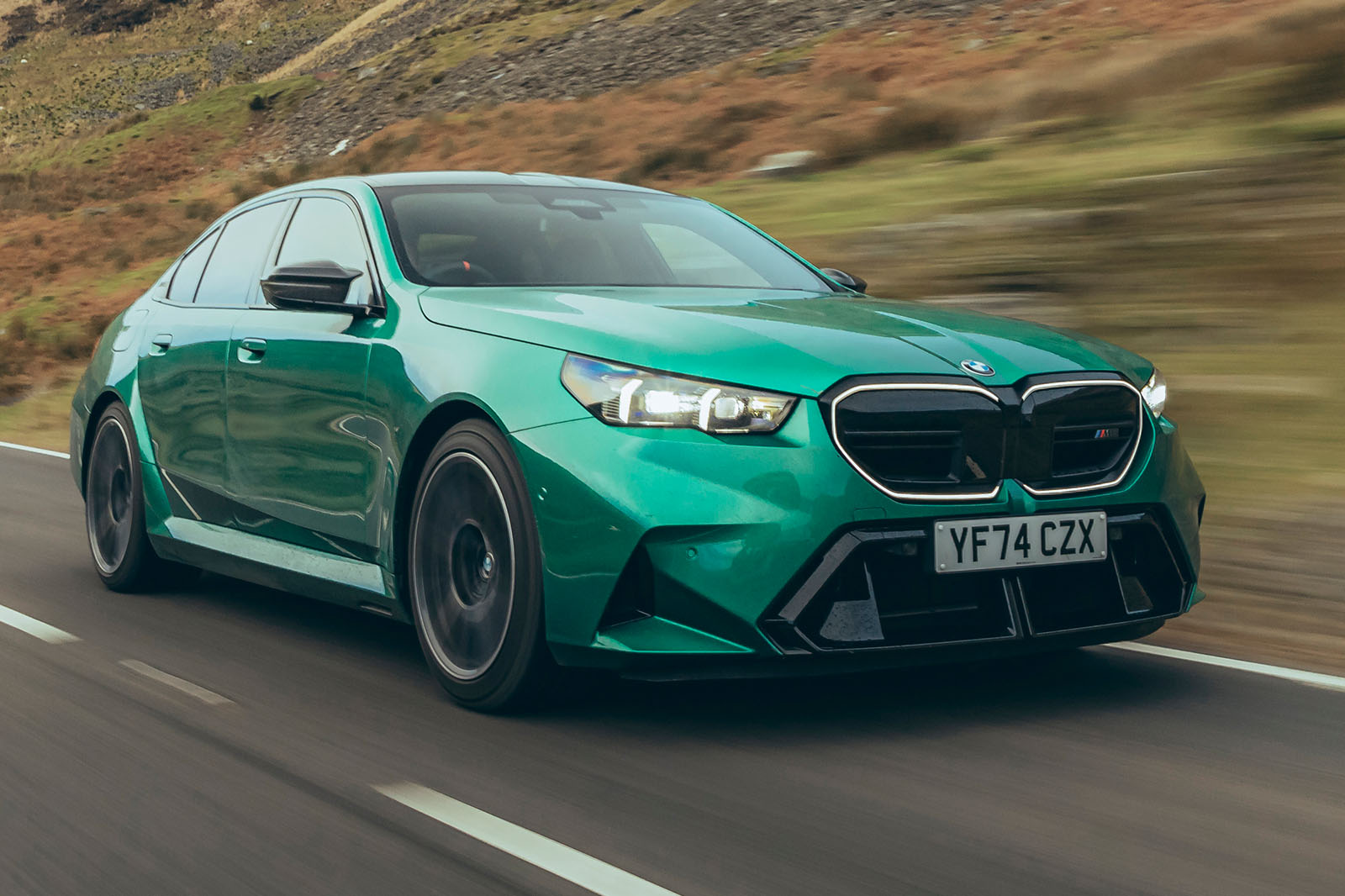
If you want to buy an M5 CS, you will have to get your head around the idea of a £140,000 M5 first. That’s not easy, and I dare say that it might be all the harder if ownership of an earlier F90 M5 has already cost you a hefty five-figure sum in depreciation over the past few years.
Much as the M5 CS clearly isn’t trying to do a Porsche GT3 impression in terms of the way that it drives, it could certainly do with some GT3-level residual values. However limited its numbers may be, you wouldn’t bet on it producing them - not least because M5s exist to be used, not collected and fawned over. That’s as it should be, but it will always make such an expensive M5 an even more expensive ownership proposition.
Still, even if you do struggle with this car’s price, you wouldn’t argue having driven one that it’s not exactly the kind of CS treatment that the M5 needed. If this ever-rapid but newly rewarding, ever-usable performance saloon is BMW’s idea of the ultimate M5, that's good news for the future health of this car, and it's worth celebrating.
Watch BMW M5 CS Teach Audi RS7 A Drag Racing Lesson
Another day, another drag race. This time the subjects of focus are the Audi RS7 Sportback as well as the mighty BMW M5 CS.
The 4.0 TFSI in the Audi RS 7 Sportback produces 441 kW and delivers 800 Nm of torque within a broad range from 2,050 to 4,500 rpm. The high-performance models will sprint from 0 to 100 km/h in only 3.6 seconds. The top speed is electronically limited to 250 km/h; this can be increased to 280 km/h with the RS Dynamic package.
With 460kW on command, the latest BMW M5 Competition is certainly no slouch. However, German performance tuner Manhart says it saw a whole lot of unused potential in the M5’s 4.4-litre twin-turbo V8 and the end result of that thought process is called the Manhart MH5 800.
What we’re talking about here is far more than just a software upgrade. Thanks to a Manhart turbo performance kit, intercooler and carbon intake, the Manhart MH5 800 produces an impressive 608kW and 1050Nm, which is a whopping 300Nm increase over the standard model. No performance figures for the Manhart MH5 800 have been released as yet, but it will surely improve upon the regular M5’s 3.3 second 0-100km/h sprint time.
Manhart also upgraded the eight-speed automatic transmission and installed a performance exhaust system, consisting of ‘Race’ downpipes without catalytic converters, stainless steel rear silencer with valve control and four tailpipes finished in either carbon or ceramics.
Next-generation BMW M5 to keep twin-turbo V8 with 560 kW?
While some performance manufacturers are dropping their eight-cylinder cars, it looks like the next-generation BMW M5 could retain its one. A new report suggests that the Bavarian brand’s halo sedan may keep this unit with some form of electrification to keep it in-line with the developing emissions standards.
As Autocarreports, the next-generation BMW M5, which is expected to break cover in 2023, is likely to employ the S63 twin-turbo 4,4-litre V8 with a plug-in hybrid electric motor which will provide a combined power output of 560 kW. This is the same unit that is expected to be used in the brand’s upcoming X8 performance SUV. This is not too unlike what Mercedes-Benz has in plan for its PHEV AMG GT four-door.
Alongside this car, there is a possibility that the brand will be developing an all-electric i5 M performance model that will make use of its CLAR architecture with three electric motors. The proposed power output for this model is in the 600 kW region but it may have considerable weight penalties.