3D Technology

Roman4604

Executive Member
Joined
Jun 27, 2005
Messages
6,190
Reaction score
5,576
Location
Badlands
Oi, did Postman "I am the ThreadLocker" Pot strike again?

Anyway, carrying on with the civil part of the 3D technology debate from here ...

His methods are also just by viewing mostly, so very subjective.
Ultimately so were Ray's views ...

We have plenty of measurement data, which provides lots of good objective evidence, but the most interesting and important part in evaluating 3D is the actual 3D imaging and visualization itself, and that only happens inside the brain, so instruments cannot help with that part of the evaluation.


His disagreement was also very moot.
Just one expert's opinion against another's. You can't claim either's is more valid, however my personal 1st hand experiences align with those of David.
 
Last edited:
Oi, did Postman "I am the ThreadLocker" Pot strike again?

Anyway, carrying on with the civil part of the 3D technology debate from here ...

Ultimately so were Ray's views ...


Just one expert's opinion against another's. You can't claim either's is more valid, however my personal 1st hand experiences align with those of David.

Whose David?
 
Oi, did Postman "I am the ThreadLocker" Pot strike again?

To mention something like this merely stirs the pot. Threads get locked because enough people who instigate derailing are childish, gang up, and report participating posts (which don't contravene rules - I have yet to see an infraction). Merely a bit of banter helping me down the 3D rabbit hole for my own benefit. So I'll keep an eye out here, maybe it can answer my questions born from statements like "LG 3D is the best". Value I understand, still uncertain about 'best' though.
 
Last edited:
To mention something like this merely stirs the pot. Threads get locked because enough people who instigate derailing are childish, gang up, and report participating posts (which don't contravene rules - I have yet to see an infraction). Merely a bit of banter helping me down the 3D rabbit hole for my own benefit. So I'll keep an eye out here, maybe it can answer my questions born from statements like "LG 3D is the best". Value I understand, still uncertain about 'best' though.

I say again CERTIFIED!!!!! - can you hear me PP, are you listening PP, or are you Trolling PP? - Sorry STOP from my side.
 

Certainly Active 3D glasses is not good for many things,ie it can cause headaches, nausea and epileptic fits. I have not seen any scientific research about eyes relevant to active 3D glasses - although Im sure that those other symptoms can easily lead you to think that its bad for your eyes as well. You may well be right that it indeed it is bad in a way. Maybe only time will tell. 3D had it worst reputation in the days of coloured anaglyph. I think that any research related to the use of Polarized glasses will be relevant on whether passive glasses are bad or not for your eyes.
 
Last edited:
I say again CERTIFIED!!!!!
Personally I think its more of a nice PR job, obviously paid for by LG.

Yes their TVs may be certified to display 1080 panel lines during 3D, but they leave out a lot of other pertinant information. Firstly not all of the source lines are displayed in the correct spacial position, and also there is the fact that a FHD 3D frame comprises of more than 1080 lines.

We've been through this before, but to recap, for each 3D movie frame (off Bluray 3D) the TV receives 2160 lines of discrete visual information every 1/24th of a sec. This comes down the HDMI cable in frame packed FHD3D format ...

Full-HD-3D-FHD3D-Content.jpg


What an active 3D TV does with it; for roughly half the frame cycle time (less HDMI transmission time) only the 1080 lines for the left eye are displayed to that eye, then for the other half only the 1080 lines for the right eye are displyed to that eye. While information is only displayed to one eye at a time, the brain's inherent image retention memory allow one to see both similtaneously, accompanied by some flicker which is viewer dependant at 24fps. The main point is that the 1080 lines for each eye are displayed accurately in the correct spacial position.

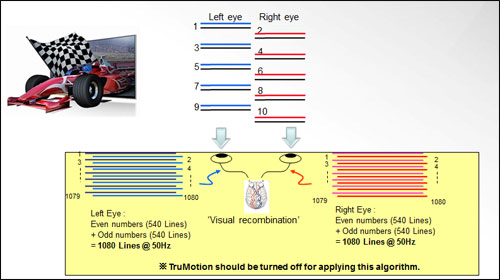
What passive 3D TV does with it; for 1st half of the frame cycle displays the even 540 left source lines on the panel's even lines, simultanseously with the even 540 right source lines on the panel's odd lines. Then during the 2nd half displays the odd 540 left source lines on the panel's even lines together with the odd 540 right source lines on the panel's odd lines. So all 2160 lines of source info are displayed, however half are inaccurately positioned.

Based on the above technical/physical facts, I cannot believe passive 3D (on 1080p panel) can ultimately match the picture quality/fidelity of active 3D. Sure most viewers will are not be appreciative of the difference, but I dont think passive 3D vendors can strictly claim their system can match active 3D's picture quality. Overall experience maybe, but thats a different debate.
 
Personally I think its more of a nice PR job, obviously paid for by LG.

Yes their TVs may be certified to display 1080 panel lines during 3D, but they leave out a lot of other pertinant information. Firstly not all of the source lines are displayed in the correct spacial position, and also there is the fact that a FHD 3D frame comprises of more than 1080 lines.

We've been through this before, but to recap, for each 3D movie frame (off Bluray 3D) the TV receives 2160 lines of discrete visual information every 1/24th of a sec. This comes down the HDMI cable in frame packed FHD3D format ...

Full-HD-3D-FHD3D-Content.jpg


What an active 3D TV does with it; for roughly half the frame cycle time (less HDMI transmission time) only the 1080 lines for the left eye are displayed to that eye, then for the other half only the 1080 lines for the right eye are displyed to that eye. While information is only displayed to one eye at a time, the brain's inherent image retention memory allow one to see both similtaneously, accompanied by some flicker which is viewer dependant at 24fps. The main point is that the 1080 lines for each eye are displayed accurately in the correct spacial position.

What passive 3D TV does with it; for 1st half of the frame cycle displays the even 540 left source lines on the panel's even lines, simultanseously with the even 540 right source lines on the panel's odd lines. Then during the 2nd half displays the odd 540 left source lines on the panel's even lines together with the odd 540 right source lines on the panel's odd lines. So all 2160 lines of source info are displayed, however half are inaccurately positioned.

Based on the above technical/physical facts, I cannot believe passive 3D (on 1080p panel) can ultimately match the picture quality/fidelity of active 3D. Sure most viewers will are not be appreciative of the difference, but I dont think passive 3D vendors can strictly claim their system can match active 3D's picture quality. Overall experience maybe, but thats a different debate.
Its Independently certified, contrary to your belief and you leave out the other most important certification -> It flicker free
 
Now we're talking. This is exactly what I was digging up yesterday (mainly the incorrectly positioned pixels ;)), so thanks Roman.
 
Now we're talking. This is exactly what I was digging up yesterday (mainly the incorrectly positioned pixels ;)), so thanks Roman.

What exactly is your point pushing some minuscle unnoticeable issues of doubtful origin, faith based religious stuff, if the certifications addresses the main issues that matters and is not faith based?
 
Its Independently certified
True, but instigated and paid for by LG, these certification labs are not charities.

Anyway my main point was to illustrate being certified 1080p does not prove their 3D picture quality/fidelity matches the best available. My understanding of the physics tells me otherwise.

contrary to your belief and you leave out the other most important certification -> It flicker free
Nope, I never personally disputed passive 3D holds the edge in viewing comfort. The preceding debate/thread was about absolute best possible 3D picture quality/fidelity available.
 
What exactly is your point pushing some minuscle unnoticeable issues of doubtful origin, faith based religious stuff, if the certifications addresses the main issues that matters and is not faith based?

We already know you think LG passive 3D is 'the best'. Plenty others think otherwise though with reasons. I'm atheist so your will to bring up religion is useless.

True, but instigated and paid for by LG, these certification labs are not charities.

Anyway my main point was to illustrate being certified 1080p does not prove their 3D picture quality/fidelity matches the best available. My understanding of the physics tells me otherwise.

Nope, I never personally disputed passive 3D holds the edge in viewing comfort. The preceding debate/thread was about absolute best possible 3D picture quality/fidelity available.

Exactly.
 
Oi, did Postman "I am the ThreadLocker" Pot strike again?

Anyway, carrying on with the civil part of the 3D technology debate from here ...

oi that thread closure was entirely my doing, no PP's, make your own thread for a heated LCD vs Plasma debate
 
Oi, did Postman "I am the ThreadLocker" Pot strike again?

Anyway, carrying on with the civil part of the 3D technology debate from here ...

Ultimately so were Ray's views ...


Just one expert's opinion against another's. You can't claim either's is more valid, however my personal 1st hand experiences align with those of David.

LG only recently introduced the firmware with their new 3D algorithm? Reviews were mostly done before the latest update so we have to see what brings in future.

Update 21-08-2011: LG recently updated their 3D algorithm on their 3DTVs. Therefore we have updated the 3D section in this review: Update to LG Cinema 3D TV review

http://www.flatpanelshd.com/news.php?subaction=showfull&id=1313938337

As for the certification

The resulting picture has earned CINEMA 3D TV “flicker free” certification from Intertek and TÜV, two world-renowned certification agencies based in Europe, making it the world’s first 3D TV to receive the designation. With such a smooth picture, the Cinema 3D TV practically eliminates the feelings of dizziness or eye fatigue that could occur with previous 3D TVs, meaning viewers can enjoy 3D content for longer and in
greater comfort.

http://www.slashgear.com/lg-cinema-3d-lw5700-hdtv-certified-flicker-free-16134157/

Also again the latest LG technology is additionally certified FHD for each eye. The technology use 1080i per eye.

See here:

cinema3dupdate-1.jpg


http://www.flatpanelshd.com/news.php?subaction=showfull&id=1313938337

CONCLUSION

LG has definitely managed to squeeze out more juice from their Cinema 3D TVs with the new 3D software. 3D pictures appear more detailed and smoother, and are pretty much crosstalk-free. 3D depth is pretty good and we felt that the “grainy look” has been minimized to an insignificant level. The polarized 3D glasses are very comfortable and cause less eyestrain compared to active 3D glasses. You still need to sit a few meters – 1,5-2 metes - away from Cinema 3D TVs, or else you will experience some crosstalk

I regard Cinema 3D as a broader 3D technology than active 3D. Cinema 3D is a better solution for everyday people who seek an easy, cheap and user-friendly 3D solution. However, I still feel that the Cinema 3D technology needs to find a better TV companion with deeper black levels. Therefore I am also very excited to see how LG’s combination of Nano TV technology and Cinema 3D turns out. Until then, try to get a chance to see Cinema 3D yourself. It is worth your time.

All is in the eye of the beholder. There are pro's and cons to each and every TV, even in the same brand and series. I still claim the Lg LW 3D is very good value for money considering the overall pro's as compared to the cons. We have to see what the future brings but in my view passive 3D with the future LED TV panel technology will be the winner forward. Samsung and others are also jumping on the Passive bandwagon. I also read that a new TV technology coming available soon is where the active portion will be build directly in the TV LCD panel, like a active/passive hybrid, where the glasses used will then be the standard passive glasses.

Soon the current active systems will become a niche market, just like Plasma. :)
 
Soon the current active systems will become a niche market, just like Plasma. :)

Plasma is a niche market? So it's been hanging on tatters for about 5 years now since Sony and others dropped it? I see more and more models coming out each year, more people buying. MyBroadband article also noted the opposite of what you claim? I would have to trust an internet review site, over your opinion !
 
Now we're talking. This is exactly what I was digging up yesterday (mainly the incorrectly positioned pixels ;)), so thanks Roman.

Please educate me. Where are the facts and information that states that the pixels are incorrectly positioned? I have not read anything of such nonsense anywhere. I know that in Plasma's they use pixel shifting to compensate for "burn in", on some forums people complained about the effect, but i have not heard anything like it for LED TV's
 
We already know you think LG passive 3D is 'the best'. Plenty others think otherwise though with reasons. I'm atheist so your will to bring up religion is useless.


Exactly.

I'm sorry that the reasons are beliefs - and that doesn't help your case though. I will not join your Atheist Church for the True Believers in the Resurrection of the Plasma. I stick to recent proven science through certified research.
 
Top
Sign up to the MyBroadband newsletter
X