I watched a movie a while ago called
Primer and while it addressed some fascinating time travel concepts the whole idea of going back in time is totally impossible,even on a theoretical level.Here's why.
In movie's when people go back in time they encounter alternate versions of themselves.How is this possible when only ONE version of you exists.
If you're talking alternate universes then you cannot meet your other self if you do go back in time since you both exist in separate realities.
Primer tries to address this making sure your real self and your alternate self do not meet so as not to alter reality, but still this is completely implausable.
Any ideas?
I think time-travel depends on the relationship between the concept of time and the concept of change. For example:
A) Time exist as a result of or is a function of change. Time is an intellectual abstraction and a mathematical expression to quantify change. Without change there is no time sort of like without mass there is no gravity.
Or…
B) Time exists as some distinct (absolute or relative) entity and/or quantity and/or dimension that is different or distinct from the process of change. Time exists as an entity and/or quantity and/or dimension irrespective of whether there are things that are changing or not.
Newtonian physics assume time to be some sort of separate absolute quantity. In Minkowski space time is treated as a separate dimension and added to spacial dimensions to form the space-time manifold and the mathematical setting of Minkowski space is the setting in which Einstein developed his theory of special relativity. So it would seem that the mathematical model of space-time is compatible with B) as it treats time as some sort of dimension.
Historically though, time has always been measured as a function of some or other entity that is changing. For example, time was measured according to the rotation (note change of position of masses) of the earth around the sun (
Ephemeris time) or atomic clocks (
cycles of radiation corresponding to the transition - note change) between two energy levels of an atom) etc. But this duration of a second (in fact any second) is only relative, there is no absolute duration of a second and this is because of special and general relativity.
Looking at special relativity, time will appear to pass slower on objects (including atomic clocks) that are moving (changing) quicker relative to an object that is moving (changing) slower. That is why if an atomic clock can travel close to the speed of light for long periods of time, the atomic clock will appear to slow down, meaning the cycles of radiation corresponding to the transition (note change) between two energy levels of an atom will slow down relatively to other slower moving atomic clocks.
Also, looking at general relativity, time will appear to pass slower on atomic clocks closer to objects of greater mass compared to atomic clocks further away from objects with the same mass . That is why time "slows down" near a black hole. Here, again, a change in mass has an effect on the duration of change. Change thus is relative.
Thus, it would seem that the view that A) Time exist as a result of or is a function of change is not necessarily incompatible with special and general relativity and as some would argue "corresponds more adequately to the physical world". Work is being done to demonstrate the mathematics and physics behind this idea.
Scientists suggest spacetime has no time dimension
Replacing time with numerical order of material change resolves Zeno problems of motion
So if option A is correct then you would literally have to reverse all the changes in the universe to go back in time.
If option B is correct and time really is some sort of distinct quantity or dimension that is distinct from the process of change then I suppose one has to find a way to access this dimension and then travel within it. Option B though runs into a number paradoxes like the one you refer to in your OP.


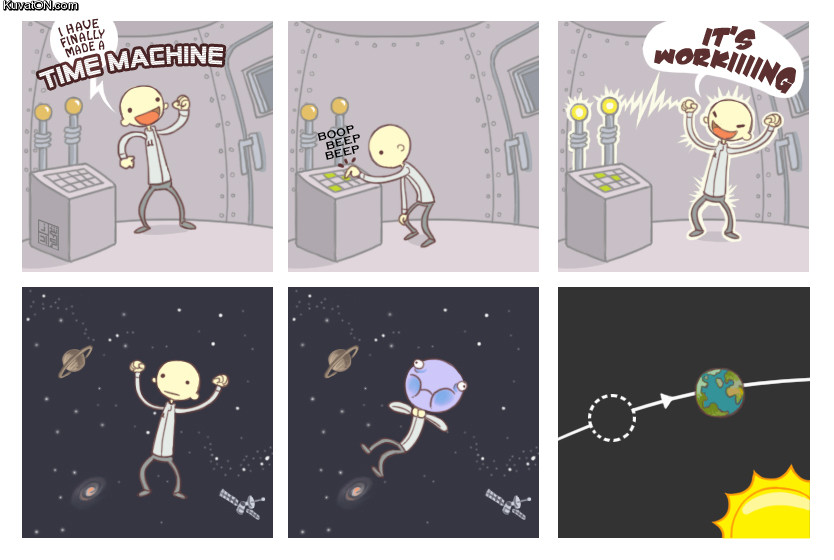


 lol
lol