Alarm system upgrade recommendation (Ideally with HA integration)

Ghost02

Expert Member
Joined
May 16, 2008
Messages
3,749
Reaction score
125
Location
CPT
The current alarm in my house is quite old and only supports 8 channels.

A security company has quoted me on upgrading to a Paradox MG5050 with an IP180 internet module. I would like to do some HA integration and it looks like the IP180 module isn't compatible with HomeAssistant and only the IP150 module is.

Should I ask for the MG5050 system with an IP150 module instead or are there other brands I should look at? I would like to keep my current wired beams and passives if possible. He said it would be with the MG5050 system.
 
What is the model number of your alarm system? Ideally the model number on the actual board.

If it's anything like a DSC PC1808 then the Envisalink 4 would work: https://www.eyezon.com/evl4.php

It also integrates well with HA, but there are some quirks that I am still working through.

My alarm system is also quite ancient, but I think mine has an expander module of sorts, so I have two or more partitions, with at least 16 zones.

These alarm companies are quick to quote you on a fancy new system, but depending on what you have you may be able to work with it. I was flat out told I couldn't make mine smart, but Google must have heard me complaining because my Youtube recommendations suddenly had a lovely how-to video on how to make mine smart. Expensive module, but well worth it for me.
 
I believe it's a Cadax MX-6.

I don't think I can expand the amount of zones on there which is the real forcing function. I mostly want to make sure that the new system I get isn't a deadend.
 
Found a very interesting youtube video regarding a smart home alarm with home assistant powered by an ESP32 board.


One question I have is whether security companies require specific systems for communication compatibility? The above device has 433Mhz radio output but I am cannot see any reference to setting up communications with 3rd party response.
 
Found a very interesting youtube video regarding a smart home alarm with home assistant powered by an ESP32 board.


One question I have is whether security companies require specific systems for communication compatibility? The above device has 433Mhz radio output but I am cannot see any reference to setting up communications with 3rd party response.

Interesting video - I also watched the follow-up. It's a nice board, I've looked at it before

I don't think the 433 MHz transceiver is built-in, the board just has ports for you to plug in a module. It will probably be the normal 433 Mhz transceivers you find on Aliexpress, range will probably not be great.

Commercial alarm monitoring companies use a big radio that is attached to the alarm motherboard via some outputs. I suspect that the protocol is proprietary - for example, I have a Paradox MG5050+ linked to Bull Security. When they call me after an alarm is triggered they know which zone triggered the alarm. That means your custom ESP32 system will have to speak whichever protocol is needed - I think it's built-in to the radio unit that they supply and is linked to the alarm.

I tried building my own alarm system with ESP32's. The problem is the type of PIR's and mmWave sensors you can buy are not in the same class as the PIR's that commercial alarm companies provide. Mostly they require dedicated wires to your alarm system, you can get past that by using something like ESP-NOW or UDP, but the fact remains, they aren't as hardened against false positives.

I feel the best of both worlds is to buy a commercial alarm system, like the Paradox MG 5050+ (not sure about DSC and what is supported), then use the serial port on the alarm to connect your alarm system to HA. I do that by running an ESP32 connected to the serial port of the alarm, which publishes the serial data over TCP to PAI, which communicates to HA via MQTT. It works like a charm and costs very little to build. Much cheaper than the dedicated Paradox IP modules and all open source.

I use Node-Red for automation, so when the alarm is armed or disarmed, I get Telegram push notifications, same with alarm events. It also tells me when a zone has supervision loss or a wireless PIR has low battery.
 
Interesting video - I also watched the follow-up. It's a nice board, I've looked at it before

I don't think the 433 MHz transceiver is built-in, the board just has ports for you to plug in a module. It will probably be the normal 433 Mhz transceivers you find on Aliexpress, range will probably not be great.

Commercial alarm monitoring companies use a big radio that is attached to the alarm motherboard via some outputs. I suspect that the protocol is proprietary - for example, I have a Paradox MG5050+ linked to Bull Security. When they call me after an alarm is triggered they know which zone triggered the alarm. That means your custom ESP32 system will have to speak whichever protocol is needed - I think it's built-in to the radio unit that they supply and is linked to the alarm.

I tried building my own alarm system with ESP32's. The problem is the type of PIR's and mmWave sensors you can buy are not in the same class as the PIR's that commercial alarm companies provide. Mostly they require dedicated wires to your alarm system, you can get past that by using something like ESP-NOW or UDP, but the fact remains, they aren't as hardened against false positives.

I feel the best of both worlds is to buy a commercial alarm system, like the Paradox MG 5050+ (not sure about DSC and what is supported), then use the serial port on the alarm to connect your alarm system to HA. I do that by running an ESP32 connected to the serial port of the alarm, which publishes the serial data over TCP to PAI, which communicates to HA via MQTT. It works like a charm and costs very little to build. Much cheaper than the dedicated Paradox IP modules and all open source.

I use Node-Red for automation, so when the alarm is armed or disarmed, I get Telegram push notifications, same with alarm events. It also tells me when a zone has supervision loss or a wireless PIR has low battery.

Yeah it's the same reason I've never jumped for this guy - https://konnected.io/products/konnected-alarm-panel-pro-12-zone-kit

Would have been nice if someone "in the industry" was also a Smart Home nerd because I'm sure it would be possible.

I actually wouldn't mind if it could just detect panic and main alarm relay tripping because after all I can see what the zones were myself.

Insurance requirement for armed response is the main reason I've never gone there.

Although I believe you can "bridge" these in place with an existing system as well, but haven't dug too deeply into that.

*****

This one "piggy backs" off existing systems - https://konnected.io/products/konnected-alarm-panel-interface-kit
 
Interesting video - I also watched the follow-up. It's a nice board, I've looked at it before

I don't think the 433 MHz transceiver is built-in, the board just has ports for you to plug in a module. It will probably be the normal 433 Mhz transceivers you find on Aliexpress, range will probably not be great.

Commercial alarm monitoring companies use a big radio that is attached to the alarm motherboard via some outputs. I suspect that the protocol is proprietary - for example, I have a Paradox MG5050+ linked to Bull Security. When they call me after an alarm is triggered they know which zone triggered the alarm. That means your custom ESP32 system will have to speak whichever protocol is needed - I think it's built-in to the radio unit that they supply and is linked to the alarm.

I tried building my own alarm system with ESP32's. The problem is the type of PIR's and mmWave sensors you can buy are not in the same class as the PIR's that commercial alarm companies provide. Mostly they require dedicated wires to your alarm system, you can get past that by using something like ESP-NOW or UDP, but the fact remains, they aren't as hardened against false positives.

I feel the best of both worlds is to buy a commercial alarm system, like the Paradox MG 5050+ (not sure about DSC and what is supported), then use the serial port on the alarm to connect your alarm system to HA. I do that by running an ESP32 connected to the serial port of the alarm, which publishes the serial data over TCP to PAI, which communicates to HA via MQTT. It works like a charm and costs very little to build. Much cheaper than the dedicated Paradox IP modules and all open source.

I use Node-Red for automation, so when the alarm is armed or disarmed, I get Telegram push notifications, same with alarm events. It also tells me when a zone has supervision loss or a wireless PIR has low battery.
Yeah maybe the best is to change my alarm to Paradox.

I have an IDS x64 system which does integrate with HA via a custom integration but it is very limited in functionality (i.e the sensors are not exposed which would be nice to use in automations).

Maybe there's an esp32 type setup that could plug into it to better integrate. Will probably look into that rather.

Insurance requirement for armed response is the main reason I've never gone there.
Yup, same. To be even more explicit (at least for my insurance), if I didn't have to have a response linked system I would be more inclined to explore DIY.
 
The current alarm in my house is quite old and only supports 8 channels.

A security company has quoted me on upgrading to a Paradox MG5050 with an IP180 internet module. I would like to do some HA integration and it looks like the IP180 module isn't compatible with HomeAssistant and only the IP150 module is.

Should I ask for the MG5050 system with an IP150 module instead or are there other brands I should look at? I would like to keep my current wired beams and passives if possible. He said it would be with the MG5050 system.
I have the MG5050 panel with IP150 module and it works with HA for arming and disarming. The integration I used doesn't have other panel functionality (e.g. bypassing).
Just double check firmware on the IP150 - IIRC the latest firmware broke usage for HA
 
I have the MG5050 panel with IP150 module and it works with HA for arming and disarming. The integration I used doesn't have other panel functionality (e.g. bypassing).
Just double check firmware on the IP150 - IIRC the latest firmware broke usage for HA
Which integration did you use, as I am having difficulty using Paradox alarm interface? I keep getting incorrect passwords in my logs.
 
A Contact ID radio will work with a Paradox MG5050 and you can use an IP150. Done this many times
Make sure you get a GSM radio

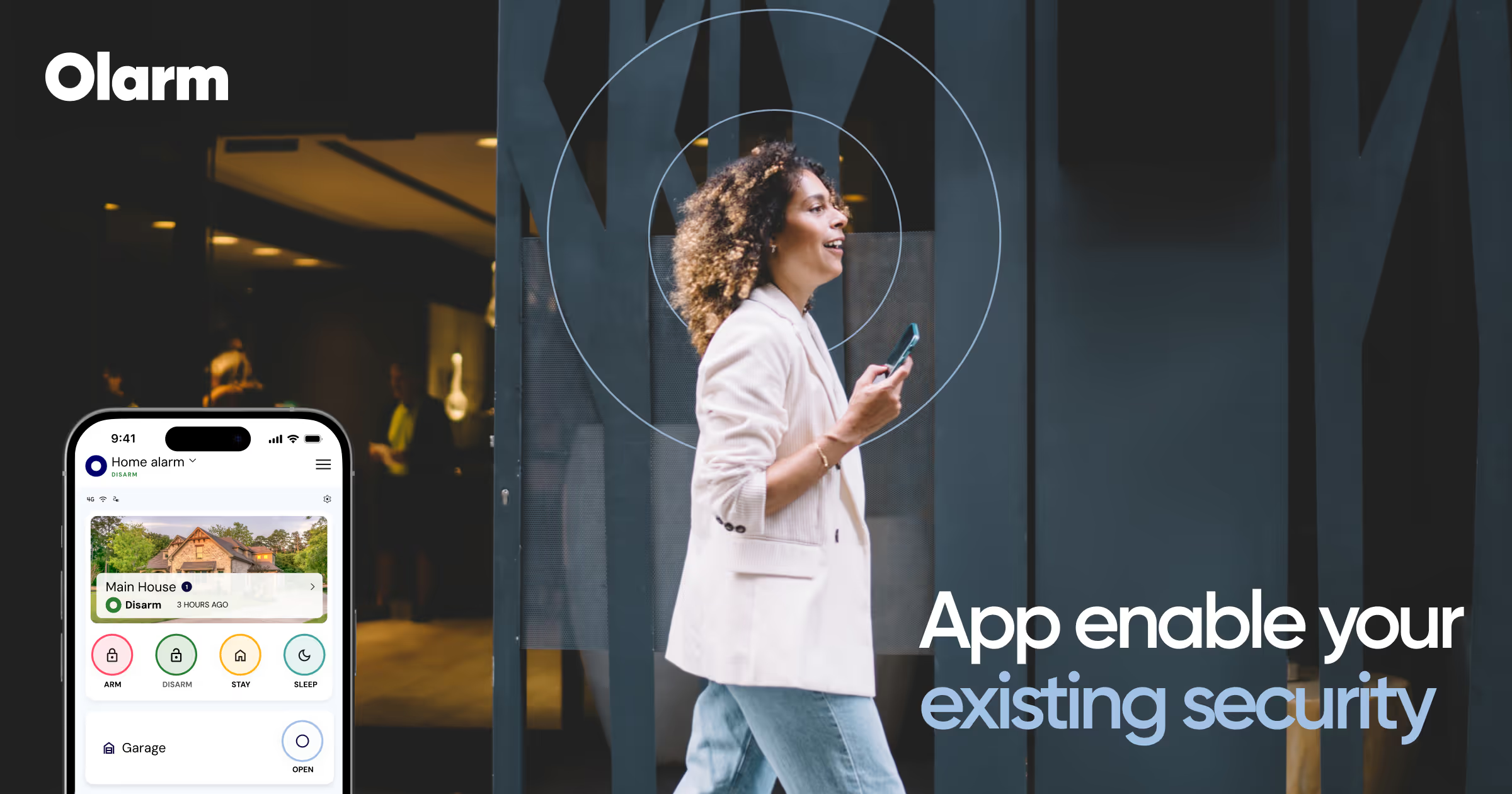
Olarm is also very good and easy to use
 
Try this product.....
Alternatively switch to an Ajax starter kit and add to it over time if you can.
Olarm is not a good choice if you want Home Assistant compatibility. The third-party Olarm integration barely works due to the restrictive Olarm API (and the integration is also no longer maintained).
 
Last edited:
Try this product.....
Alternatively switch to an Ajax starter kit and add to it over time if you can.
Olarm has a monthly subscription. I also don't want my alarm system exposed to the Internet via any 3rd party system
 
I have the MG5050 panel with IP150 module and it works with HA for arming and disarming. The integration I used doesn't have other panel functionality (e.g. bypassing).
Just double check firmware on the IP150 - IIRC the latest firmware broke usage for HA
I was wrong on the bypass - functionality is there I just haven't gone through the effort of setup (it's been a while since I installed the integration)
 
Which integration did you use, as I am having difficulty using Paradox alarm interface? I keep getting incorrect passwords in my logs.

2 things to check:
- Did you set your access code (like you would for Babyware?)

Default connection password is "0000" but you need to set that through the panel - see: https://www.alarmtec.co.za/paradox-alarm/paradox-software/babyware-p-1519{7}893.html

- If your code is '0000' - that doesn't work for me, I needed to encode it as hex, so 'AAAA'

Example config:
pai.conf:

CONNECTION_TYPE = 'IP'
IP_CONNECTION_HOST = 'YOUR ESP32 IP ADDRESS COMES HERE' # IP Module address when using direct IP Connection
IP_CONNECTION_PORT = 23 # IP Module port when using direct IP Connection
IP_CONNECTION_PASSWORD = 'paradox' # IP Module password. "paradox" is default.
IP_CONNECTION_BARE = True
KEEP_ALIVE_INTERVAL = 10 # Interval between status updates
IO_TIMEOUT = 15 # Timeout for IO operations
PASSWORD = 'AAAA'
 
2 things to check:
- Did you set your access code (like you would for Babyware?)

Default connection password is "0000" but you need to set that through the panel - see: https://www.alarmtec.co.za/paradox-alarm/paradox-software/babyware-p-1519{7}893.html

- If your code is '0000' - that doesn't work for me, I needed to encode it as hex, so 'AAAA'

Example config:
pai.conf:

CONNECTION_TYPE = 'IP'
IP_CONNECTION_HOST = 'YOUR ESP32 IP ADDRESS COMES HERE' # IP Module address when using direct IP Connection
IP_CONNECTION_PORT = 23 # IP Module port when using direct IP Connection
IP_CONNECTION_PASSWORD = 'paradox' # IP Module password. "paradox" is default.
IP_CONNECTION_BARE = True
KEEP_ALIVE_INTERVAL = 10 # Interval between status updates
IO_TIMEOUT = 15 # Timeout for IO operations
PASSWORD = 'AAAA'
I've got similar config with no issues since installation
 
Top
Sign up to the MyBroadband newsletter
X