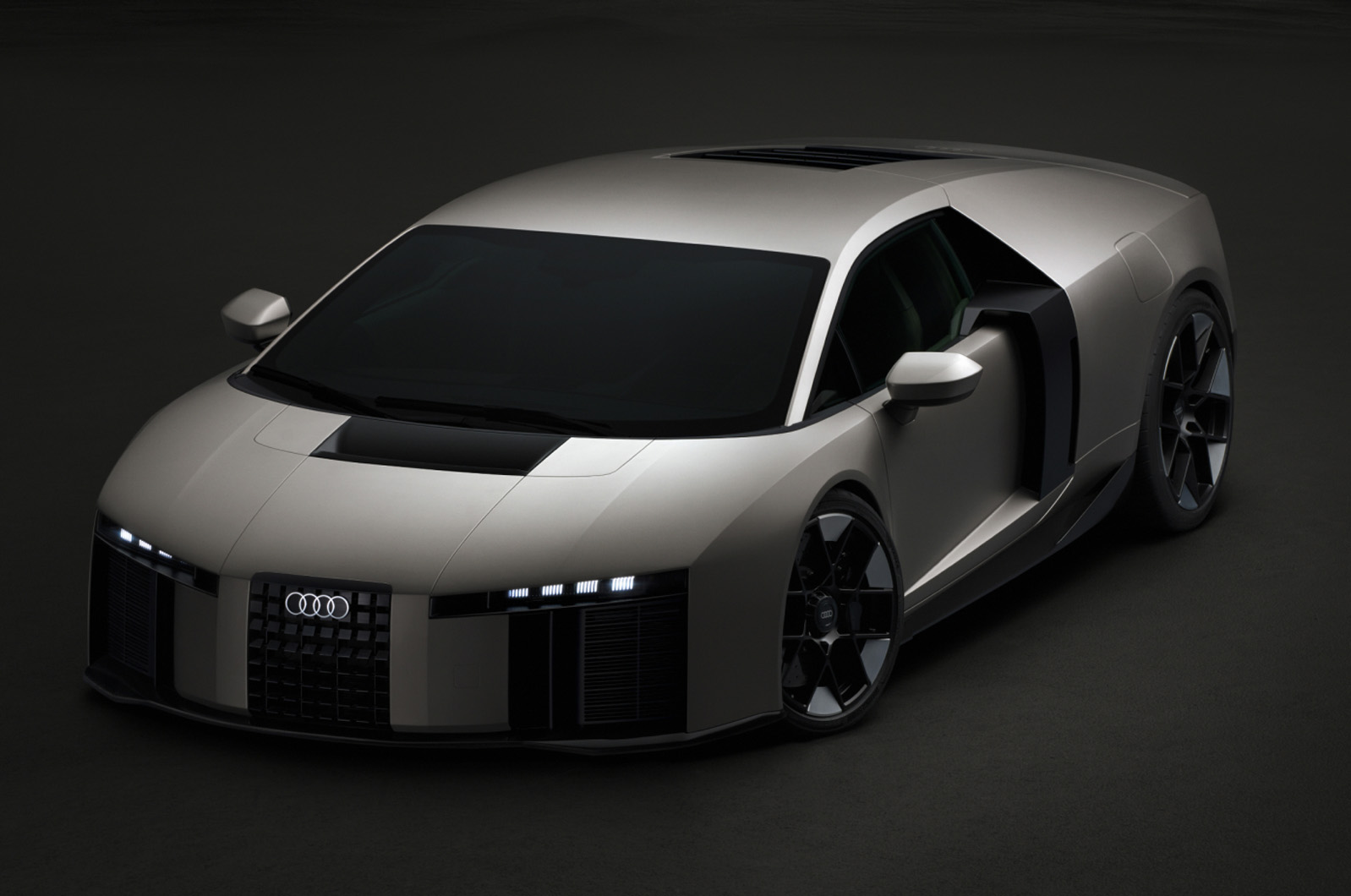
Audi Nuvolari

Audi's upcoming new supercar, 1000bhp V8 hybrid that'll rev to 10,000rpm.

Nuvolari: Audi reveals shock new V8 supercar to replace R8

Ultra-exclusive Lambo Temerario twin gets nearly 1000bhp from hybrid V8 – and introduces new design language

The new Audi Nuvolari is a limited-run 987bhp V8 hybrid supercar that serves as a new flagship more exclusive than the R8 – and, according to boss Gernot Döllner, serves as “a statement for the future” of the brand.

Powered by a twin-turbocharged 4.0-litre engine aided by three electric motors, the mid-engined Nuvolari is the fastest and most powerful production car the German firm has ever produced.

It features Formula 1-inspired technology including active aerodynamics, a carbonfibre body and a torque vectoring four-wheel drive system.

Due to arrive early next year and limited to 499 units, the Nuvolari is the first car that will go into production showcasing Audi’s new design language, first previewed by last year’s Concept C.

Revealed in near-production form, Audi claims that the Nuvolari is the "next tangible evidence" of its renewal after the Concept C.

Döllner added that the supercar “brings together outstanding design and a new speed of innovation with a lot of technical content”.

Serving as the flagship of Audi’s new-era line-up, the Nuvolari is pitched above the R8 that it effectively succeeds in terms of both pricing and ethos.


1.jpg

8.jpg

7.jpg

6.jpg

5.jpg

4.jpg

2.jpg

3.jpg
 
Audi Nuvolari

With the Nuvolari, Audi is unveiling its first supercar with a high-performance hybrid powertrain - further accelerating technological progress. With 1,001 PS and a top speed of more than 350 km/h, the Nuvolari is set to become the most powerful vehicle and the fastest production vehicle in the history of the four rings. Deliveries of the supercar, limited to 499 units, will begin in the first half of 2027.

The Audi Nuvolari accelerates from 0 to 100 km/h in 2.6 seconds and reaches 200 km/h in 6.8 seconds. These figures are enabled by a range of innovations inspired by Formula 1, including the high-performance hybrid powertrain, quattro predictive ride, active aerodynamics, and the new Audi Space Frame (ASF) with carbon exterior.

"With the Audi Nuvolari, we are accelerating technological progress," says Gernot Döllner, Chairman of the Board of Management of AUDI AG. "It shows what is possible when the focus is on technology, performance, and execution through teamwork - and when we achieve progress together."

Design at its most visceral

As the first production vehicle that follows Audi's new design philosophy, the Nuvolari will combine the high-performance character of a supercar with a distinctive design. Taut surfaces, seamlessly integrated technology, and intelligent aerodynamics define its appearance.

The mid-engine layout defines the proportions, resulting in a monolithic volume, a powerful stance, and a strong presence.

The exterior is characterized by Audi's new signature color Titanium, a paint also used on the Audi Concept C and the Audi Formula 1 race car. In combination with carbon elements, it highlights the precise lines of the Nuvolari.

High-performance hybrid powertrain with four drive units

The Audi Nuvolari is powered by a hybrid high-performance powertrain with a maximum system output of 736 kW (1,001 PS). It combines a 4.0-liter V8 biturbo engine delivering 588 kW (800 hp) with three axial flux electric motors, each producing 110 kW. The lithium-ion battery has a gross capacity of 7.3 kWh.

The combustion engine delivers a maximum torque of 730 Nm and reaches up to 10,000 rpm - a range previously reserved for motorsports.

Two oil-cooled axial flux electric motors at the front axle deliver up to 2,150 Nm of torque. As an integral part of the quattro system, they support variable torque distribution. A third electric motor between the V8 mid-engine and the transmission completes the drive concept.

The high-performance drivetrain accelerates the vehicle from 0 to 100 km/h in 2.6 seconds and from 0 to 200 km/h in 6.8 seconds, reaching a top speed of more than 350 km/h.

"With the Audi Nuvolari, our entire team has once again demonstrated its technical expertise, innovative strength, and dedication," says Rouven Mohr, CTO of Audi. "This is reflected not only in the vehicle's performance and its Formula 1-inspired technologies, but also in the ability to transfer innovations quickly and precisely into a production vehicle."


Welcome back, Audi R8: this is the 217mph, V8-engined Audi Nuvolari

Audi unleashes a limited-run, half-a-million quid V8 supercar that'll rev to 10,000rpm

Having fielded a grand prix team for the first time since the 1930s, Audi is aiming to feed off that buzz with a 1,001bhp supercar. To connect those dots, it's named the Nuvolari, after Tazio Nuvolari. probably the greatest driver of that era, and sometime pilot of those snorting supercharged V12 Auto Union Type D monsters.

Its unveiling, on the eve of the Monaco Grand Prix, has dropped a lot of jaws. Especially as it's a true production car, limited to 499 units at a price just on the high side of half a million pounds. Left-hand-drive only, sorry. They arrive with buyers a year from now.

Its technical layout is a modern supercar archetype: a powerful turbo engine, three electric motors, hybrid torque distribution. As you'd expect, those basic elements are brought across from cousin Lamborghini's Temerario. When something that special is available, well, it'd be rude not to.

But the Audi has upgrades to take advantage of new tech, and is also retuned in powertrain and chassis to give it more of an Audi flavour.

It even has more power. Imagine the internal politics. Performance numbers are pretty brutal. Audi claims 0-125mph in 6.8 seconds. That's a gaping 2.2 seconds faster than the first of the plug-in 4WD hypercars… the Porsche 918. The Nuvolari sneers at your 155mph limiter, pushing on through to 217mph.

The bodywork is all carbon fibre, and here Audi points fairly to Formula One practice because it's the pre-preg stuff, where mats of different weaves and numbers of laminations are patched together, squeezed by vacuum and baked in an autoclave. This allows intricate shapes with precise strength distribution and the minimum possible weight.

Also, it allows the option of a beautiful naked finish. But more significant, the tooling cost is lower than for the alternative RTM production method.

 
It’s not crazy over-styled. There was a strong possibility they could have farked it up design-wise.

The rear 3/4 has strong base level Huracán vibes but it still gels well into the overall design.

Interior wise it’s not overloaded with massive screens & I'm fairly sure this is Audi’s first portrait orientation screen.
 
Top
Sign up to the MyBroadband newsletter
X