Climate Change Thread

I'd be very curious as to how quickly the Chinese are able to install them, look to them establishing a bench marks

I'm sure China can build them a lot quicker (and probably cheaper), by skipping a lot of safety measures. That's a far cry from what is possible elsewhere. And compared to renewables that are reliably delivered everywhere, for cheaper.

alloytoo said:
Realistically 10-15 years with reducing performance as they grow older.

Nope.

alloytoo said:
capacity is not the same as production and wind farms produce about 35% of their capacity on a good day then global supply is about 0%.
Given that wind can never be "on demand" and that it requires on demand (normally fossil fuel powered) generation to back it for when the wind stops. Wind is only good for pumping water off the grid and I'm not so sure about that.

Good thing we've developed nifty storage devices, which are improving and becoming cheaper at an exponential rate.

alloytoo said:
You mean aside from the thousands of birds and bats they kill, the eyesore they create? The fossil fuels required to actually make them practical.

They actually kill a lot fewer than is often touted, and they kill fewer than nuclear plants.

And something you consider an 'eyesore' isn't an "environmental nightmare".

alloytoo said:
For the most part hydro schemes require water and a valley to dam, these are not always available where you need the power.

Geothermal plants also require water and can be subject to over exploitation if everyone is attempting to same resource, the water table drops and the steam required for generation is no longer available.

Sure. But you can use them where they are feasible, as part of a mix.

alloytoo said:
Bioenergy is touted as a zero carbon energy source because you're burning material which can be regrown?

Energy derived from biological material that already exists and is created as the byproduct of other processes that already happen and will continue to happen.

alloytoo said:
A low level of certainty, a high degree of uncertainty.

it's more cost effective to plough money into certainties like vaccinations (or nuclear power plants).

Or you can plough money into certainties like renewables, and take advantage of the huge economic opportunity it presents.
 
Good thing we've developed nifty storage devices, which are improving and becoming cheaper at an exponential rate.

Newsflash.

Battery technology is not subject to Moore's law, capacity has barely doubled since Moore postulated exponential growth in processing power and memory storage.

Thus far the very best batteries we have for large scale electrical storage are called dams, they have extensive lifespans and don't short out when wet.


Sure. But you can use them where they are feasible, as part of a mix.

I love Hydro and Geo-Thermal, they are however subject to limitations.


Energy derived from biological material that already exists and is created as the byproduct of other processes that already happen and will continue to happen.

It still takes 20 years to replace the tree that was wood chipped and burnt in order to cover for the failing wind farm, burning wood chips (less energy value and more pollution than gas) keeps it "Renewable" for tax credit purposes.


Or you can plough money into certainties like renewables, and take advantage of the huge economic opportunity it presents.

Renewables are a crock (Hydro and geothermal excluded), even if they were reliable (which they're not) they simply can't replace existing fossil fuel plants.

The only thing that can is Nuclear.

Actually it's a pretty clear pathway.

1. Expand Hydro and Geothermal if possible (cause they make sense)
2. Convert as many coal burning plants to gas as you can.
3. Replace your fossil fuel plants with Nuclear as soon as possible.
4. Use solar for off the grid applications.

That reduces carbon immissions and improves pollution without condemning the poor to remain poor and rest of us to get poorer.

It doesn't result in economic upheaval.

and of course if we have another mini-ice age we'll be prepared.
 
Newsflash.

Battery technology is not subject to Moore's law, capacity has barely doubled since Moore postulated exponential growth in processing power and memory storage.

Nope.

20170819_WOC913.png


alloytoo said:
I love Hydro and Geo-Thermal, they are however subject to limitations.

Yes, as is literally every source of energy.

alloytoo said:
It still takes 20 years to replace the tree that was wood chipped and burnt in order to cover for the failing wind farm, burning wood chips (less energy value and more pollution than gas) keeps it "Renewable" for tax credit purposes.

There are other sources of bioenergy than wood chips.


alloytoo said:
Renewables are a crock (Hydro and geothermal excluded), even if they were reliable (which they're not) they simply can't replace existing fossil fuel plants.

They're not, though, and yeah they can.

alloytoo said:
The only thing that can is Nuclear.

Not in the time frame required, and at higher cost.

alloytoo said:
Actually it's a pretty clear pathway.

1. Expand Hydro and Geothermal if possible (cause they make sense)
2. Convert as many coal burning plants to gas as you can.
3. Replace your fossil fuel plants with Nuclear as soon as possible.
4. Use solar for off the grid applications.

That reduces carbon immissions and improves pollution without condemning the poor to remain poor and rest of us to get poorer.

It doesn't result in economic upheaval.

You still haven't in any way explained this idea that shifting to renewables would make "the rest of us get poorer" or result in economic upheaval.
 
It's actually quite substantial, and in many cases they were too conservative, with warming happening even faster.
Not because they wanted to be. The models simply aren't accurate so how can we trust they don't ignore something else that can have a substantial impact?

Well, yeah. Denier pundits should stop doing it then.
You seem to be forgetting who the pundits are.

No, there hasn't. They mean different things, and have both been used for a long time in different contexts.
With one being used less and less and the other more. Go through the literature. You'll see it is the case.

Realistically 10-15 years with reducing performance as they grow older.
Realistically it's 1% per year with the figure tapering off. So after 50 years you typically still have 75% of initial capacity. Besides as I said what do we do in a few decades when nuclear sources are depleted? Then we're back to square one where we debate fossil fuels vs renewables except nuclear won't be in the mix.

Newsflash.

Battery technology is not subject to Moore's law, capacity has barely doubled since Moore postulated exponential growth in processing power and memory storage.

Thus far the very best batteries we have for large scale electrical storage are called dams, they have extensive lifespans and don't short out when wet.
That's because battery tech isn't subject to a refined process that keeps cramming in a little more each year. It's more like there's a leap every 5 years or so. You seem to treat it like we didn't move from NiCad to NiMH to LiIon to now LiPO to name just a few.
 

Yes.

1554943005669.png

There are other sources of bioenergy than wood chips.

Are there any that don't involve burning something? I'm curious.


They're not, though, and yeah they can.

Actually no, take the their energy generation density, work out how much land is required to meet existing demand and then consider how many of those sites are actually suitable. Big deficit.

Solar will of course work once we find a way of getting the energy from orbit, wind is only suitable for sailing.

Not in the time frame required, and at higher cost.

Wind and solar can NEVER meet demand, if we're serious we'll improve our production techniques and that will reduce time and cost. We would be there already if it wasn't for the environmental numpties in the early 90's.

You still haven't in any way explained this idea that shifting to renewables would make "the rest of us get poorer" or result in economic upheaval.

Because like it or not the world runs on fossil fuels, industrialised nations have built their economies and infrastructure around it. Developing nations are using it to get industrialised. If you're going to reduce emissions you're going to have to tell developed populations to reduce their lifestyles and lifespans because the "Green alternatives" are hopelessly insufficient to sustain our industrialized civilization and will never allow developing nations to improve their lot.

The result is that the vast majority will say "Stuff You" and continue to use fossil fuel resources and if they cannot access that they will use start stripping forests for fuel.

Nuclear energy provides a pathway out of energy poverty that meets emission goals.
 
Essential reading, from a progressivist Democrat who was open enough to remove some blinkers.
It's always the same guy who promotes nuclear, surely he can't be the only democrat who does so? Anyway, the GND allows for nuclear power as a solution to our problems, even if AOC is anti it
 
If nuclear was the only "green" energy that ever worked we're farked anyway.
 
It's always the same guy who promotes nuclear, surely he can't be the only democrat who does so? Anyway, the GND allows for nuclear power as a solution to our problems, even if AOC is anti it

Of course he isn't, and yeah, the GND doesn't say anything about nuclear, but they have to keep the strawman going.

Here's Ed Markey, a lead sponsor of the resolution, confirming it once again.

https://www.vox.com/energy-and-envi...06596/green-new-deal-climate-change-ed-markey

And there’s nothing in the resolution about those nuclear power plants. To the extent they stay online, it helps to provide a long-term transition toward a fully renewable system. There’s no call for shutting down any existing nuclear power plant in the United States, with the exception of those found unsafe to operate.

But the resolution does not in any way say that nuclear cannot compete in the future, if there are economically and safely constructed new nuclear power plants.
 
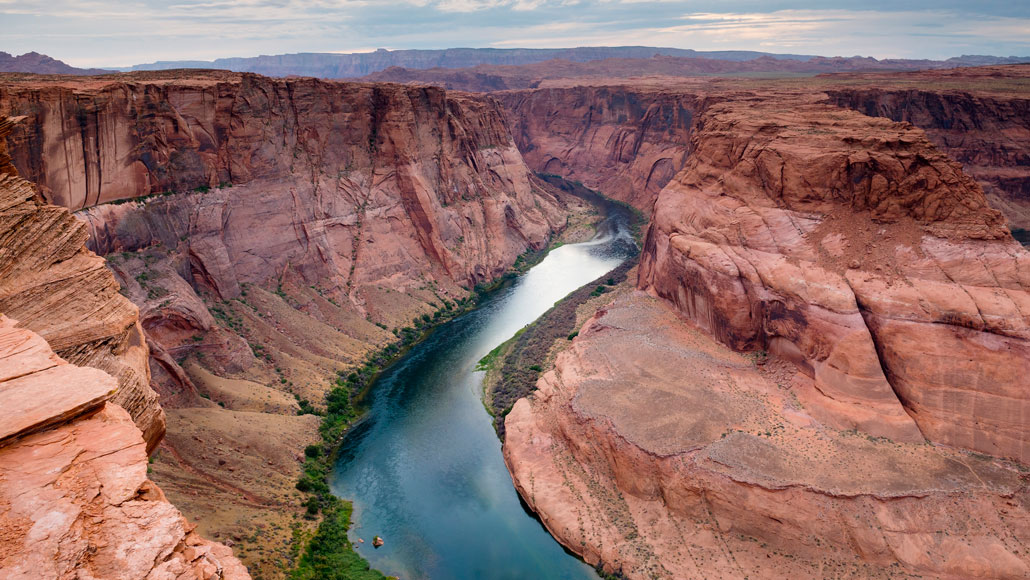
Climate change is slowly drying up the Colorado River
Climate change is threatening to dry up the Colorado River — jeopardizing a water supply that serves some 40 million people from Denver to Phoenix to Las Vegas and irrigates farmlands across the U.S. Southwest.

Computer simulations of the Colorado River Basin indicate that, on average, a regional temperature increase of 1.4 degrees Celsius over the last century reduced the annual amount of water flowing through the river by more than 11 percent. Researchers from the U.S. Geological Survey in Princeton, N.J., report these results online February 20 in Science.

These findings “should be a cause for serious concern,” says climate scientist Brad Udall of Colorado State University in Fort Collins. As the world continues to warm, significant changes to the Colorado River’s flow — like other snow-fed waterways around the globe — could leave many communities with severe water shortages (SN: 5/29/19).


How scientists wrestle with grief over climate change
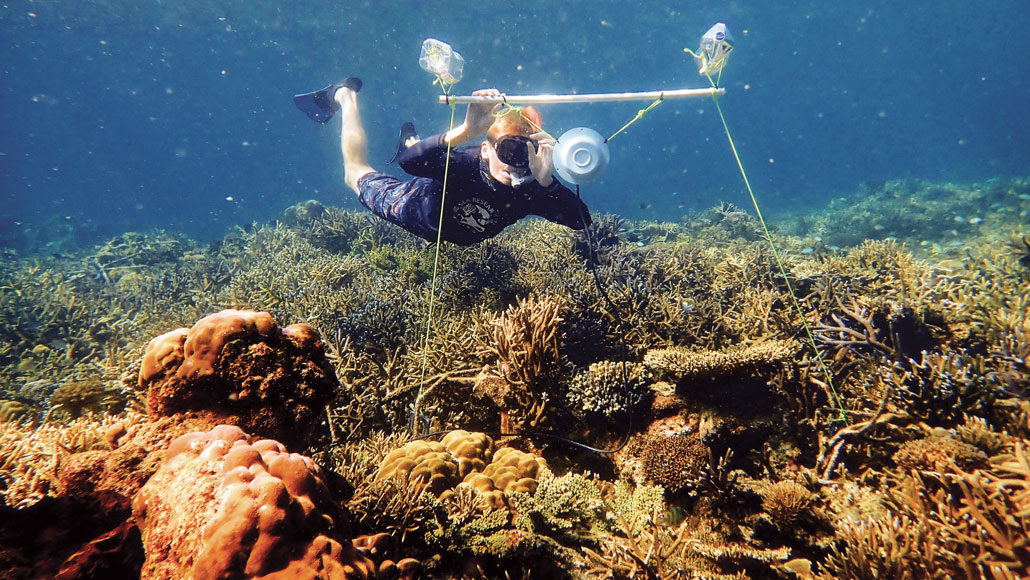
Arriving at Australia’s Great Barrier Reef in October 2016, Tim Gordon thought he was living a dream. As a boy growing up in the southeast African country of Malawi, he’d covered his bedroom walls with Technicolor reef posters and vowed one day to explore those underwater worlds. The marine biologist was unprepared for what he found: a silent and colorless field of submerged rubble.

At Lizard Island, off the northeastern coast of Queensland, Gordon hoped to study the sounds of the reef’s creatures. “A reef should be noisy,” with crunching parrot fish, scraping sea urchins and myriad squeaks, rumbles and whoops of other marine animals, says Gordon, of the University of Exeter in England. But many of these creatures had vanished as climate change warmed the ocean, triggering widespread coral bleaching in 2016 and 2017.

“Instead of documenting nature’s wonders,” he says, “I was documenting its degradation.”

Scientists like Gordon are grieving over the ecological losses they’re witnessing firsthand. They are worried about the probability of more losses to come and are frustrated that warnings about the dangers of unchecked carbon emissions have gone largely unheeded.

 
Carbon the usual scapegoat. So far the only factor that coral reef extinction can be traced to is actual pollution of the ocean.
 
Astounding Images of Antarctica's Blood-Red Ice Are Really an Ominous Climate Sign
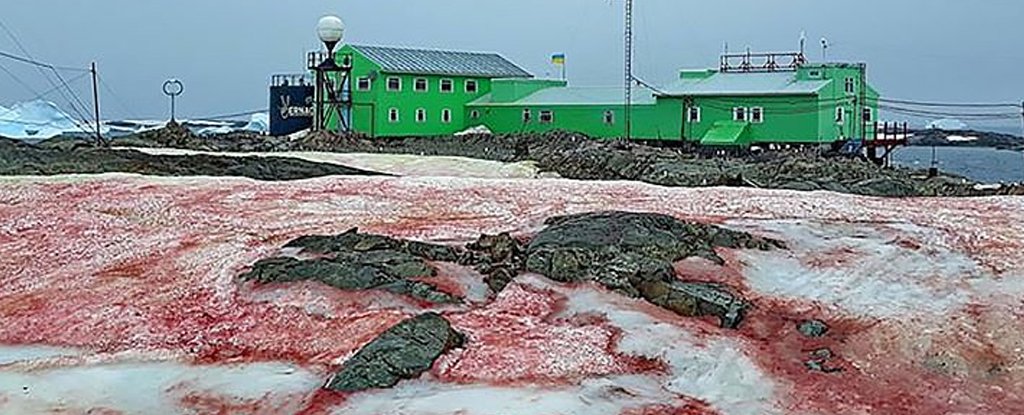
A few weeks ago, scientists at Ukraine's Vernadsky Research Base in Antarctica awoke to find their usually pristine white surrounds drenched in a shocking blood-red.

From the gory-looking images, you could be forgiven for wondering if there'd been some sort of horror-movie-style penguin massacre. The good news is that the real cause is far less dramatic; unfortunately, it still has dire implications.


Marine ecologist Andrey Zotov from the National Academy of Sciences of Ukraine, captured these images while conducting research at the Antarctic station. For such an epic mess, the culprits behind this dramatic redecoration are incredibly tiny.

 
Astounding Images of Antarctica's Blood-Red Ice Are Really an Ominous Climate Sign


Sensationalist nonsense.

It's an algae bloom because the the ice melt.
They don't get into any real evidence for climate change by comparing how much the ice normally melts.
There's rocks as a reference point. Can the scientist at the research center not do any real science and measure some stuff?
 
So what's the consensus here? Is the brunt of global warming man-made or happenstance of the Earth doing its thing, regardless of us?
 
^Maybe it's trying to get rid of us for being such POSs.
 
Six-fold jump in polar ice loss lifts global oceans

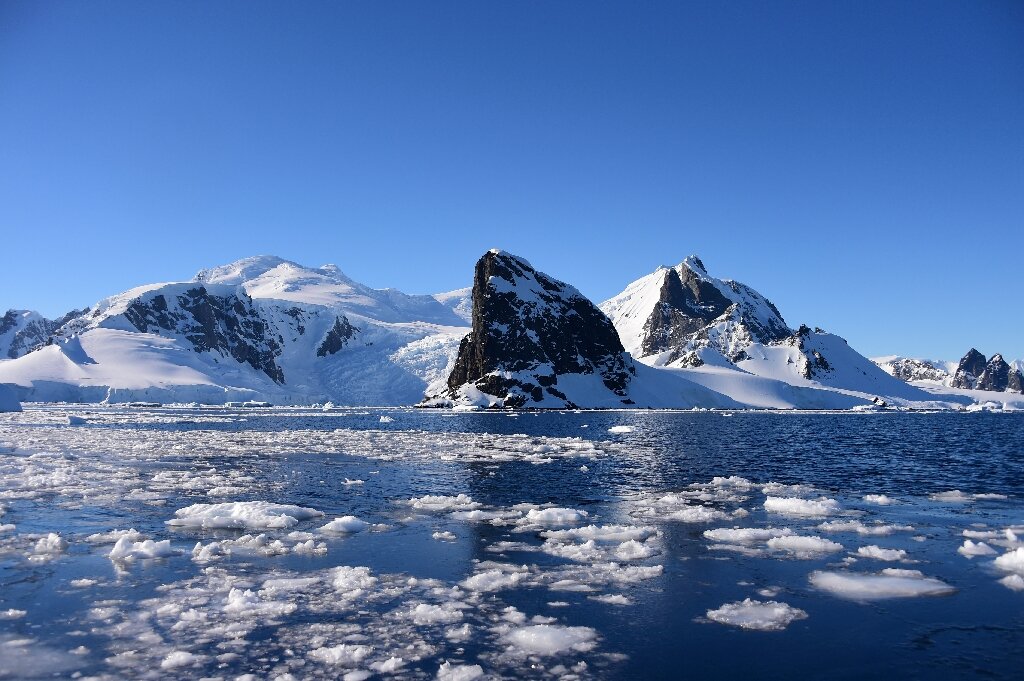
Greenland and Antarctica are shedding six times more ice than during the 1990s, driving sea level rise that could see annual flooding by 2100 in regions home today to some 400 million people, scientists have warned.

The kilometres-thick ice sheets atop land masses at the planet's extremities sloughed off 6.4 trillion tonnes of mass from 1992 through 2017, adding nearly two centimetres (an inch) to the global watermark, according to an assessment by 89 researchers, the most comprehensive to date.

Last summer's Arctic heatwave will likely top the 2011 record for polar ice sheet loss of 552 billion tonnes, they reported in a pair of studies, published Wednesday in Nature.

That is roughly the equivalent of eight Olympic pools draining into the ocean every second.

 
Top
Sign up to the MyBroadband newsletter
X