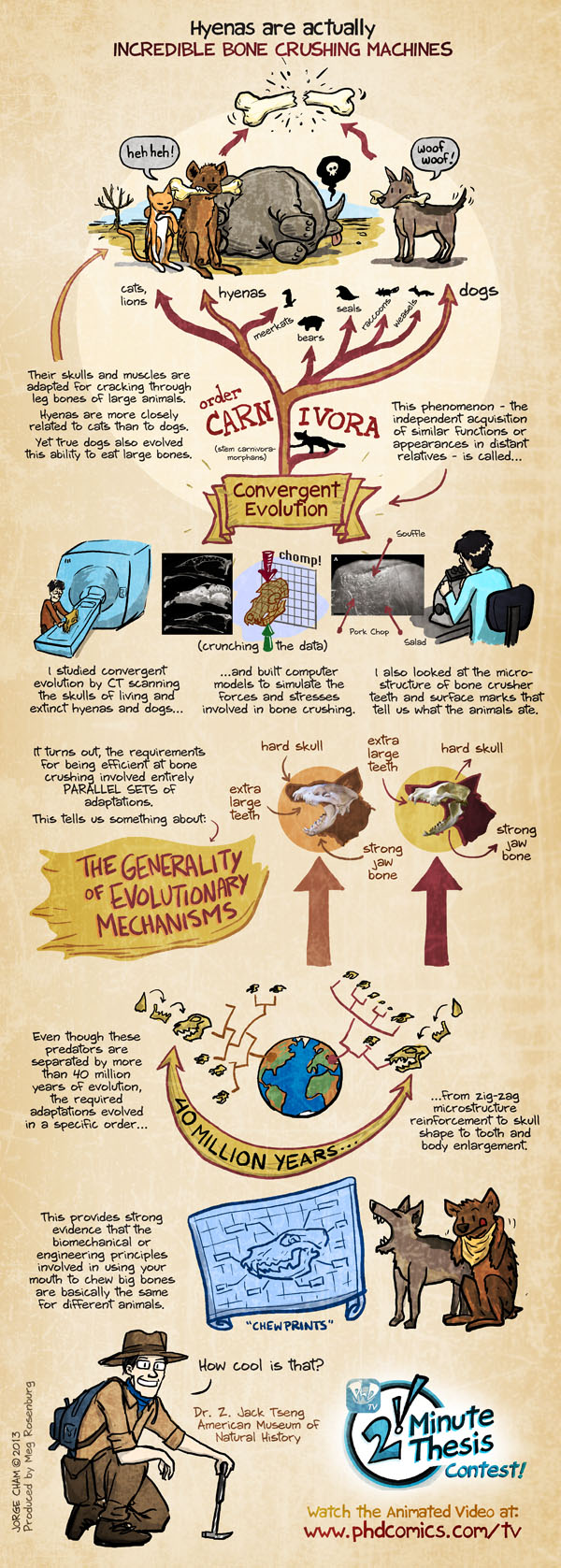
Here is a wonderful website dedicated to the phenomena of convergent evolution.
Map of Life: Convergent evolution online
What is evolutionary convergence? Here
There are some fascinating examples e.g. Independent eye movement in fish, chameleons and frogmouths
Have fun .
.
Map of Life: Convergent evolution online
The purpose of the Map of Life is to document diverse examples of evolutionary convergence from throughout the living world, based on information from peer-reviewed journals and other scientific literature. Each example of convergence is connected by an array of links to other related topics, creating an extensively cross-referenced database. Moving around the pages of the site allows you to effectively explore the fascinating nature of convergent evolution and what it tells us about predictability in biological systems.
The name ‘Map of Life’ reflects the way that evolution has repeatedly arrived at, or converged upon, the same adaptive solutions from more or less unrelated starting points, as though evolutionary trajectories were following a metaphorical ‘map’ to the same destination.
What is evolutionary convergence? Here
Evolutionary convergence occurs when unrelated organisms evolve similar adaptations to similar environmental or selective pressures, arriving there by very different routes. Here is a famous example. As you look out onto the world you do so through what we call a camera-eye, with a lens suspended between two fluid-filled chambers. Perhaps surprisingly, the octopus also has a remarkably similar camera-eye (as do squid and cuttlefish), yet we know that the octopus belongs to an invertebrate group called the cephalopod molluscs, evolutionarily very distant from the vertebrates (or speaking more widely the chordates), to which of course we belong. Our knowledge of animal relationships tells us that neither the common ancestor of molluscs nor chordates could possibly have possessed a camera-eye, so quite clearly they have evolved independently; the same solution has been arrived at by completely different routes.
The Map of Life documents many more examples of convergence for you to explore, and in fact in the case of the camera-eye alone there is much more to be said. The camera-eye has actually evolved at least seven times, most extraordinarily in a group of jellyfish known as the box-jellies (or cubozoans). Although these jellyfish have a nervous system, they don’t have a brain, and furthermore they belong to a phylum known as cnidarians, widely agreed to be amongst the most primitive of animals.
There are some fascinating examples e.g. Independent eye movement in fish, chameleons and frogmouths
Have fun
.