Curiosity rover

Binary_Bark

Forging
Joined
Feb 24, 2016
Messages
41,646
Reaction score
23,552
Location
Midgard
If you could travel back in time 3.5 billion years, what would Mars look like? The picture is evolving among scientists working with NASA's Curiosity rover.

Imagine ponds dotting the floor of Gale Crater, the 100-mile-wide (150-kilometer-wide) ancient basin that Curiosity is exploring. Streams might have laced the crater's walls, running toward its base. Watch history in fast forward, and you'd see these waterways overflow then dry up, a cycle that probably repeated itself numerous times over millions of years.

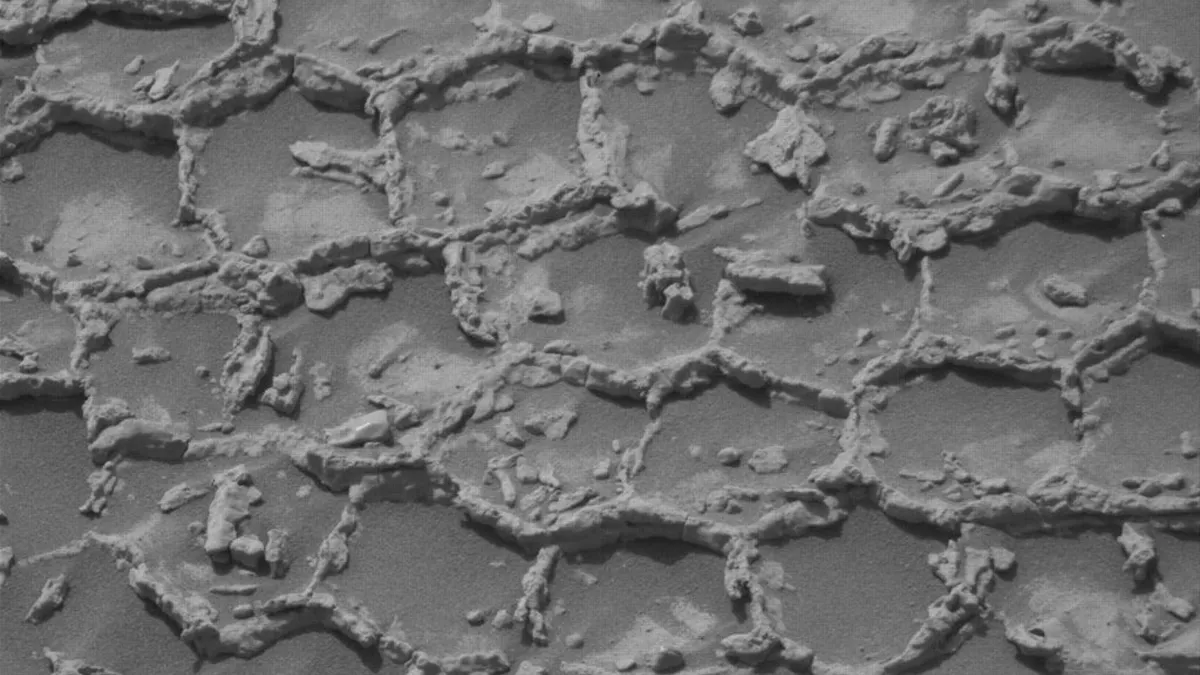
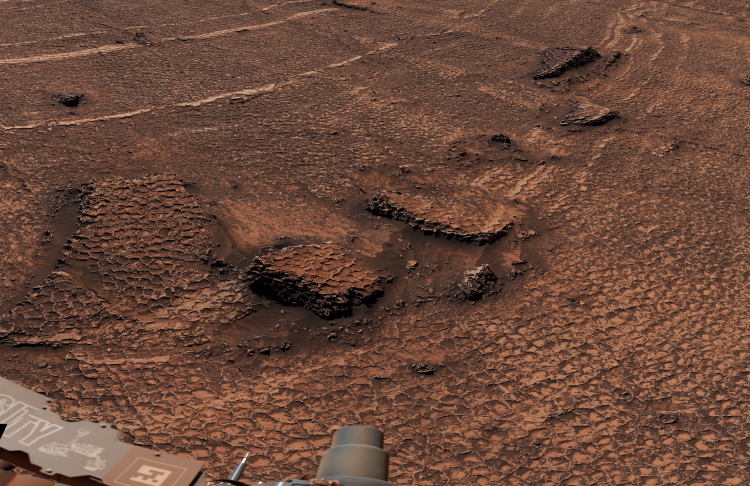
That is the landscape described by Curiosity scientists in a Nature Geoscience paper published today. The authors interpret rocks enriched in mineral salts discovered by the rover as evidence of shallow briny ponds that went through episodes of overflow and drying. The deposits serve as a watermark created by climate fluctuations as the Martian environment transitioned from a wetter one to the freezing desert it is today.

More At: https://phys.org/news/2019-10-curiosity-rover-ancient-oasis-mars.html
 
  • Like
Reactions: 3WA
Had no idea the rover was still on the move. Very nice find.

What's next, lifeforms found in rocks?
 

Curiosity rover discovers new evidence Mars once had 'right conditions' for life​

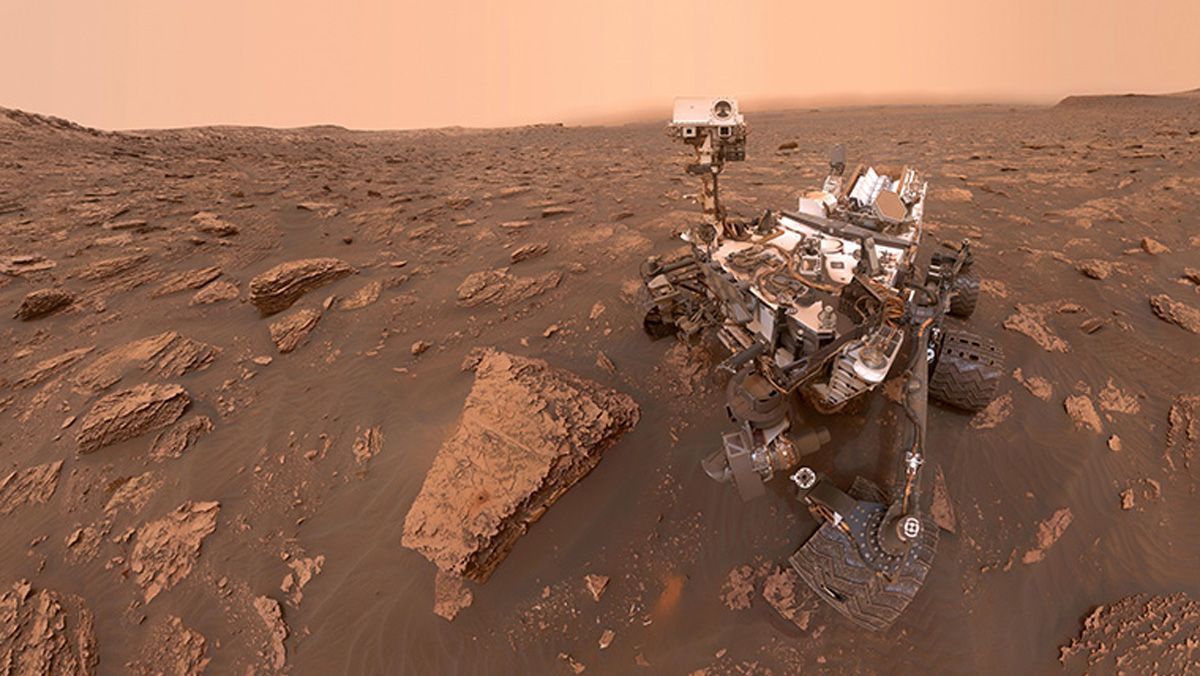
a wheeled robot with a camera on a stalk rolls around in red dirt

NASA's Curiosity rover on Mars. (Image credit: NASA)


Thanks to a combination of images from NASA's Curiosity rover, scans of sedimentary rock beneath the Gulf of Mexico on Earth and computer simulations, geologists have identified the ancient, eroded remnants of rivers in a number of craters on Mars.
A team of researchers examining data collected by NASA's Curiosity rover at Gale crater, a large impact basin on the Martian surface, discovered further evidence that rivers once flowed across the Red Planet, perhaps more widespread than was previously thought. "We're finding evidence that Mars was likely a planet of rivers," said geoscientist Benjamin Cardenas of Penn State University and lead author of the research in a statement.


Curiosity rover captures colourful clouds drifting over Mars​


Red-and-green-tinted clouds drift through the Martian sky in a new set of images captured by NASA's Curiosity rover using its Mastcam—its main set of "eyes." Taken over 16 minutes on Jan. 17 (the 4,426th Martian day, or sol, of Curiosity's mission), the images show the latest observations of what are called noctilucent (Latin for "night shining"), or twilight clouds, tinged with colour by scattering light from the setting sun.

Sometimes these clouds even create a rainbow of colours, producing iridescent, or "mother-of-pearl" clouds. Too faint to be seen in daylight, they're only visible when the clouds are especially high and evening has fallen.


Curiosity Mars rover discovers largest organic molecules ever seen on Red Planet.​


Scientists have announced the discovery of the largest organic molecules ever found on Mars.

These molecules could have come from the breakdown of fatty acids that existed 3.7 billion years ago before being preserved in sediments laid down by an ancient lake on the Red Planet. While molecules don't exactly prove the existence of past life on Mars, scientists say that they show that such a discovery might indeed be possible.


"Our study proves that, even today, by analyzing Mars samples we could detect chemical signatures of past life, if it ever existed on Mars," said Caroline Freissinet, an astrochemist from the Laboratoire Atmosphères et Observations Spatiales in Guyancourt, France, in a statement.


Long-chain Hydrocarbons Found on Mars​


The search for evidence of life on Mars just got a little more interesting with the discovery of large organic molecules in a rock sample. The Mars Curiosity Rover, which is digging in the Martian rock beds as it goes along, tested pieces of its haul and found interesting organic compounds inside them.

To be specific, the sample contains three molecules called decane, undecane, and dodecane. They're carbon-rich molecules and look like fragments of fatty acids - which are part of the chemical recipe for life. Not only might these molecules indicate some interesting chemical mixing on ancient Mars, but their existence may also help fill in the history of Yellowknife Bay in Gale Crater on Mars. That's where the sampled rocks containing these fragments were found.


Curiosity Take Its Closest Look Yet At Martian Spiderwebs​


In this age of Mars rovers, questions about the planet's ancient past have shifted. A growing body of evidence supports the idea that Mars was once warm and wet. Now researchers are focused on the timeline of the red planet's watery past. Research efforts all come down to the ultimate question regarding the planet: Did it ever host life?

Powerful orbital cameras like NASA's HiRISE and the ESA's High Resolution Stereo Camera have documented numerous Martian surface features that indicate the ancient presence of water. There are sedimentary river deltas, dry river beds, and other landscape features that would be anomalies on a world that had never seen surface water.


Mars rover detects never-before-seen organic compounds in new experiment​


NASA's Curiosity Mars rover has uncovered a diverse mix of organic molecules on Mars, including chemicals widely considered building blocks for the origin of life on Earth.

The findings, which come from a chemical experiment performed for the first time on another world, reveal that the Martian surface can preserve the kinds of molecules that could serve as signs of ancient life. However, this experiment cannot distinguish between organic compounds from potential past life on Mars and those formed through geologic processes or delivered by meteorites.

 
Top
Sign up to the MyBroadband newsletter
X