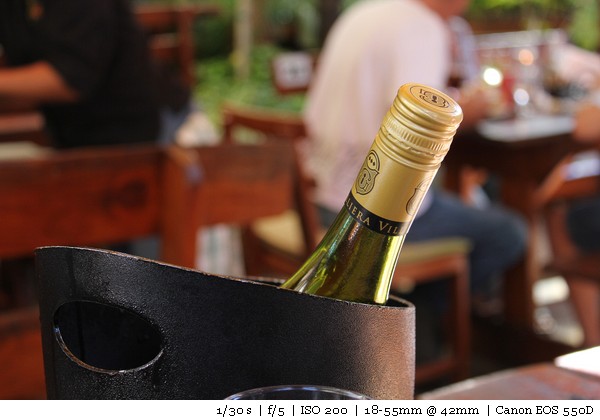
Depth of Field

Dolby

Honorary Master
Joined
Jan 31, 2005
Messages
39,237
Reaction score
6,204
How do I get DOF? :/

I've read low F stop (is that low or high aperature) so I can choose F2.8 - but everything still looks clear! One way I have managed to telephoto, portrait mode and a far away background - but what if I'd like to blur out bushes that are close by?

Weakness of a bridge?
 
Weakness of a bridge?

Yes. Get a real camera. OK, just kidding - I was just saying that to annoy Roux ;) I assume you're looking for shallow DOF. Four things influence this:

1. Aperture
2. Size of the focus plane
3. Focal length of the lens
4. Focus distance.

It works like this - a larger aperture (i.e. smaller number) will give you shallower depth of field, if everything else is equal

If you have two cameras, one with a large sensor, and one with a small sensor, and you give them the same aperture, and take the same picture, the camera with the larger sensor wil give you shallower depth of field.

If you focus on something that is 1 meter away, with a 200mm lens, you will get much shaller depth of field than if you do the same with a 50mm lens (same camera, same aperture, same focus distance)

And lastly, if you take the above example, and move your subject half a meter closer, you will get shallower depth of field on both setups (assuming you can focus that close)

So with your bridge, you might get shallower DOF if you soom in all the way at f/8 than you would if you zoom out all the way at f/2.8. With wide angle lenses the DOF is naturally much larger. For example, with my 10-20mm lens on the 50D, at 10mm and f/5.6 I only need to focus about a meter away and everything benhind it will be in focus.

Now you can't change the size of the sensor in your camera, but you can experiment with the other factors - combine them and see what happens.
 
koffiejunkie has given the most concise explanation that I've ever seen. The only thing he left out is the last resort: Gaussian blur filter in photoshop :D
 
Thanks K :)

I didn't realise the sensor has much to do with it - which gives me another reason for dSLR one day ;)
 
Thanks K :)

I didn't realise the sensor has much to do with it - which gives me another reason for dSLR one day ;)

It's all about the sensor :) No not really, but yeah, it plays a massive role. The reason for this is that the light coming out of a curved lens, is, well, curved. If you take a curved object (think of, say, a banana) and try to align it to a straight object, only a little bit of the two are going to line up. That's more or less the effect. The longer the both are, the smaller the in focus bit is in relation. The wider the rounded bit becomes (the DOF), the more of the straight bit will fit in it, until the entire thing does. Does that make sense?

For interest's sake, if you want some really narrow DOF, get yourself an old medium or large format camera :)
 
Burn holes? ;) Sorry yeah, that explanation works better with pictures...

Actually a bit of banana smeared on the front element could give you some bokeh. Could remove some scratches too if the DVD fix is to believed.

Anyways my wife just walked off eating the banana. :p
 
Ia this a decent size sensor for creating a shallow depth of field?

22.3 x 14.9mm CMOS

It's the sensor on the 550D
 
Dolby, you do not need a posh camera to manipulate depth of field. What you need is a basic understanding of how it works. When you have that, you will be able to achieve DOF with ANY camera - even a cheap point and shoot.
I suggest you read the Wikipedia page first to get some basic info. Then, using whatever camera you have, put your camera on a tripod and put something like a pen near you lens. Take 10 shots of it, but change the DOF for every shot. Look at the results and learn from them.

Learning DOF is only possible when you understyand the basic theory, which is quite simple, but then ALL the real pro's suggest that you practice it until you get it right.

Hope this helps.
 
What Plazma said. First get down the basics. If you can control your aperture, you can do it. Get familiar with it first and get to know what your camera can do. I can make shallow DOF on my G9.
 
If you have a point and click camera like me
use the magic wand to select the focal point
invert selection
blur
 
This was shot with my Canon 400D with a 50mm f1.8 lens @ f2.0
4515061697_8909399a63.jpg


I just know that when it comes to the DOF between a P&S and a dSLR, its much easier to get the shallow DOF with any dSLR than a P&S. It's still possible to get some shallow DOF with your bridge camera but you'll need to work the zoom a bit. I may be mistaken here but I think if you want to get a shallow DOF and have the space behind you, you can back up a bit and use the zoom. Maybe Koffijunkie or anyone else can correct me if I'm wrong.
 
Ia this a decent size sensor for creating a shallow depth of field?

22.3 x 14.9mm CMOS

It's the sensor on the 550D

As a new convert from P&S (Canon S5) to DSLR (Canon 550D) I can tell you it's much easier to obtain shallow DOF. As previous posters said, the principles involved are the same - but the larger sensor makes a huge difference.

Wiki -

The greater DOF with the smaller format can be either an advantage or a disadvantage, depending on the desired effect. For the same amount of foreground and background blur, a small-format camera requires a smaller f-number and allows a shorter exposure time than a large-format camera; however, many point-and-shoot digital cameras cannot provide a very shallow DOF. For example, a point-and-shoot digital camera with a 1/1.8″ sensor (7.18 mm × 5.32 mm) at a normal focal length and f/2.8 has the same DOF as a 35 mm camera with a normal lens at f/13.


A few recent examples -

IMG_1858_2.jpg

2010-04-01_014.jpg

2010-03-31_025.jpg


/noob disclaimer applies :)
 
Buyers remorse?

Not at all. I planned to get a dSLR as well - the main question was which came first.

I think there are pros & cons of each. I've chatted to a few photographers and they have a bridge and a dSLR. Check my flickr (only a few pictures loaded) http://www.flickr.com/photos/dolby2000/ and see what I've managed with a P&S. I probably wouldn't be able to capture half those shots with a dSLR of R6,500.00 - as I'd be stuck with a short, little lens.

My major con (that I've discovered so far) is a small sensor - so it's more difficult to blur and also high noise about ISO 400. But at the price, I have a a decent lens (think faster than the entry level lens with a dSLR?) with a very decent zoom.

The only dSLR I could have bought (1000D) has the larger sensor, but the same mexapixel, older image processor, smaller/slower lens (standard) and slower continuous shooting. If I could have afforded more than the price, then maybe you have a point ;)
 
Last edited:
Top
Sign up to the MyBroadband newsletter
X