Eskom issues tender for green hydrogen project builder

Hanno Labuschagne

Journalist
Staff member
Joined
Sep 2, 2019
Messages
6,513
Reaction score
4,791
Eskom issues tender for green hydrogen project builder

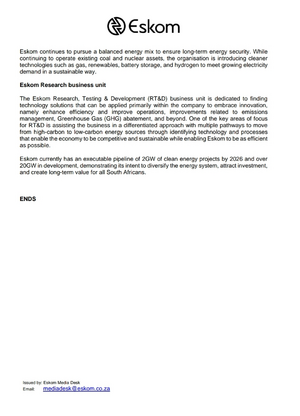
Eskom has issued an invitation for companies to tender for the construction of a pilot renewable green hydrogen facility (RHF) at its Johannesburg Research, Testing and Development (RT&D) unit.

The power utility said that developing renewable green hydrogen production capacity was a key priority for achieving net-zero carbon emissions by 2050 in South Africa.
 
What will they do with this hydrogen?
fertilizer, ammonia, steel and cement production. Its great way to utilize excess/cheap power and create value out of it. I'm also willing to bet they can use it in their peaker plants instead of diesel.
 
fertilizer, ammonia, steel and cement production. Its great way to utilize excess/cheap power and create value out of it. I'm also willing to bet they can use it in their peaker plants instead of diesel.
Do these production entities exist in South Africa? They should make this hydrogen plant next to the peaker plants then or are they going to turn it into liquid at their R-D jhb office and then truck it to western cape?
 
Do these production entities exist in South Africa? They should make this hydrogen plant next to the peaker plants then or are they going to turn it into liquid at their R-D jhb office and then truck it to western cape?
These are R&D facilities, so this would be a proof of concept plant. They are building it next to 400kw solar, which isn't enough power to do anything meaningful.

We have massive cement and fertilizer plants. We used to have a lot of steel, not so sure about that anymore. These processes are incredibly dirty with the amount of co2 released during production.

Ammonia is also interesting because it can be used as an energy/hydrogen source and it is way easier to handle/store than hydrogen itself.
 
These are R&D facilities, so this would be a proof of concept plant. They are building it next to 400kw solar, which isn't enough power to do anything meaningful.

We have massive cement and fertilizer plants. We used to have a lot of steel, not so sure about that anymore. These processes are incredibly dirty with the amount of co2 released during production.

Ammonia is also interesting because it can be used as an energy/hydrogen source and it is way easier to handle/store than hydrogen itself.
I mean, what are they going to do with the hydrogen from the R&D facility?

Are our current production facilities compatible with hydrogen? Knowing hydrogen, facilities would need to be retrofitted/upgraded first imho.
 
These are R&D facilities, so this would be a proof of concept plant. They are building it next to 400kw solar, which isn't enough power to do anything meaningful.

We have massive cement and fertilizer plants. We used to have a lot of steel, not so sure about that anymore. These processes are incredibly dirty with the amount of co2 released during production.

Ammonia is also interesting because it can be used as an energy/hydrogen source and it is way easier to handle/store than hydrogen itself.
I mean, what are they going to do with the hydrogen from the R&D facility?

Are our current production facilities compatible with hydrogen? Knowing hydrogen, facilities would need to be retrofitted/upgraded first imho.
Don't think they'll produce much hydrogen, it's more the research.
EU plans for steel emissions reduction (China is set to have 10% of its steel use hydrogen in 2025, aim for 20% in 2030):

Then for fertilizer:
With lots of German research:
The first bit:
Hydrogen can be produced by splitting water (H2O) into hydrogen (H2) and oxygen (O2) using electrical energy. To make this process sustainable, the energy should come from renewable sources. "This can only be done in a country where there is plenty of space for wind power and lots of sun for photovoltaics, for example in Namibia," explains Wolfgang Schuhmann. In order to build an economy based on hydrogen in Germany, it must therefore be imported from distant countries. The crux of the matter is that a lot of energy is needed to liquefy hydrogen for transport, as it only becomes liquid at extremely low temperatures of minus 253 degrees Celsius or high pressures.


Ammonia is easier to transport than hydrogen


Alternative concepts therefore envisage converting hydrogen into ammonia at the production site, as this becomes liquid at minus 33 degrees Celsius. It also has a higher energy density. "A tanker full of liquid ammonia would transport around 2.5 times more energy than a tanker full of liquid hydrogen," explains Schuhmann. Finally, ammonia would have to be converted back into hydrogen at the point of use. This is usually done using the reverse Haber-Bosch reaction, in which ammonia (NH3) is converted into nitrogen (N2) and hydrogen (H2). Of the two products, however, only the hydrogen can be utilized profitably.


Double the hydrogen yield
Research into it will be interesting, but tbh, don't think Eskom can contribute that much to it, worried this is more a tender/news thing since Bush started with the green hydrogen stuff.

Most of "green" hydrogen is just hype, it will never be useful for storage vs battery/salt alternatives imho, its interest is more the steel/fertilizer alternative, and South Africa at least used to be a steel giant with ArcelorMittal, but lots of that is closing down.
 
Last edited:
Don't think they'll produce much hydrogen, it's more the research.
EU plans for steel emissions reduction (China is set to have 10% of its steel use hydrogen in 2025, aim for 20% in 2030):

Then for fertilizer:
With lots of German research:
The first bit:

Research into it will be interesting, but tbh, don't think Eskom can contribute that much to it, worried this is more a tender/news thing since Bush started with the green hydrogen stuff.

Most of "green" hydrogen is just hype, it will never be useful for storage vs battery/salt alternatives imho, its interest is more the steel/fertilizer alternative, and South Africa at least used to be a steel giant with ArcelorMittal, but lots of that is closing down.

Its probably closer to this:
(Hydrogen part is at about 18 mins but the entire video is fascinating)

 
Use it as a battery.

When you have excess power (solar/wind etc) then you use that power to convert water into hydrogen and oxygen.
Then when you need power you use the Hydrogen to generate power.
I understand all that. Where is this power generation at R&D JHB? Will they truck it down to the peaker plants in WC?
1748002980524.png
 
Top
Sign up to the MyBroadband newsletter
X