N0ddy;5049835 said:
i hope-pray it slows them down in the race.. then at least the beloved reds can be at ease to try for that win...
not until they figure this party trick:
Ferrari experimenting with new non-linear suspension settings amid qualifying and race pace:
https://scuderiafans.com/ferrari-ex...nsion-settings-amid-qualifying-and-race-pace/
"... The most popular question about the SF-23 concerns the performance difference between qualifying and race, which in Azerbaijan appeared to be undoubtedly lower. The park ferme rules prohibit mechanics from intervening in the setup of the car after qualifying. Only small aerodynamic adjustments related to the downforce that can be developed on the front are available to balance, if necessary, the load between the two axes. The only parameter that changes, therefore, is the fuel load.
Ferrari has tried different approaches, even changing the supplier of some mechanical parts at the rear. However, this measure did not solve the problem. This is a headache shared with Mercedes, which, through James Allison, made known some modifications to these internal elements that the Brackley team would have implemented during the spring break.
The purpose, in fact, was precisely to vary their behavior at different loads. This path was also taken by the Italian team, which, through this setting choice combined with a targeted study of the setup produced by many hours of work spent in the simulator, managed to decrease the performance delta between the fast lap and the long run.
Before proceeding with the analysis and arriving at certain conclusions, it is worth clarifying some concepts. In general, asserting with certainty that the SF-23 should always run with a “rigid” suspension setup is quite simplistic and does not reflect absolute truth. If this were the only issue limiting the red car in the administration of the compounds and, consequently, in the management of the race pace, such a scenario would also negatively affect the performance in qualifying, which, on the contrary, is very good.
Undoubtedly, the high fuel setup has created quite a few problems for the Maranello team, as the 2023 F1 Ferrari car is very sensitive in this regard, degrading the tires quite a bit. However, by carefully observing the Ferrari steering wheel dashboard through on-board cameras, along with the comments from drivers and engineers, we can say that this phenomenon mainly occurred during acceleration in the central sector of the Baku city circuit.
As a result, the temperature on the rear axle rose, forcing the red car’s drivers to continuously work on “saving” the tires to return to the correct operating window. Therefore, we are talking about thermal degradation due to a lack of grip rather than physical wear determined solely by the suspension setup.
There is a search for the “secret” of Red Bull in managing the tires, mentioning anti-dive and anti-squat suspensions, a topic still not very clear to most people. Contrary to what one might think, in fact, this factor does not bring significant advantages in managing Pirelli tires; on the contrary, exacerbating this concept would mean reducing load transfer, lowering the car’s grip.
What is undoubtedly giving the two RB19s an extra edge is the study of vehicle dynamics, through a truly prepared team that has long been able to make a clear difference in terms of performance. This seems to be the real strength, not just the ability to manage the transition from qualifying to the race.
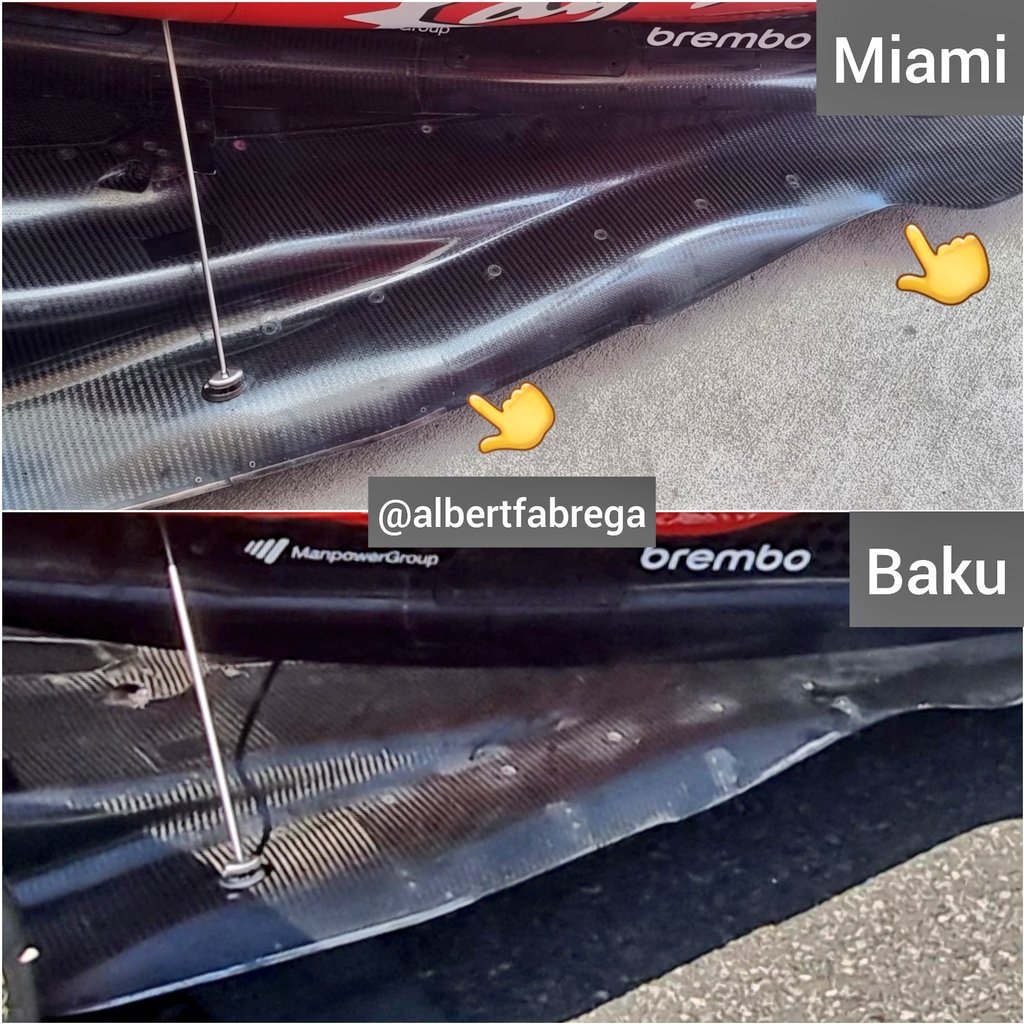
Returning to Scuderia Ferrari, with 100 kg of fuel on board, the non-linear response of the suspension systems is different, a factor that has the ability to determine different heights outside the optimal range specified in the project. Obviously, in high fuel configuration, the internal components work with greater loads than in the qualifying session.
The problem, therefore, must be sought in the non-linear reactions of individual elements. With a higher imposed load, the suspension response is not what is desired, and therefore the floor position does not remain within the range estimated by the project. To this must be added the endemic lack of vertical thrust, accentuated by the need to further unload the car to limit the speed gap that the SF-23 suffers from compared to the Red Bull, a super-efficient car at the aerodynamic level.
In conclusion, to summarize what has been said, Ferrari is working hard to change the internal response of the suspension elements, whose tasks are of crucial importance in determining the floor’s kinematics. The ultimate goal is to obtain a more stable position of the floor during driving and, consequently, generate the right amount of vertical thrust that can reduce tire degradation, reducing the performance delta between qualifying and the race."