-
- News
-
Categories
- 5G
- ADSL
- AI
- Banking
- Black Friday
- Broadband
- Broadcasting
- Business
- Business Telecoms
- Cellular
- Cloud and Hosting
- Columns
- Cryptocurrency
- Energy
- Enterprise
- Fibre
- Gadgets
- Gaming
- Government
- Hardware
- Industry News
- Internet
- Internet of Things
- Investing
- IT Services
- Motoring
- Reviews
- Science
- Security
- Smartphones
- Software
- Technology
- Telecoms
- Trending
- Wireless
- Press Office
- Forum
- Industry News
- What's Next
- Company hub
- Speed Test
- About us
- Advertise with us
- Contact
- Careers


-
Join the MyBroadband community
South Africa’s biggest forum. Discuss, discover, and connect with thousands of members.
-
Question of the Day: How do you normally pay for purchases in stores?

- Forums
- General discussions
- Motoring and Transportation: Cars, Bikes and Plane
- General Motoring News and Reviews
You are using an out of date browser. It may not display this or other websites correctly.
You should upgrade or use an alternative browser.
You should upgrade or use an alternative browser.
Ferrari F80
- Thread starter FiestaST
- Start date


FiestaST
Honorary Master
FiestaST
Honorary Master
FiestaST
Honorary Master
Carwow first look at the F80
justplain
Expert Member
I am not wowed. I thought I'd want one. I dont?
The interior looks a little too bland to me.
Sure it'll be mental fast, obviously, it just doesnt seem like somewhere I WANT to sit.
Still a haptic start button? Thats a fail in my opinion.
We've got the Macca, and the Fezza, now we wait for the Porschie.
The interior looks a little too bland to me.
Sure it'll be mental fast, obviously, it just doesnt seem like somewhere I WANT to sit.
Still a haptic start button? Thats a fail in my opinion.
We've got the Macca, and the Fezza, now we wait for the Porschie.
FiestaST
Honorary Master
evo India first look at the F80
FiestaST
Honorary Master
Ferrari F80 Unveiled as (895 kW!) V6 Successor to the LaFerrari
The successor to iconic Ferraris, such as the F40 and LaFerrari, the Prancing Horse brand has unveiled the F80, the most powerful road car ever produced by the Italian firm.
Signifying a new chapter in Ferrari’s illustrious history, the Maranello marque has whipped the wraps off the F80, the new pinnacle Prancing Horse in the firm’s portfolio. Only 799 examples will be made.
The F80’s petrol-electric configuration comprises a 3.0-litre turbocharged V6 and a trio of electric motors — two of which are fixed to the front axle, with a single unit sited at the rear — coupled with a 860 V, 2.28 kWh battery pack. The petrol engine is endowed with 671 kW (available from 8 750 r/min) and 850 N.m (on tap as soon as the rev needle edges the 5550 r/min marker). The fore and aft electric motors produce 105 kW/121 N.m and 70 kW/45 N.m, respectively. The result? A combined peak power output of an immense 895 kW, sent to all four corners via an eight-speed dual-clutch gearbox.

 www.carmag.co.za
The successor to iconic Ferraris, such as the F40 and LaFerrari, the Prancing Horse brand has unveiled the F80, the most powerful road car ever produced by the Italian firm.
Signifying a new chapter in Ferrari’s illustrious history, the Maranello marque has whipped the wraps off the F80, the new pinnacle Prancing Horse in the firm’s portfolio. Only 799 examples will be made.
The F80’s petrol-electric configuration comprises a 3.0-litre turbocharged V6 and a trio of electric motors — two of which are fixed to the front axle, with a single unit sited at the rear — coupled with a 860 V, 2.28 kWh battery pack. The petrol engine is endowed with 671 kW (available from 8 750 r/min) and 850 N.m (on tap as soon as the rev needle edges the 5550 r/min marker). The fore and aft electric motors produce 105 kW/121 N.m and 70 kW/45 N.m, respectively. The result? A combined peak power output of an immense 895 kW, sent to all four corners via an eight-speed dual-clutch gearbox.
Ferrari F80 Unveiled as (895 kW!) V6 Successor to the LaFerrari
Here it is; the Pinnacle Prancing Horse. Ferrari's F80 debuts as the spiritual successor of the F40 and a potent replacement for the LaFerrari.
www.carmag.co.za
FiestaST
Honorary Master
The LaFerrari successor is here: meet the 1,183bhp, V6 hybrid Ferrari F80
Out goes the V12, in comes a twin-turbo V6... and a triplet of electric motors. Maranello’s latest is a downforce-obsessed 4WD hypercar
How the hell do you follow a 40-year bloodline that’s a rollcall of hypercar royalty? 288 GTO, F40, F50, Enzo, LaFerrari… and now F80. Yep, Ferrari bosses completely ignored Top Gear’s hypercar name generator, and went with something sensible instead. It’s a name that celebrates the company’s 80th anniversary, occurring in 2027, by which time they’ll be pumping out these £3.1m hypercars to the 799 lucky owners who got the nod.
It is motivated not by a soaring naturally-aspirated V12 like the LaF, but by a twin-turbo V6 hybrid powertrain, which is a bit disappointing, but the rationale is clear: this 120-degree 3.0-litre V6 is a heavily-modified version of the one that took the 499P to back to back wins at the Le Mans 24hrs. It’s the configuration also used in F1. Boxes ticked. It’s also more compact, power dense and lighter than a V12 and thanks to a pair of e-turbos (bigger blowers for more power at higher revs, but with electric motors to spool them up instantly) produces 888bhp on its own – that’s 234bhp more than the 296 GTB’s V6, despite weighing the same.
The other 295bhp – for a total of 1,183bhp, making it the most potent Ferrari road car ever - comes from a trio of electric motors designed, engineered and built in house. Two live on the front axle (meaning this is 4WD while the freshly minted and even more powerful McLaren W1 is RWD) and the third is bolted to the bottom of the engine and can deliver 70kW to the battery in regen mode, or an extra 80bhp of forward thrust. The 800V battery is a 2.3kWh unit tucked behind the seats, infused with F1 tech for rapid charging and discharging – there’s no electric-only mode here. In fact, whilst gawping at the rolling chassis we counted no fewer than 13 e-motors – two more on the 48V e-turbos, one at each corner for the 48V active suspension and four more 12V units in the wing to enable all that lift and tilt.
Out goes the V12, in comes a twin-turbo V6... and a triplet of electric motors. Maranello’s latest is a downforce-obsessed 4WD hypercar
How the hell do you follow a 40-year bloodline that’s a rollcall of hypercar royalty? 288 GTO, F40, F50, Enzo, LaFerrari… and now F80. Yep, Ferrari bosses completely ignored Top Gear’s hypercar name generator, and went with something sensible instead. It’s a name that celebrates the company’s 80th anniversary, occurring in 2027, by which time they’ll be pumping out these £3.1m hypercars to the 799 lucky owners who got the nod.
It is motivated not by a soaring naturally-aspirated V12 like the LaF, but by a twin-turbo V6 hybrid powertrain, which is a bit disappointing, but the rationale is clear: this 120-degree 3.0-litre V6 is a heavily-modified version of the one that took the 499P to back to back wins at the Le Mans 24hrs. It’s the configuration also used in F1. Boxes ticked. It’s also more compact, power dense and lighter than a V12 and thanks to a pair of e-turbos (bigger blowers for more power at higher revs, but with electric motors to spool them up instantly) produces 888bhp on its own – that’s 234bhp more than the 296 GTB’s V6, despite weighing the same.
The other 295bhp – for a total of 1,183bhp, making it the most potent Ferrari road car ever - comes from a trio of electric motors designed, engineered and built in house. Two live on the front axle (meaning this is 4WD while the freshly minted and even more powerful McLaren W1 is RWD) and the third is bolted to the bottom of the engine and can deliver 70kW to the battery in regen mode, or an extra 80bhp of forward thrust. The 800V battery is a 2.3kWh unit tucked behind the seats, infused with F1 tech for rapid charging and discharging – there’s no electric-only mode here. In fact, whilst gawping at the rolling chassis we counted no fewer than 13 e-motors – two more on the 48V e-turbos, one at each corner for the 48V active suspension and four more 12V units in the wing to enable all that lift and tilt.
FiestaST
Honorary Master
Here's how the stunning new Ferrari F80 moves the game on from LaFerrari
The first AWD entry into Ferrari's hypercar annals is a complex, hugely powerful machine - we decipher it here
Welcome to the most powerful Ferrari road car ever built. A car that entirely ignores TopGear.com's expert name generator and goes for something traditional. Something with history. Something punchy.
Speaking of which, the new F80 - great name - comes out swinging not with a gloriously high-revving naturally-aspirated V12, but a blown V6, infusing this road-going LMP1-lookalike with F1 levels of tech. There are three electric motors. There is a literal tonne of downforce. And there is speed.
How then, does this new F80 move the game on from the peerless LaFerrari? Over to Top Gear's Jack Rix for the full deep dive...
The first AWD entry into Ferrari's hypercar annals is a complex, hugely powerful machine - we decipher it here
Welcome to the most powerful Ferrari road car ever built. A car that entirely ignores TopGear.com's expert name generator and goes for something traditional. Something with history. Something punchy.
Speaking of which, the new F80 - great name - comes out swinging not with a gloriously high-revving naturally-aspirated V12, but a blown V6, infusing this road-going LMP1-lookalike with F1 levels of tech. There are three electric motors. There is a literal tonne of downforce. And there is speed.
How then, does this new F80 move the game on from the peerless LaFerrari? Over to Top Gear's Jack Rix for the full deep dive...
FiestaST
Honorary Master
FiestaST
Honorary Master
Ferrari F80 Is A $4 Million Race Car Built For The Road
Ferrari's latest hypercar features technology pulled from its Le Mans and F1-winning machinery
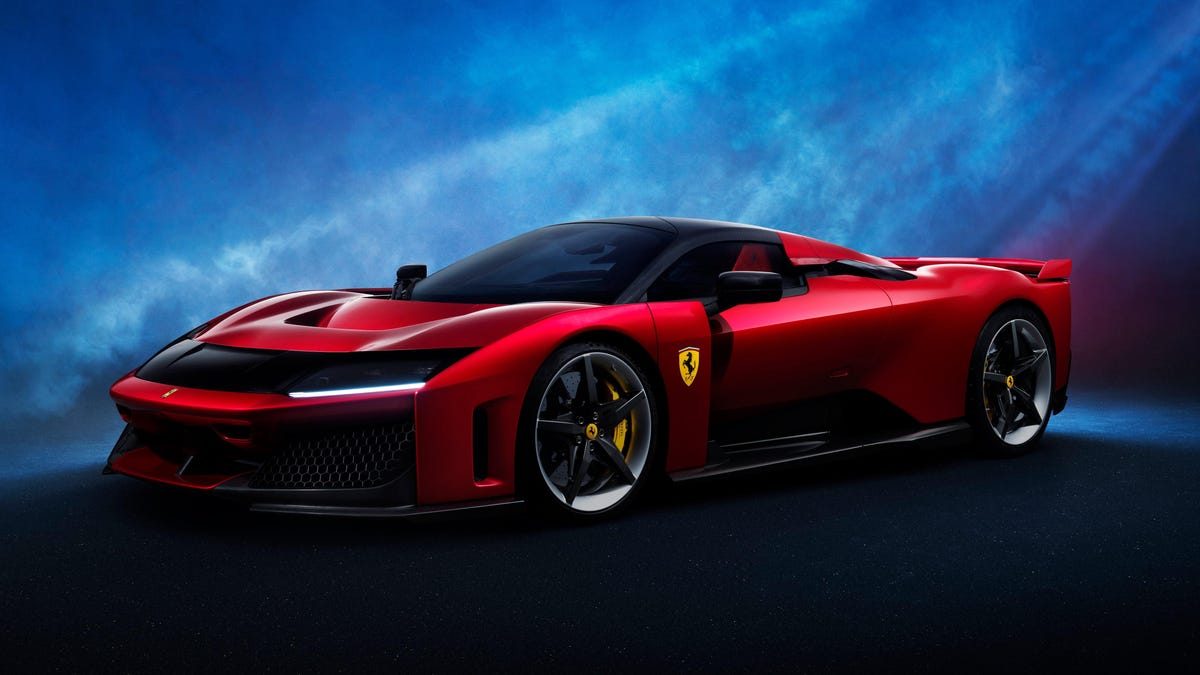
Ferrari pulled the covers off its latest hypercar, the Ferrari F80, this past Thursday. The F80 leverages the Italian brand’s racing pedigree at Le Mans and in Formula 1 to put cutting-edge performance in the hands of a privileged few. While the $4 million sticker price is eye-watering, the F80 doesn’t qualify for superlatives in any particular metric. The main selling point is the badge and the passion associated with it. Ferrari plans on only producing 799 F80s.
The F80 is powered by a hybrid three-liter V6 engine, a scaled-up version of the configuration familiar to F1 fans. The hypercar even utilizes the same energy recovery technology from its Grand Prix machinery. The F80's power unit produces an impressive 1,183 horsepower, with 887 hp from combustion and 297 hp from electric power.
Continuing the F1-inspired trend, the F80's asymmetric chassis is constructed from the same carbon fiber as Ferrari’s racing cars. The machine has a dry weight of 3362 pounds. The interior also hints that the hypercar was initially intended to be a truly single-seater before a passenger seat was added. Gianmaria Fulgenzi, Ferrari’s chief product development officer, told Wired:
“We are at the pinnacle. Thanks to the integration and software, we are able to push the boundaries, to create a new red line, you could say. The aerodynamics, the control of the slip angles, the acceleration… it’s a car you can push to the limit. To your personal limits. You can feel everything that’s going on immediately. The software is playing a key role, but you don’t perceive it. Instead you feel like you’ve been driving the car for a long time. It becomes part of you.”
 jalopnik.com
Ferrari's latest hypercar features technology pulled from its Le Mans and F1-winning machinery
Ferrari pulled the covers off its latest hypercar, the Ferrari F80, this past Thursday. The F80 leverages the Italian brand’s racing pedigree at Le Mans and in Formula 1 to put cutting-edge performance in the hands of a privileged few. While the $4 million sticker price is eye-watering, the F80 doesn’t qualify for superlatives in any particular metric. The main selling point is the badge and the passion associated with it. Ferrari plans on only producing 799 F80s.
The F80 is powered by a hybrid three-liter V6 engine, a scaled-up version of the configuration familiar to F1 fans. The hypercar even utilizes the same energy recovery technology from its Grand Prix machinery. The F80's power unit produces an impressive 1,183 horsepower, with 887 hp from combustion and 297 hp from electric power.
Continuing the F1-inspired trend, the F80's asymmetric chassis is constructed from the same carbon fiber as Ferrari’s racing cars. The machine has a dry weight of 3362 pounds. The interior also hints that the hypercar was initially intended to be a truly single-seater before a passenger seat was added. Gianmaria Fulgenzi, Ferrari’s chief product development officer, told Wired:
“We are at the pinnacle. Thanks to the integration and software, we are able to push the boundaries, to create a new red line, you could say. The aerodynamics, the control of the slip angles, the acceleration… it’s a car you can push to the limit. To your personal limits. You can feel everything that’s going on immediately. The software is playing a key role, but you don’t perceive it. Instead you feel like you’ve been driving the car for a long time. It becomes part of you.”
Ferrari F80 Is A $4 Million Race Car Built For The Road
Ferrari's latest hypercar features technology pulled from its Le Mans and F1-winning machinery
jalopnik.com
FiestaST
Honorary Master

If I need to pick between a F40, F50, Enzo, La Ferrari or a F80, then the F80 would not be my first pick.
The F40 was by far the most beautiful.
Wonder what the price of this beast will be, not they you will be able to buy it because all 799 was sold long time ago.
The F40 was by far the most beautiful.
Wonder what the price of this beast will be, not they you will be able to buy it because all 799 was sold long time ago.
FiestaST
Honorary Master
I dig the lines of the F50 as well.
FiestaST
Honorary Master
FiestaST
Honorary Master
FiestaST
Honorary Master
FiestaST
Honorary Master
