Home Automation - Smartkit

I suspect that geyser wise relay got damaged as a result of a bad connection on the output cable plug.

Last week I installed a ZMAI-90 running on Tuya on my geyser - working well so far.

I considered a Sonoff and a contactor, but want to track power usage

You surely mean the input (coming into the relay) where it burnt?

I’m not so sure as that actually works perfectly fine testing it with a voltmeter, while the insulation has burnt right off the wiring still works perfectly.

I can’t recall if the photo was before or after I cleaned it up with some bicarbonate and vinegar though.

***

For some clarity the power comes in at the right side of the box, the geyser goes out at the top.

The top left of the chocolate block terminals is the power input with the bottom left going up and out to the geyser.
 
By output/s, I mean the contacts of the relay - input of the relay I regard as the coil - the outputs, where the large current flows, is prone to overheating at bad connections, which I suspect to be where the wires from the geyser or from the supply connect to the relay - the other option is that the physical relay contacts were worn, resulting in a bad connection
 
By output/s, I mean the contacts of the relay - input of the relay I regard as the coil - the outputs, where the large current flows, is prone to overheating at bad connections, which I suspect to be where the wires from the geyser or from the supply connect to the relay - the other option is that the physical relay contacts were worn, resulting in a bad connection

I don’t know how they would have worn having been untouched forever and a day.

They are also those slide on connectors like 12V batteries have with multiple strands of wire so I don’t see how the connection would bad.

Likely it’s just a case of age and needing to turn on and off multiple times a day over a number of years while living in a hot environment on top of that.

The device has been issue free until Thursday morning when it was suddenly dead.

But either way if it was the connectors at fault it all happened on the input side where the Live enters the relay from the mains.
 
Think @Geoff.D has explained a number of times the issue of wear as well as limitations of the sonoffs for geyser usage.

Yeah I assumed wear would mean the relay only having so many chances to turn on again.

Didn’t think it would come down to physical wear on the connectors over time.

But if Brights has a 30A contactor I’ll just get one of those and then come back asking how the hell to wire the thing.

*****

Also if using a Contactor with the POW R2 am I going to lose power monitoring? Since it seems I would only feed the Live through the contactor?

Or do I still pass both Live and Neutral through the POW? Doesn’t that defeat the purpose of the contactor?
 
Last edited:
Yeah I assumed wear would mean the relay only having so many chances to turn on again.

Didn’t think it would come down to physical wear on the connectors over time.

But if Brights has a 30A contactor I’ll just get one of those and then come back asking how the hell to wire the thing.

*****

Also if using a Contactor with the POW R2 am I going to lose power monitoring? Since it seems I would only feed the Live through the contactor?

Or do I still pass both Live and Neutral through the POW? Doesn’t that defeat the purpose of the contactor?
You lose monitoring
 
AFAIK the POW R2 has a sjunt resistor to measure the current and some limited output device to activate the relay, so simply replacing the relay with a higher rated one, could also be problematic, even if the tracks on the PC board are strengthened.

Personally I wouldn't use the POW R2 over 12A - Over 12A (and probably up to 40A) the ZMAI-90 is my choice
 
Yeah I assumed wear would mean the relay only having so many chances to turn on again.

Didn’t think it would come down to physical wear on the connectors over time.

But if Brights has a 30A contactor I’ll just get one of those and then come back asking how the hell to wire the thing.

*****

Also if using a Contactor with the POW R2 am I going to lose power monitoring? Since it seems I would only feed the Live through the contactor?

Or do I still pass both Live and Neutral through the POW? Doesn’t that defeat the purpose of the contactor?
relays normally have a spec for mechanical and electrical endurance - electrical normally much lower, especially when switched under load
 
This explains it nicely.

Electrical relay durability & life cycle​

Durability (life) of a relay is the number of times the relay can switch until it fails to meet the specified values in terms of operating characteristic and performance.
Relay durability is divided into two categories: Mechanical Durability (relay life) and Electrical Durability (relay life).
Mechanical durability (relay life)This is to see how many cycles the relay can operate at the specified switching frequency with no load applied to the contacts.Electrical durability (relay life)This is to see how many cycles the relay can operate at the specified switching frequency with the rated load applied to the contacts.

Switching Capacity​

Users shall check the maximum switching capacity of each relay, using graphs to find a relay suitable to their applications.
Maximum switching capacity and durability curve can be used as guidelines for selecting a relay.
Note that the values obtained here are only guidelines; the relay must be tested under actual load condition.
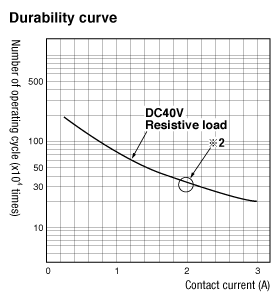
The following shows how to read the graphs of maximum switching capacity and durability curve.
For example, if contact voltage (V1) is already determined, the maximum contact current (I1) can be obtained from the intersection point on the characteristic curve.
Conversely, if the maximum contact current I1 is already determined, contact voltage (V1) can be obtained.
Then the I1 obtained is used to obtain the number of operating cycles from the durability curve.
Example on these graphs:
If contact voltage is 40V,
Contact switching current is up to 2A …… *1
The number of operating cycle at maximum contact current 2A is approx. 340,000 times …… *2
  • Maximum switching capacity
  • Durability curve

 
Yeah I assumed wear would mean the relay only having so many chances to turn on again.

Didn’t think it would come down to physical wear on the connectors over time.

But if Brights has a 30A contactor I’ll just get one of those and then come back asking how the hell to wire the thing.

*****

Also if using a Contactor with the POW R2 am I going to lose power monitoring? Since it seems I would only feed the Live through the contactor?

Or do I still pass both Live and Neutral through the POW? Doesn’t that defeat the purpose of the contactor?
Yes with contactor you lose power monitoring. That's why I went with the CBI ASC Astute.
 
I suspect that geyser wise relay got damaged as a result of a bad connection on the output cable plug.

Last week I installed a ZMAI-90 running on Tuya on my geyser - working well so far.

I considered a Sonoff and a contactor, but want to track power usage
Where do you get these (the ZMAI-90)?
 
The ZMAi-90 is relatively easy to flash with Tasmota. See https://www.creationfactory.co/2019/12/reverse-engineering-zmai-90-din-rail.html for flashing instructions. The versions currently shipped by Banggood use TuyaMCU comms between the V9821 and the ESP in the Tuya module, so you don't have to capture the raw comms data as detailed in that blog article. There's a simple template and Tasmota setup details at https://templates.blakadder.com/ZMAi-90.html

The ZMAi-90 claims a 60A maximum current, which looks pretty plausible given that the relay is rated 80A - plenty for most applications even when applying a safety derating factor based on its country of origin. Other things I like about it are that it uses a bistable relay, so the coil only consumes power while changing state, and that the current shunt is integrated into one of the beefy legs of the relay itself rather than using a surface mount resistor like so many other power monitors. That means you're never pushing your full load current through a tiny sliver of copper on the PCB.

The LCD and button are run by the V9821 and remain functional when you flash the ESP with Tasmota, so you get the bonus of voltage, current, power and cumulative energy readings on the LCD and an impulse LED that gives you a visible indication of power even at a distance if you aren't close enough to read the LCD.
 
The ZMAi-90 is relatively easy to flash with Tasmota. See https://www.creationfactory.co/2019/12/reverse-engineering-zmai-90-din-rail.html for flashing instructions. The versions currently shipped by Banggood use TuyaMCU comms between the V9821 and the ESP in the Tuya module, so you don't have to capture the raw comms data as detailed in that blog article. There's a simple template and Tasmota setup details at https://templates.blakadder.com/ZMAi-90.html

The ZMAi-90 claims a 60A maximum current, which looks pretty plausible given that the relay is rated 80A - plenty for most applications even when applying a safety derating factor based on its country of origin. Other things I like about it are that it uses a bistable relay, so the coil only consumes power while changing state, and that the current shunt is integrated into one of the beefy legs of the relay itself rather than using a surface mount resistor like so many other power monitors. That means you're never pushing your full load current through a tiny sliver of copper on the PCB.

The LCD and button are run by the V9821 and remain functional when you flash the ESP with Tasmota, so you get the bonus of voltage, current, power and cumulative energy readings on the LCD and an impulse LED that gives you a visible indication of power even at a distance if you aren't close enough to read the LCD.

This is great. Will probable order some of them -- I'm leaning towards installing an aircon and would love to be able to know if it is currently running or not.

That and knowing if my geyser and oven is currently running or not.
 
This is great. Will probable order some of them -- I'm leaning towards installing an aircon and would love to be able to know if it is currently running or not.

That and knowing if my geyser and oven is currently running or not.
They're definitely worth Tasmotising. I have several, but the first one I bought as a test is still running the original Tuya firmware because it got installed before I'd figured out how easy it was to flash. I have access to its power readings via TuyaLocal, but I hate not having control over how often I get power readings. Fortunately the power it's measuring (my whole office sub-DB) is relatively constant, but flashing it is definitely on the to-do list. For my newer Tasmotised units I use a combination of PowerDelta and a rule-driven dynamic TelePeriod to make sure that they report in as soon as the geyser starts or stops drawing power.
 
Does the ZMAi-90 have a manual override -- i.e. can you turn it on/off from inside your DB?
They're definitely worth Tasmotising. I have several, but the first one I bought as a test is still running the original Tuya firmware because it got installed before I'd figured out how easy it was to flash. I have access to its power readings via TuyaLocal, but I hate not having control over how often I get power readings. Fortunately the power it's measuring (my whole office sub-DB) is relatively constant, but flashing it is definitely on the to-do list. For my newer Tasmotised units I use a combination of PowerDelta and a rule-driven dynamic TelePeriod to make sure that they report in as soon as the geyser starts or stops drawing power.

Can you switch them using a button or something without an app / Home Assistant?
 
Top
Sign up to the MyBroadband newsletter
X