Hyundai H-1 (2018)

Pricing! Hyundai adds 12-seater H-1 variant to SA range

Hyundai Automotive South Africa has added a 12-seater flagship derivative to its local H-1 range.

Priced at R664 900, the newcomer commands a R10 000 premium over on the 2,5 Elite nine-seater on which it is based.

Featuring four rows of three seats, the new H-1 derivative effectively gains an extra rear bench, which can be moved forward to increase luggage space when not in use.

The new model employs the same 2,5-litre turbodiesel engine as the nine-seater, sending 125 kW and 441 N.m maximum to the rear axle via a five-speed automatic transmission.

Pricing:

Hyundai H-1 2,5 Panel Van: R476 900
Hyundai H-1 2,5 Multicab: R553 900
Hyundai H-1 2,4 Executive Bus: R527 900
Hyundai H-1 2,5 Elite Bus: R654 900
Hyundai H-1 2,5 Elite 12-seater Bus: R664 900

https://www.carmag.co.za/news/new-models/pricing-hyundai-adds-12-seater-h-1-variant-to-sa-range/

625365839_1.jpg625365839_2.jpg625365839_4.jpg
 
2019 Hyundai H1: Now with 12 Seats

The Hyundai H1 is one of the popular entries in the people-moving minivan segment and now the range has been bolstered with a 12-seater version. Here's how much it costs.

The Hyundai H1 recently received an update in 2018 and now for 2019, the range receives a 12-seater derivative. For those wanting to carry large numbers of people, the 3-3-3-3 setup is available, but customers can fold the final row of seats down to increase the luggage capacity.

Hyundai H1 Price in South Africa (June 2019)

Pricing includes Hyundai’s 7-year/200 000 km warranty, as well as a 5-year/150 000 km roadside assistance plan and 5-year/90 000 km service plan.

H-1 2. 5 Elite 12-Seater Bus (turbodiesel, auto) R664 900

H-1 2.4 Executive 9-Seater Bus (petrol, manual) R527 900

H-1 2.5 Elite 9-Seater Bus (turbodiesel, auto) R654 900

H-1 2.5 Turbodiesel 3-seater Panel Van (turbodiesel, auto) R476 900

H-1 2.5 Turbodiesel 6-seater Multicab (turbodiesel, auto) R553 900

https://www.cars.co.za/motoring_news/2019-hyundai-h1-now-with-12-seats/46795/
 
Hyundai has built an H-1 N ‘Drift Bus’ ... powered by a twin-turbo V6!

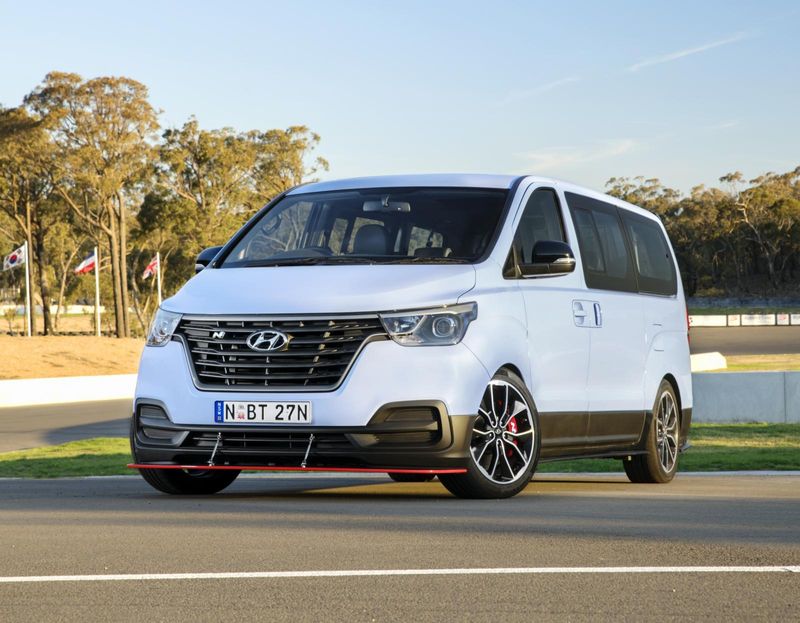
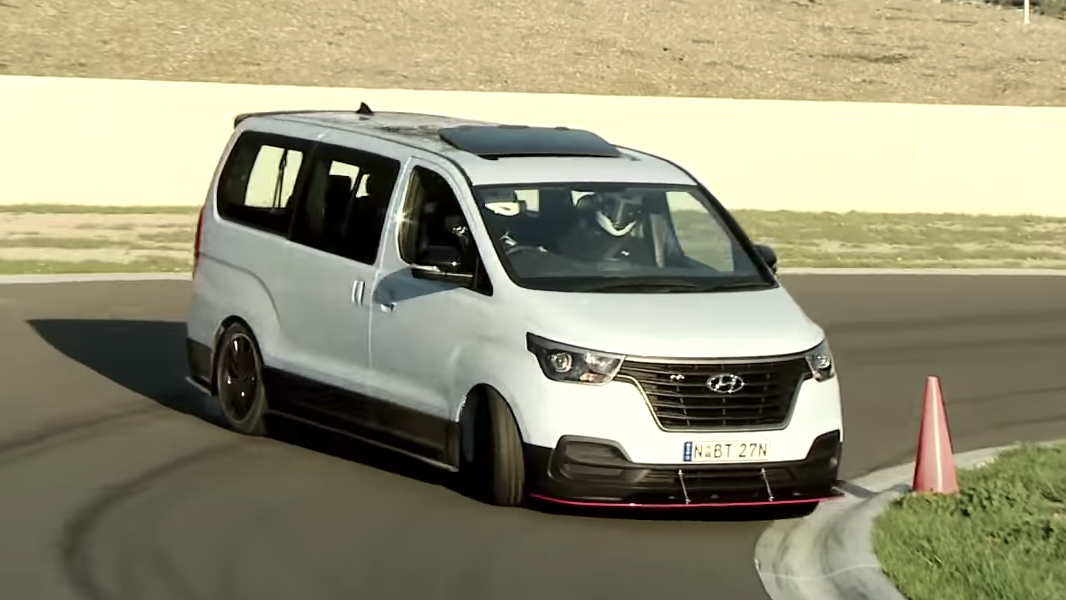
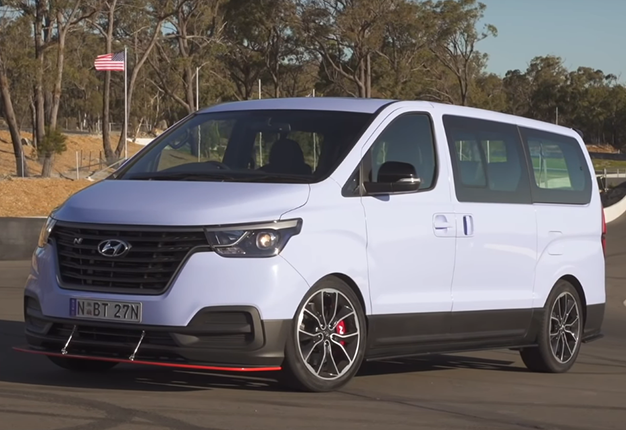
Hyundai in Australia has taken the wraps off a crazy one-off H-1 N ‘Drift Bus’, handing the eight-seater people-mover a turbocharged V6 petrol engine and a host of other upgrades.

The H-1 (or, as it’s known in Australia, the iMax) swapped its standard 2,5-litre turbodiesel heart for a 3,5-litre twin-turbocharged V6 petrol unit engine, sending “over 300 kW” and 555 N.m to the rear axle.

The powerplant is paired with a Hyundai-developed eight-speed automatic transmission, while the suspension arrangement features electronically controlled dampers. And the brakes? Well, they’ve been given an N performance upgrade, while the 19-inch alloy wheels pilfered from the i30 N are wrapped in high-performance tyres.


26494554_2.jpg26494554_3.jpg26494554_1.jpg
 
Hyundai Makes Ultimate H1 With V6

Meet the ultimate Hyundai H1, complete with a turbocharged V6 with over 300 kW and 500 Nm!

Sadly, don't get your hopes up or get too excited as this is a once-off custom creation from Hyundai Australia. Dubbed the Hyundai H1 iMax N Drift Bus (H1 is the iMax Down Under), it's been extensively modified and is inspired by the N brand,

The 2.5-litre CRDi diesel motor was ripped out and replaced with a rorty 3.5-litre twin-turbo V6 with over 300 kW and 555 Nm, all of which is sent to the rear wheels via an 8-speed automatic gearbox. A differential was also fitted. Hyundai Australia says it has 50/50 weight distribution and it'll accelerate to 100 kph in under 5 seconds.

 
WATCH: Hyundai unleashes tyre-scorching, 300kW 'drift bus'

It all started when Hyundai’s Australian division posed a rather enticing question to its fans on a social media poll: which Hyundai should get the N treatment next?

The respondents actually chose the Tucson SUV, but Hyundai said that would simply be too easy, so they chose the second placed iMax MPV, which is sold as the H1 Bus in South Africa.

What the local division’s ‘underground skunkworks team’ came up with is far more than just a mildly tinkered bus with fancy wheels - what we have here is a tyre-shredding 300kW drifting bus that still seats eight people - so more can enjoy the sideways thrills.

Sure, in the wrong hands and in the wrong place (namely public roads) this could simply be a way of endangering even more lives, but thankfully this is a one-off custom creation that’s not even classified as road legal. It will, however be competing in various drifting events in Australia.

 
Hyundai IMax N Drift Bus Packs A 402 HP (300 KW) Twin-Turbo V6

In general, vans are practical and somewhat boring but Hyundai Australia has given an iMax bus the full N treatment and we love it.

Say hello to the Hyundai iMax N Drift Bus, the eight-passenger, rear-drive machine that’ll happily go sideways.

In stock form, the iMax gets an inline-four 2.5-litre turbodiesel engine but that was ditched for a 3.5-litre twin-turbo V6 that produces 402 hp (300 kW) and 550 Nm of torque. The engine comes paired exclusively to an eight-speed automatic transmission developed in house by Hyundai. It also comes with a limited-slip differential and a dual-mode active exhaust system just like the i30 N.

 
WATCH | Here's why Hyundai built a 300kW minibus

There isn’t really a market for high-performance vans. Although Mercedes-Benz does a tidy trade by producing an AMG version of practically all its vehicles, there is no V63 AMG.

Same thing with VW. They have an established van legacy, but you’ll never see a Transporter R. Despite this, Hyundai has shown unexpected initiative in producing a very potent H1 N.

Ingenuity spilling over

The Korean automotive brand has made a serious effort of increasing its performance car offering in the last few years, with the i30 N hot hatchback. Now it would appear that some of that ingenuity has spilled over into Hyundai’s H1 people carrier.

Commissioned as a one-off concept by Hyundai Australia, the H1 N shows that rear-wheel drive and a very long wheelbase can arc some ridiculous drifts.

 
Next-gen Hyundai H-1 coming in 2021 ... and switching to FWD – report

A fresh report out of South Korea claims a new Hyundai H-1 will finally debut in 2021, switching to a front-wheel-drive configuration.

According to Auto Post, the third-generation H-1 (which is badged as the Starex in many markets) will drop the current model’s rear-wheel-drive layout for a front-driven arrangement.

 
Spy Shots: New Hyundai H1

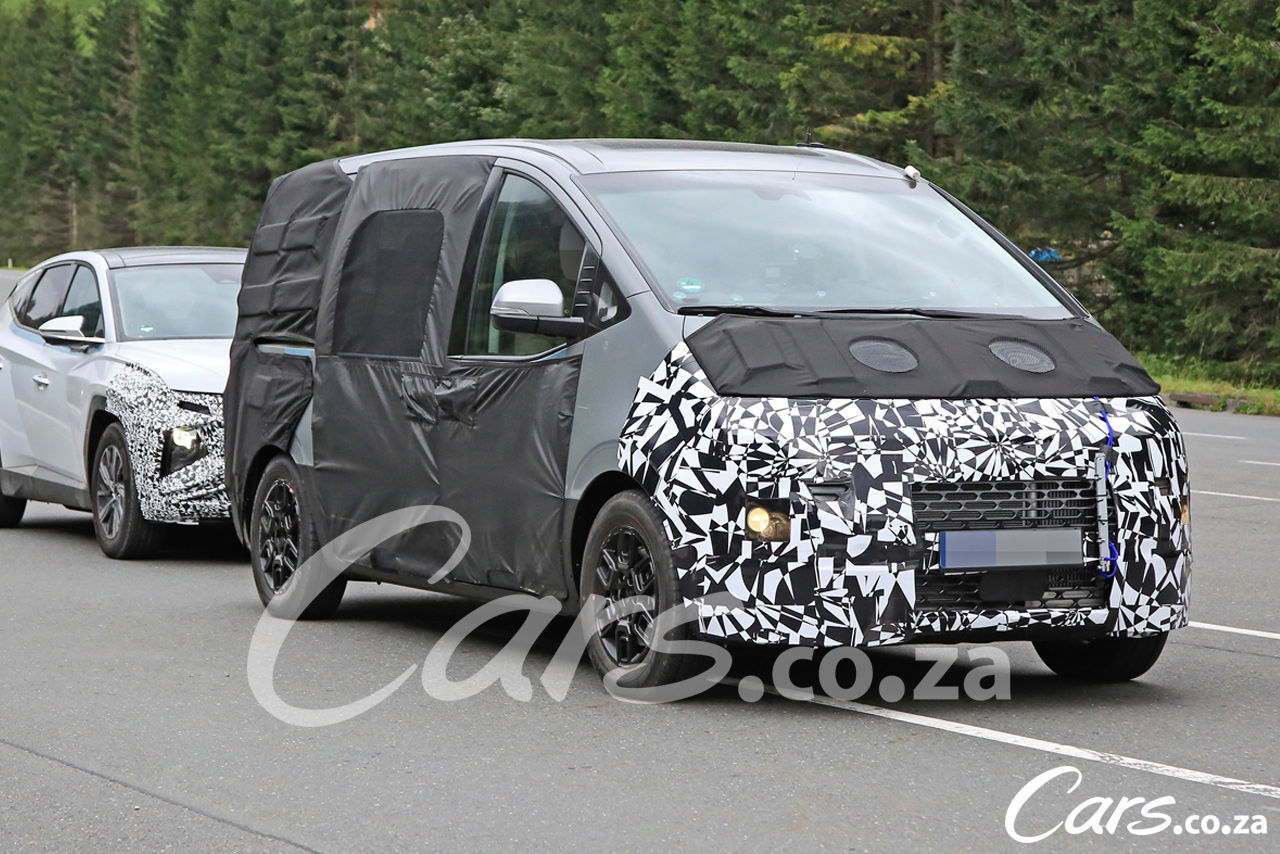
A new Hyundai H1 people-mover has been spied testing.

Hyundai’s H1 people-mover was first introduced way back in 2009 and it’s become a hugely successful model for the Korean automotive giant. An updated version was launched in 2018 and now a new model is in development, as confirmed by these spy images captured in the Alps.

This prototype was captured doing tow-testing but despite the heavy camouflage, there are a few hints of what the new H1 will look like. Firstly, note the curved front-end that tapers off to the rear giving the H1 a sleeker appearance. A large grille will give the H1 notable road presence and the headlights are likely to be split, much like we have seen on other Hyundai products such as the Santa Fe and Venue. The H1 is also expected to feature larger rear glass windows which will improve outward visibility for passengers.


H1 1.jpgH1 2.jpg
 
Goodbye H-1, hello Staria? Hyundai teases bold new people-mover

Hyundai has released a set of teaser images giving us a glimpse of the top-spec version of its upcoming new Staria people-mover.

From what we understand, the new Staria is set to replace the H-1, which is also known as the Starex or iMax in some markets.

While the Korean firm has yet to release details on powertrain options, it does promise the new Staria will be equipped with “various driver-centric features and futuristic design elements”.

The automaker describes the exterior styling as “strikingly futuristic”, saying it “resembles a spaceship”. As you can see in the accompanying teaser shots, the front end is dominated by a full-width horizontal daytime running light positioned above the headlamps (the latter units integrated into a gaping grille). Round back, you'll notice the vertically positioned taillamps.


Hyundai 1.jpgHyundai 2.jpgHyundai 3.jpgHyundai 4.jpgHyundai 5.jpgHyundai 6.jpg
 
Top
Sign up to the MyBroadband newsletter
X