Juno

Juno reveals the roots of Jupiter's Great Red Spot

[video=youtube;uj3Lq7Gu94Y]https://www.youtube.com/watch?time_continue=13&v=uj3Lq7Gu94Y[/video]

The Great Red Spot, a gigantic storm of crimson clouds bigger than the Earth, has been raging on Jupiter's surface for centuries. We've known its size in two dimensions for a long time, but after a close flyover in July the Juno probe has finally given us an answer about how deep into the atmosphere the storm's roots run. In the process, the mission also uncovered two new radiation zones.

While astronomers have been monitoring the Great Red Spot since 1830, the storm is believed to have marked the gas giant's face for up to 350 years. As of April this year it measured around 10,000 miles (16,000 km) wide, making it about 1.3 times the diameter of Earth. Impressive as that sounds, it seems the spot is shrinking at an increasing rate: when Voyager 1 and 2 whipped past in 1979 on their grand tour of the Solar System, the storm was twice the size of Earth.

To get a closer look, Juno swung low during its first pass over the Spot in July 2017, and along with a collection of stunning photos, the spacecraft tuned all of its instruments towards the storm. In particular, the Microwave Radiometer was able to peer deep beneath the clouds and reveal how far down it goes.

"One of the most basic questions about Jupiter's Great Red Spot is: how deep are the roots?" says Scott Bolton, principal investigator on the Juno project. "Juno data indicate that the solar system's most famous storm is almost one-and-a-half Earths wide, and has roots that penetrate about 200 miles (320 km) into the planet's atmosphere."

More At: https://newatlas.com/jupiter-great-red-spot-roots/52571/
 
NASA Juno Findings - Jupiter’s Jet-Streams Are Unearthly

Data collected by NASA’s Juno mission to Jupiter indicate that the atmospheric winds of the gas-giant planet run deep into its atmosphere and last longer than similar atmospheric processes found here on Earth. The findings will improve understanding of Jupiter’s interior structure, core mass and, eventually, its origin.

Other Juno science results released today include that the massive cyclones that surround Jupiter’s north and south poles are enduring atmospheric features and unlike anything else encountered in our solar system. The findings are part of a four-article collection on Juno science results being published in the March 8 edition of the journal Nature.

“These astonishing science results are yet another example of Jupiter’s curve balls, and a testimony to the value of exploring the unknown from a new perspective with next-generation instruments. Juno’s unique orbit and evolutionary high-precision radio science and infrared technologies enabled these paradigm-shifting discoveries,” said Scott Bolton, principal investigator of Juno from the Southwest Research Institute, San Antonio. “Juno is only about one third the way through its primary mission, and already we are seeing the beginnings of a new Jupiter.”

The depth to which the roots of Jupiter’s famous zones and belts extend has been a mystery for decades. Gravity measurements collected by Juno during its close flybys of the planet have now provided an answer.

“Juno’s measurement of Jupiter’s gravity field indicates a north-south asymmetry, similar to the asymmetry observed in its zones and belts,” said Luciano Iess, Juno co-investigator from Sapienza University of Rome, and lead author on a Nature paper on Jupiter’s gravity field.

On a gas planet, such an asymmetry can only come from flows deep within the planet; and on Jupiter, the visible eastward and westward jet streams are likewise asymmetric north and south. The deeper the jets, the more mass they contain, leading to a stronger signal expressed in the gravity field. Thus, the magnitude of the asymmetry in gravity determines how deep the jet streams extend.


“Galileo viewed the stripes on Jupiter more than 400 years ago,” said Yohai Kaspi, Juno co-investigator from the Weizmann Institute of Science, Rehovot, Israel, and lead author of a Nature paper on Jupiter’s deep weather layer. “Until now, we only had a superficial understanding of them and have been able to relate these stripes to cloud features along Jupiter’s jets. Now, following the Juno gravity measurements, we know how deep the jets extend and what their structure is beneath the visible clouds. It’s like going from a 2-D picture to a 3-D version in high definition.”

The result was a surprise for the Juno science team because it indicated that the weather layer of Jupiter was more massive, extending much deeper than previously expected. The Jovian weather layer, from its very top to a depth of 1,900 miles (3,000 kilometers), contains about one percent of Jupiter’s mass (about 3 Earth masses).

More At: https://www.nasa.gov/feature/jpl/nasa-juno-findings-jupiter-s-jet-streams-are-unearthly
 
NASA to Extend Juno Jupiter Mission by Three Years

The Juno spacecraft currently orbiting Jupiter was supposed end its mission by crashing into the gas giant next month. Not anymore!

It turns out the scientific mission will be extended through at least 2021 so it can meet its goals, as Business Insider first reported yesterday. This will delay the probe’s dramatic demise for at least a few years.

“NASA has approved Juno to continue through 2022 to finish all of our originally planned science,” Scott Bolton, Juno’s principle investigator from the Southwest Research Institute, told Gizmodo in an email. “The orbits are longer than planned, and that is why Juno needs more time to gather our planned scientific measurements.”

Juno departed Earth for Jupiter in 2011 and arrived at the gas giant on July 4, 2016. Since then, it’s sent back a host of valuable data that has revealed new insights into Jupiter, like the depth of the red spot, three-dimensional views of the gas below its surface, and how its auroras work. It’s also delivered some of the best space images ever.

But things didn’t go off without a hitch. Juno is still in its initial 53-day orbit around Jupiter. An engine burn was supposed to shorten the orbit to 14 days, a maneuver that was canceled to avoid risk, according to a NASA release: “Two helium check valves that are part of the plumbing for the spacecraft’s main engine did not operate as expected when the propulsion system was pressurized in October.”

The longer-than-planned orbits meant the probe would pass close to the planet fewer times. Extending the mission will allow the scientists more time to gather their data.

NASA has yet to officially announce the update, and would not provide any additional information.

A longer life for Juno is great news. I don’t know if space fans are ready for another probe’s death so soon after Cassini’s last farewell.

https://gizmodo.com/nasa-to-extend-juno-jupiter-mission-by-three-years-1826581220
 
It looks like an oil canvas, but its an entire world...

Crazy the engineering and science that went into Juno... Just surviving the radioactive environment around Jupiter is a massive achievement.
 
NASA Juno spacecraft offers another incredible image of Jupiter

Juno, you spoil us.

It was only last week NASA released a stunning Van Gogh-like image of Jupiter's tumultuous atmosphere taking by the Jovian orbiter's JunoCam and colorized by citizen scientists. And now we have this...

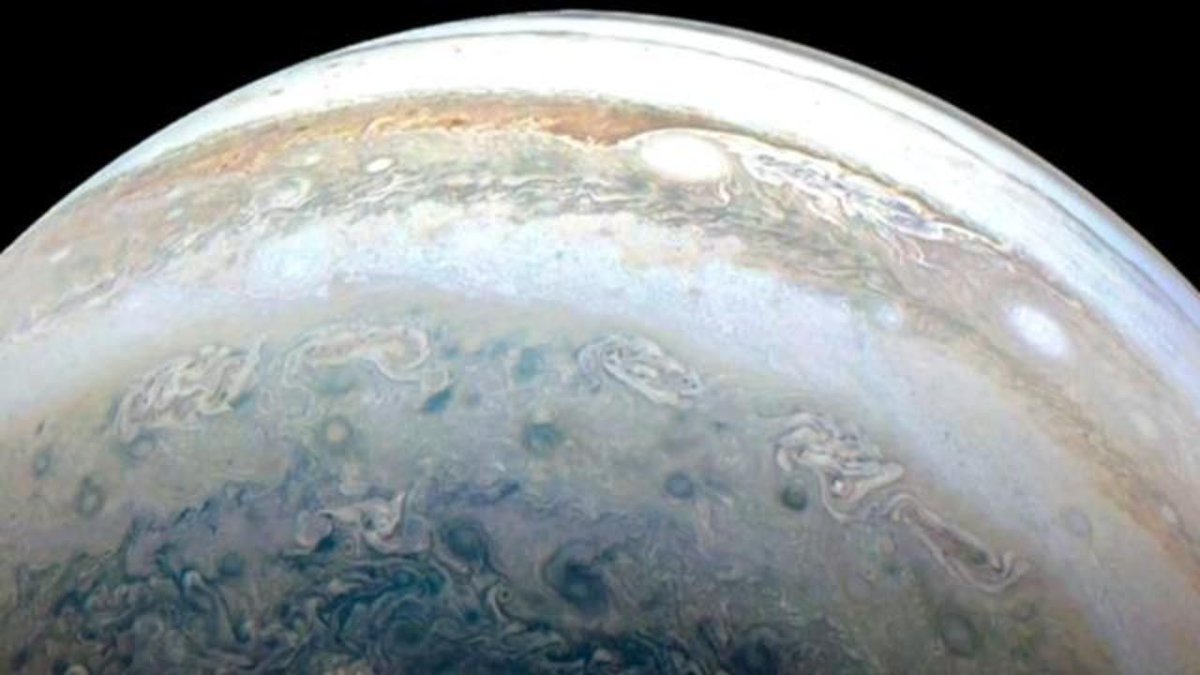
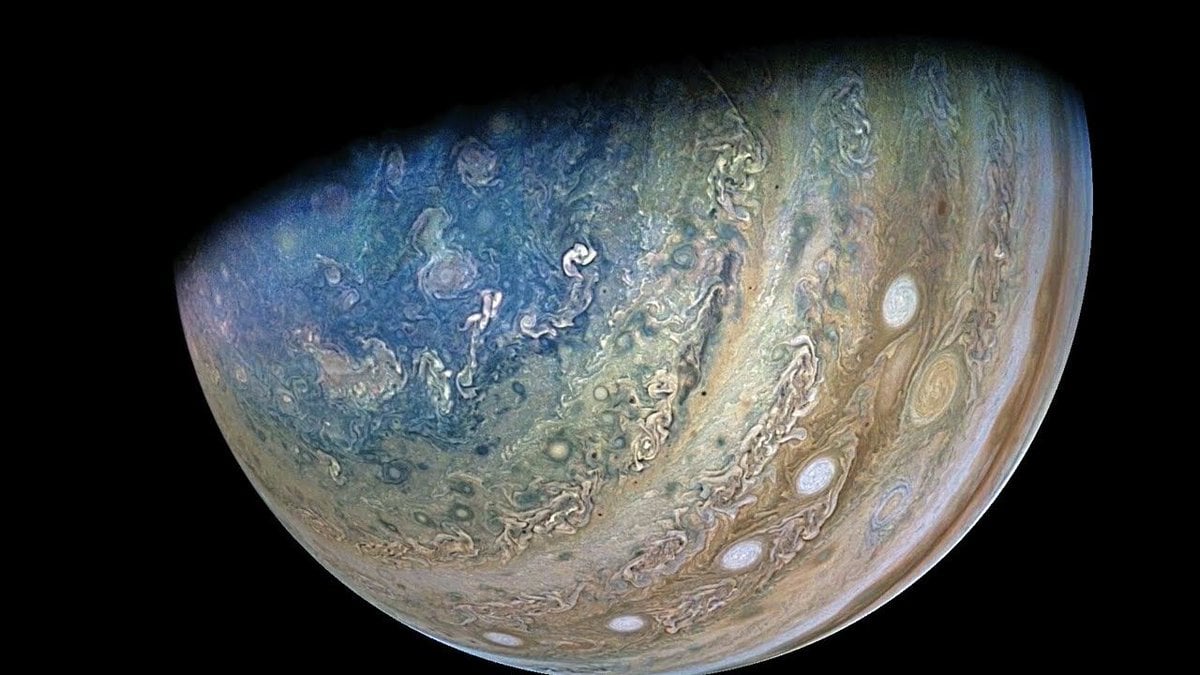
Yes, Juno, which last month had its mission extended to 2022, has again produced the goods with an image detailing Jupiter's southern hemisphere from approximately 44,300 miles away, NASA reports.

The jawbreaker-like hemisphere is jaw-dropping, backed by the obsidian darkness of space. It's hard to grasp just how big the planet is as it fades to black, but citizen scientist Kevin M. Gill's colour-enhanced image makes it feel like you could swipe it up in the palm of your hand.

You couldn't.

You shouldn't try to do that. Jupiter is so big that 1,300 Earths can fit inside it.

Juno's the first spacecraft that we've sent to Jupiter that isn't just flying along its equator -- it orbits the poles, allowing scientists to study the "atmospheric dynamics" and giving us an unprecedented look at the solar system's biggest celestial body.

Juno, travel well, and keep beaming these images back to us evermore.
$.jpg
 
Data from Juno shows Jupiter moons causing footprints in aurorae

A team of researchers with members from Italy, the U.S. and Belgium has discovered that two of Jupiter's moons cause "footprints" in the planet's aurorae. In their paper published in the journal Science, the researchers describe what they found and how it helps better understand both the planet and its moons.

On Earth, as the authors note, an aurora is seen as the Northern or Southern lights—dazzling displays of light in the night sky. Jupiter also has aurorae, but they are caused by a different process. Jupiter has a surrounding magnetosphere—plasma carried by the planet's strong magnetic field. Charged particles from the magnetosphere at times strike the atmosphere of the planet, causing light shows similar to the ones we see on here on Earth. But they have something ours do not—footprints from the planet's moons. These footprints, the researchers explain, are disturbances in an aurora caused by the presence of a moon—in this case, by Io or Ganymede.

The researchers found evidence of the footprints when studying data sent back to Earth by NASA's Juno space probe. They found that when Io passed close to Jupiter, it caused a double trail of squiggles to appear in a small section of an aurora. The researchers describe it as similar to a Von Kármán vortex—one that streams for hundreds of kilometers. The footprint disappears as the moon moves farther away from the planet.

The group also found a footprint created by Ganymede, a spot in an aurora that, upon closer view, turned out to be two spots—the footprint was split in half. The researchers were not able to find a reason for the split, but note that Ganymede is the only moon orbiting Jupiter that has its own magnetic field. This, they suggest, means that the footprint created by the moon represents the interaction of two magnetospheres.

The researchers suggest that learning more about the footprints caused by Jupiter's moons will help to understand how the moons interact with the planet and how strong magnetic forces in a natural environment interact. They also note that neither footprint was in the location that had been predicted, which indicates that models built to describe such events will need to be adjusted.

Read more at: https://phys.org/news/2018-07-juno-jupiter-moons-footprints-aurorae.html#jCp
 
NASA’s Juno Mission Spots Another Possible Volcano on Jupiter’s Moon Io

When the Juno spacecraft arrived in orbit around Jupiter in 2016, it became the second spacecraft in history to study Jupiter directly – the first being the Galileo probe, which orbited Jupiter between 1995 and 2003. With every passing orbit (known as a perijove, which take place every 53 days), the spacecraft has revealed more about Jupiter’s atmosphere, weather patterns, and magnetic environment.

In addition, Juno recently discovered something interesting about Jupiter’s closest orbiting moon Io. Based on data collected by its Jovian InfraRed Auroral Mapper (JIRAM) instrument, Juno detected a new heat source close to the south pole of Io that could indicate the presence of a previously undiscovered volcano. This is just the latest discovery made by the probe during its mission, which NASA recently extended to 2021.
 
NASA's Jupiter probe just beamed back mesmerizing new photos of the gas giant

It’s been a busy and exhilarating couple of months for scientists who study Jupiter — and space nerds fascinated by the gas giant.
Yesterday, a team of researchers announced the discovery of 12 new Jovian moons, bringing Jupiter’s total up to 79. Last week, scientists revealed that data from NASA’s $1 billion Juno mission suggested there may be a previously undiscovered volcano on Jupiter’s moon Io. And last month, the team behind Juno figured out that Jupiter's lighting is more similar to Earth’s than previously thought — which solved a 39-year-old mystery.

jupiters-storms-and-clouds-form-patterns-that-can-look-as-trippy-as-they-are-beautiful-sen-doran.jpg

but-jupiter-has-plenty-of-other-remarkable-cloudscapes-and-storms-swirling-this-swath-of-high-al.jpg

More At: http://uk.businessinsider.com/nasa-...ield-which-can-damage-sensitive-electronics-1
 
Astronomers discover 10 new moons for Jupiter

Our solar system is full of moons of many different kinds, just as diverse and amazing as the planets they orbit. While Earth only has one moon, and some planets, like Mercury and Venus, have none, others have dozens, namely Jupiter and Saturn. The ice giants Uranus and Neptune also have quite a few each.

On July 17, 2018, astronomers announced they’ve discovered even more moons orbiting Jupiter – 10 additional moons, in fact, bringing the known total of Jupiter’s moons now to 79. Nine of those 10 moons are what the astronomers are calling normal, but they’ve labeled one as a real oddball. As so often happens, the astronomers found the moons while searching for something completely unrelated.

More at Earth Sky dot ORG
 
Another Juno Flyby, Another Amazing Sequence of Images of Jupiter

In July of 2016, the Juno spacecraft established orbit around Jupiter, becoming the first spacecraft since the Galileo probe to study the planet directly. Since that time, the probe has been sending back vital information about Jupiter’s atmosphere, magnetic field and weather patterns. With every passing orbit – known as perijoves, which take place every 53 days – the probe has revealed more exciting things about this gas giant.

pia22686-16.jpg


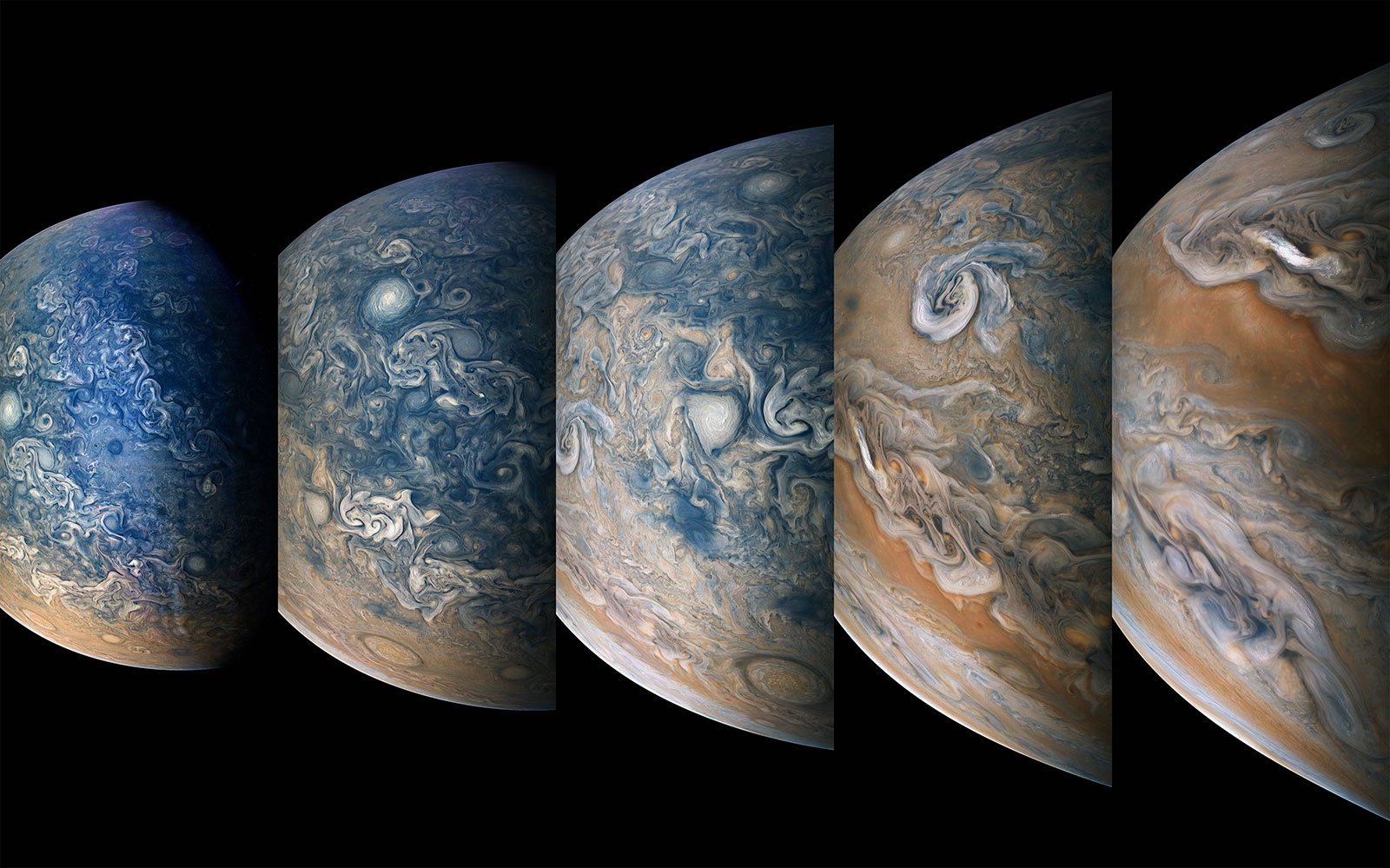
In addition, each perijove has been an opportunity for Juno to snap pictures with its JunoCam. With the help of the public, these pictures have been processed and turned into stunning color-enhanced images. The latest image to be released, which was processed by citizen scientists Gerald Eichstädt and Seán Doran, provides a beautiful time-lapse sequence of atmospheric features in Jupiter’s northern hemisphere.

More At: https://www.universetoday.com/13985...nother-amazing-sequence-of-images-of-jupiter/
 
JunoCam Wows Us Again With Detailed Images of the Great Red Spot

For almost 200 years humans have been watching the Great Red Spot(GRS) on Jupiter and wondering what’s behind it. Thanks to NASA’s Juno mission, we’ve been getting better and better looks at it. New images from JunoCam reveal some of the deeper detail in our Solar System’s longest-lived storm.


JunoCam is the visible light instrument onboard NASA’s Juno mission to Jupiter. It’s not part of the Juno spacecraft’s primary scientific payload. It was included in the mission just to engage and thrill us, and it hasn’t disappointed. But as it turns out, JunoCam’s high-resolution images are serving a scientific purpose.

A new study led by Agustín Sánchez-Lavega (University of the Basque Country, Spain) has used the detailed images from JunoCam to look more closely at the morphology of the clouds that make up the GRS. Up until now most of what we know about the GRS has come from previous missions to Jupiter. First were the Voyager missions, then the Galileo mission, and of course the Hubble Space Telescope. The image resolution of each succeeding mission has improved, but nothing close to JunoCam’s resolution.


NASA:https://www.nasa.gov/feature/goddar...f-the-great-red-spot-to-find-water-on-jupiter
 
Juno approaches halfway mark of its science mission
NASA's Juno orbiter arrived at Jupiter on July 4, 2016, but the unmanned explorer is already approaching the halfway mark of its science mission. On December 21 at 8:49:48 am PST (11:49:48 am EST), the spacecraft will be marking the midpoint of its Jovian mapping and data collection mission with a close flyby on its 16th of 32 scheduled science orbits that will bring it within 3,140 mi (5,053 km) of the planet's cloud tops while traveling at 128,802 mph (207,287 km/h).

More & Photos At: https://newatlas.com/juno-mission-halfway-mark/57642/
 

Juno Just Saw a Spacerock Crash Into Jupiter​

Timing is extraordinarily important in many aspects of astronomy. If an astronomer or their instrument is looking the wrong way at the wrong time they could miss something spectacular. Alternatively, there are moments when our instruments capture something unexpected in regions of space that we were searching for something else. That is exactly what happened recently when a team of scientists, led by Rohini Giles at the Southwest Research Institute, saw an image of what is likely a meteor impacting Jupiter’s atmosphere.


The team collects data from the UVS, one of the instruments on Juno, NASA’s mission tasked with studying the largest solar system planet up close. UVS is Juno’s ultraviolet spectrograph, which collects data in the ultraviolet spectra from 68-210 nm. It’s primary mission is to study Jupiter’s atmosphere and watch for its breathtaking auroras.

 
Visualizations shape how we perceive space exploration. Whether it’s the Pale Blue Dot, the Hubble Ultra Deep Field, Earthrise, or any other myriad images captured as part of this great endeavor, they all help inspire the next generation of explorers. Now, with advances in image capture and processing technology, we can finally start to take the next step in those visualizations – video. Ingenuity was recently captured on video during its first flight a few months ago. And this week, NASA released a breathtaking video of Juno’s view of Jupiter and Ganymede, one of its moons, as it flew past the gas giant.


The views themselves are stunning, with lightning flashing on Jupiter’s night side and Ganymede’s textured terrain coming across in full force. However, Juno was still busy capturing scientific data in addition to these spectacular images.

 
Top
Sign up to the MyBroadband newsletter
X