JWST - James Webb space telescope

Zyraz

Expert Member
Joined
Jul 7, 2011
Messages
2,660
Reaction score
32
5621574713_7dbd195a54_o.jpg

14753947223_7058ebbd8a_osmall.jpg

NASA recently announced that it has installed the first telescope mirror on the next generation James Webb Space Telescope (JWST). This mirror is one of eighteen units that will be attached to the satellite, which scheduled to launch in late 2018. The James Webb Space Telescope is designed to replace the Hubble Space Telescope, which has been orbiting for 25 years and is reaching the end of its usable lifespan.
The hexagonal shaped mirror was installed on the JWST using a robotic arm inside a clean room at NASA’s Goddard Space Flight Center in Greenbelt, Maryland. Built by Colorado-based Ball Aerospace & Technologies, each mirror measured 4.2 feet wide and weighed 88 pounds. The mirrors are comprised of a lightweight beryllium material with a gold coating to reflect infrared light. All materials were selected specifically for their ability to operate at extreme temperatures as low as minus 406 degrees Fahrenheit. When all 18 mirrors are installed, the telescope will function as one large 21.3 foot (6.5 meter) mirror that will fold for launch and then unfold and adjust to shape after it is deployed.
Related: NASA is going to launch two rockets into the Northern Lights this weekend, for science
The JWST will expand upon the observations of both the Hubble Telescope and Spritzer Space telescope. It is being heralded as “the premier astronomical observatory of the next decade.” Unlike the Hubble which measures visible or ultraviolet light, the JWST will focus instead on infrared and near-infrared light astronomy. It will provide detailed information on the first stars and galaxies that formed after the Big Bang and will give astronomers an opportunity to study planetary and stellar formation. Astronomers hope to use the data collected from the JWST to learn more about the development of our solar system as well as possibly discover other solar systems and exoplanets similar to the Earth that are capable of supporting life.
The James Webb Space Telescope is being developed as part of a collaborative international effort that is lead by NASA along with contributions from the European Space Agency (ESA) and the Canadian Space Agency.

jwst-topside-large1.jpg


Read more: http://www.digitaltrends.com/cool-tech/nasa-webb-telescope-mirror/#ixzz3t0vRToyD


Webcam screengrab courtesy of NASA
Engineering at its finest... :love:

http://jwst.nasa.gov/webcam.html

JWST 1st mirror installed.jpg
 
Last edited:
New Video Shows NASA’s Webb Telescope First Mirror Installation
[video=youtube;_V7KGzr4E84]https://www.youtube.com/watch?v=_V7KGzr4E84[/video]

A couple of mirrors already installed as seen on Live webcam moments ago .
Capture.jpg
 
Last edited:
Cannot wait to see the new discoveries this will bring us. If its anything as prolific as Hubble and lasts anywhere near as long we're in for a treat.
 
One dozen flight mirrors are now installed on NASA's James Webb Space Telescope, out of the eighteen mirror segments that make up the primary mirror. The assembly of the primary mirror is an important milestone for the Webb telescope, but is just one component of this huge and complex observatory.

Since December 2015, the team of scientists and engineers have been working tirelessly to install all the primary mirror segments onto the telescope structure in the large clean room at NASA's Goddard Space Flight Center in Greenbelt, Maryland. The twelfth mirror was installed on January 2, 2016.

"This milestone signifies that all of the hexagonal shaped mirrors on the fixed central section of the telescope structure are installed and only the 3 mirrors on each wing are left for installation," said Lee Feinberg, NASA's Optical Telescope Element Manager at NASA Goddard.

"The incredibly skilled and dedicated team assembling the telescope continues to find ways to do things faster and more efficiently."

Each hexagonal-shaped segment measures just over 4.2 feet (1.3 meters) across and weighs approximately 88 pounds (40 kilograms). After being pieced together, the 18 primary mirror segments will work together as one large 21.3-foot (6.5-meter) mirror.

The primary mirror will unfold and adjust to shape after launch. The mirrors are made of ultra-lightweight beryllium. The mirrors are placed on the telescope's backplane using a robotic arm, guided by engineers. The full installation is expected to be completed in a few months.

The mirrors were built by Ball Aerospace and Technologies Corp., Boulder, Colorado. Ball is the principal subcontractor to Northrop Grumman for the optical technology and lightweight mirror system. The installation of the mirrors onto the telescope structure is performed by Harris Corporation of Rochester, New York. Harris Corporation leads integration and testing for the telescope.

While the mirror assembly is a very significant milestone, there are many more steps involved in assembling the Webb telescope. The primary mirror and the tennis-court-sized sunshield are the largest and most visible components of the Webb telescope. However, there are four smaller components that are less visible, yet critical.

The instruments that will fly aboard Webb - cameras and spectrographs with detectors able to record extremely faint signals - are part of the Integrated Science Instrument Module (ISIM), which is currently undergoing its final cryogenic vacuum test and will be integrated with the mirror later this year.

The Near InfraRed Spectrograph (NIRSpec) has programmable microshutters which enable observation up to 100 objects simultaneously. The Near Infrared Camera (NIRCam) is equipped with coronagraphs, instruments that allow astronomers to take pictures of very faint objects around a central bright object, like stellar systems.

The Webb telescope also has a cryocooler for cooling the Mid-Infrared Instrument (MIRI) to a very cold 7 Kelvin so they can work. MIRI has both a camera and a spectrograph that sees light in the mid-infrared region of the electromagnetic spectrum, with wavelengths that are longer than our eyes see. There's also the Fine Guidance Sensor (FGS) allows Webb to point precisely, so that it can obtain high-quality images.

Over the next two years in preparation for launch, various components of the Webb telescope will endure rigorous environmental and optical testing. The sunshield will be joined with the spacecraft bus (main structure) followed by more testing. The Webb telescope is planned for launch in 2018.

Source
 
16-013b.jpg
Inside a massive clean room at NASA's Goddard Space Flight Center in Greenbelt, Maryland the James Webb Space Telescope team used a robotic am to install the last of the telescope's 18 mirrors onto the telescope structure.
Credits: NASA/Chris Gunn


The 18th and final primary mirror segment is installed on what will be the biggest and most powerful space telescope ever launched. The final mirror installation Wednesday at NASA’s Goddard Space Flight Center in Greenbelt, Maryland marks an important milestone in the assembly of the agency’s James Webb Space Telescope.

“Scientists and engineers have been working tirelessly to install these incredible, nearly perfect mirrors that will focus light from previously hidden realms of planetary atmospheres, star forming regions and the very beginnings of the Universe,” said John Grunsfeld, associate administrator for NASA’s Science Mission Directorate in Washington. “With the mirrors finally complete, we are one step closer to the audacious observations that will unravel the mysteries of the Universe.”

Using a robotic arm reminiscent of a claw machine, the team meticulously installed all of Webb's primary mirror segments onto the telescope structure. Each of the hexagonal-shaped mirror segments measures just over 4.2 feet (1.3 meters) across -- about the size of a coffee table -- and weighs approximately 88 pounds (40 kilograms). Once in space and fully deployed, the 18 primary mirror segments will work together as one large 21.3-foot diameter (6.5-meter) mirror.

"Completing the assembly of the primary mirror is a very significant milestone and the culmination of over a decade of design, manufacturing, testing and now assembly of the primary mirror system," said Lee Feinberg, optical telescope element manager at Goddard. "There is a huge team across the country who contributed to this achievement."

While the primary mirror installation may be finished on the tennis court-sized infrared observatory, there still is much work to be done.

"Now that the mirror is complete, we look forward to installing the other optics and conducting tests on all the components to make sure the telescope can withstand a rocket launch," said Bill Ochs, James Webb Space Telescope project manager. "This is a great way to start 2016!"

The mirrors were built by Ball Aerospace & Technologies Corp., in Boulder, Colorado. Ball is the principal subcontractor to Northrop Grumman for the optical technology and optical system design. The installation of the mirrors onto the telescope structure is performed by Harris Corporation, a subcontractor to Northrop Grumman. Harris Corporation leads integration and testing for the telescope.

“The Harris team will be installing the aft optics assembly and the secondary mirror in order to finish the actual telescope,” said Gary Matthews, director of Universe Exploration at Harris Corporation. “The heart of the telescope, the Integrated Science Instrument Module, will then be integrated into the telescope. After acoustic, vibration, and other tests at Goddard, we will ship the system down to Johnson Space Center in Houston for an intensive cryogenic optical test to ensure everything is working properly.”

The James Webb Space Telescope is the scientific successor to NASA's Hubble Space Telescope. It will be the most powerful space telescope ever built. Webb will study many phases in the history of our universe, including the formation of solar systems capable of supporting life on planets similar to Earth, as well as the evolution of our own solar system. It’s targeted to launch from French Guiana aboard an Ariane 5 rocket in 2018. Webb is an international project led by NASA with its partners, ESA (European Space Agency) and the Canadian Space Agency.

16-013a.jpg
In this rare view, the James Webb Space Telescope's 18 mirrors are seen fully installed on the James Webb Space Telescope structure at NASA's Goddard Space Flight Center in Greenbelt, Maryland.
Credits: NASA/Chris Gunn


To watch the Webb telescope being built at Goddard, visit the "Webb-cam" page at:

http://www.jwst.nasa.gov/webcam.html

Source
 
NASA's James Webb Space Telescope will look across vast distances to find the earliest stars and galaxies and study the atmospheres of mysterious worlds orbiting other stars. But the observatory also will investigate objects in Earth's own neighborhood - planets, moons, comets and asteroids in our solar system. These studies will help scientists understand more about the formation of the solar system and how Earth became capable of supporting life.

"The James Webb Space Telescope will be an innovative tool for studying objects in the solar system and can help take planetary science to a new level," said Stefanie Milam, the Webb telescope's deputy project scientist for planetary science at NASA's Goddard Space Flight Center in Greenbelt, Maryland.

Scheduled for launch in 2018, the Webb telescope will carry four science instruments to take images of and collect information about the physical characteristics and compositions of astronomical objects. Together, these instruments will cover the near- and mid-infrared parts of the spectrum, including wavelengths that are important when looking for water and other clues about the evolution and potential habitability of a planetary system.

From its vantage point a million miles beyond Earth, the Webb telescope will have a spectacular view of objects in the solar system. It will orbit the sun at a position called the Lagrange point 2, or L2, which will help to keep the telescope's temperature stable - instability distorts its view - and allows the large sun shield to protect the observatory from the light and heat of the sun and Earth.

Scientists envision using the observatory to monitor the water cycle on Mars, look at weather patterns on Saturn's moon Titan, and hunt for new rings around the giant planets. Comets could be tracked, and the water and gases they release during their journeys could be mapped. Ices and minerals could be identified on the surfaces of moons, asteroids and distant minor planets, helping researchers better understand the evolution of our solar system.

These and other possibilities are described in a 2016 special issue of the Publications of the Astronomical Society of the Pacific, with Milam serving as the guest editor. A total of 11 papers were contributed by authors from across the planetary science community, with Goddard scientists taking the lead on how to use the Webb telescope to study Mars, Titan and near-Earth objects.

From a technical standpoint, some adjustments have to be made when studying planetary objects, which can be a very different proposition from looking at an extremely distant star or galaxy.

"We're taking an instrument designed to detect the faint light from the first stars of the universe and instead using it to look at the brightest objects in the sky - and objects that move fast with respect to objects outside of our solar system," Milam said.

To observe planets and other bright bodies, scientists will be able to reduce the amount of light by reading out smaller portions of the detectors very rapidly or by filtering out all but a few wavelengths of light. For moving targets, the entire telescope will move, using non-linear tracking to follow objects along curved paths - a more realistic motion that yields better accuracy.

The authors estimate that from its orbital position, the Webb telescope could have access to observe nearly three-fourths of the near-Earth object population each year. Nearly all asteroids and comets beyond Mars could be observed, as well as all but the three innermost planets - Mercury, Venus and Earth. The observatory also will be able to see minor planets and other objects beyond Neptune - and even watch them cross in front of nearby stars.

"The Webb telescope will make it possible to observe many objects that are too small, too distant or too faint for ground-based instruments," said John Stansberry at the Space Telescope Science Institute in Baltimore. "The truly exciting opportunity is that we will be able to determine basic physical characteristics - shape, size, reflectivity - for a whole catalog of these objects and to conduct very sensitive measurements of their compositions."

Global studies will be possible, because the Webb telescope will be able to image the entire disk (or face) of many planets, moons and small objects with high resolution. This will help scientists map water, carbon dioxide, methane and other gases, to see how the atmospheres of planets (or moons) change from season to season or when night falls - and to detect sudden plumes of gases that might warrant further investigation. Some investigations could even be detailed enough to look at emissions from individual volcanoes on Jupiter's moon Io.

Studies like these will help scientists refine their models of how our solar system formed and evolved to support life.

"There are still many questions to answer right here in the solar system, and by answering them, we will better understand what we observe in other planetary systems," Stansberry said.

Source
 
Time-lapse: The Assembly of the James Webb Space Telescope Primary Mirror

[video=youtube;1d1sHLkmNQI]https://www.youtube.com/watch?v=1d1sHLkmNQI[/video]

NASA's latest time-lapse video shows the James Webb Space Telescope's primary mirror's full assembly from start to finish. The video, which covers almost three months of work has been sped up to run just over a minute to cover this meticulous labor-intensive procedure. Using a robotic arm reminiscent of a claw machine, the team meticulously installed all of Webb's primary mirror segments onto the telescope structure.

"Installing the primary mirror segments onto the telescope structure was an amazing team effort amongst incredibly talented engineers and technicians and one highly reliable robot," said Lee Feinberg, optical telescope element manager at NASA's Goddard Space Flight Center in Greenbelt, Maryland. "Building the primary mirror is a key milestone in the development of any telescope and this is especially the case for Webb."

Each of the hexagonal-shaped mirror segments measures just over 4.2 feet (1.3 meters) across - about the size of a coffee table - and weighs approximately 88 pounds (40 kilograms). Once in space and fully deployed, the 18 primary mirror segments will work together as one large 21.3-foot diameter (6.5-meter) mirror.

The James Webb Space Telescope team completed this significant milestone, but continues to work on other key steps to build and test this tennis-court sized space telescope.

"Between now and early 2017 will be the most significant year to date in the integration and test of Webb," said Bill Ochs, James Webb Space Telescope project manager. "Each of the four major elements, the telescope, science instrument package, spacecraft bus, and sunshield, will be delivered and will be integrated into the two major pieces which make up the observatory."

Photographer Chris Gunn and Producer Michael McClare, both from NASA Goddard collaborated to produce the video. They captured 141,639 images for the time-lapse at a rate of one image taken every 30 seconds between November 11, 2015 and February 1, 2016 - 83 days total.

"Months before the mirror installation began, I looked for the perfect time-lapse camera placement, one that would give viewers an unprecedented look at the mirror integration of the space telescope," Gunn said. "When I decided that the best place to mount the camera would be on the 'over deployment fixture' directly above telescope structure I expected the mirror integration team to reject the proposal. After they verified the safety of our proposed camera set-up they were just as enthusiastic about the idea as I was."

Gunn and McClare have been following the engineers and technicians documenting their work.

"Chris and I knew this angle would be spectacular. The camera location presented a myriad of challenges due to the sensitive work environment," said McClare. "The camera is about 50-feet above the ground securely affixed to a structure near the spacecraft, it could not be directly accessed after it was mounted. Our system had to work continuously for almost four months capturing the complete mirror installation."

The mirrors were built by Ball Aerospace and Technologies Corp., in Boulder, Colorado. Ball is the principal subcontractor to Northrop Grumman for the optical technology and optical system design. The installation of the mirrors onto the telescope structure is performed by Harris Corporation, a subcontractor to Northrop Grumman. Harris Corporation leads integration and testing for the telescope.

The James Webb Space Telescope is the scientific successor to NASA's Hubble Space Telescope. It will be the most powerful space telescope ever built. Webb will study many phases in the history of our universe, including the formation of solar systems capable of supporting life on planets similar to Earth, as well as the evolution of our own solar system. It's targeted to launch from French Guiana aboard an Ariane 5 rocket in 2018. Webb is an international project led by NASA with its partners, ESA (European Space Agency) and the Canadian Space Agency.

Source
 
Webb Telescope Coming Together Over Next Two Years

The year 2015 marked big progress on NASA's James Webb Space Telescope and there are still a number of large milestones before the next generation telescope is launched in 2018. Recently, all of the 18 segments of the Webb telescope primary mirror segments were installed on the observatory's backplane at NASA's Goddard Space Flight Center in Greenbelt, Maryland. But that's just one component of the Webb.

Over the next two years, more components of the Webb will be integrated onto the spacecraft and it will visit three more locations before launch.

"From 2016 to 2018, there are installations and tests for the telescope and the telescope plus the instruments, followed by shipping to NASA's Johnson Space Center in Houston, Texas where end-to-end optical testing in a simulated cryo-temperature and vacuum space environment will occur," said Paul Geithner, Webb telescope manager - Technical, at NASA Goddard.

"Then all the parts will be shipped to Northrop Grumman for final assembly and testing, then to French Guiana for launch."

At NASA Goddard:
+ Aft-Optics System installation
+ Secondary mirror installation
+ Integrated Science Instrument Module (ISIM) Installation into Telescope Structure
+ Metrology test of Telescope and Instruments
+ Vibration test of Telescope and Instruments
+ Acoustic test of Telescope and Instruments

At NASA Johnson Space Center:
+ Optical test of Telescope and Instruments in Chamber A

At Northrop Grumman:

+ Assemble Spacecraft Element
+ Finish Sunshield and Integrate into Spacecraft
+ Assembling entire Observatory (Telescope and Instruments and Spacecraft)
+ Observatory-level tests

Transport to French Guiana
The two largest parts of the observatory are the primary mirror and the tennis-court-sized sunshield. Additionally, there are four scientific instruments-cameras and spectrographs with detectors able to record extremely faint signals-that will fly aboard Webb.

All four flight science instruments were integrated into the Integrated Science Instrument Module (ISIM) in March 2014 and since have been undergoing multiple tests. However, the ISIM has not yet been added to the observatory.

Over the next year, teams at Goddard will work to complete the telescope by installing the other optics in addition to the primary mirror segments. The other optics include installing the aft-optics subsystem or AOS, secondary mirror and both fixed and deployed radiators. Once complete, engineers will connect the Telescope and instruments together when the ISIM is attached to the observatory.

Testing is a continuous part of the assembly process. "After the mating of the ISIM, to the Telescope there will be a room-temperature optical check before a simulated launch environment exposure," Geithner said. That means the observatory will undergo vibration and acoustic testing to ensure it can endure the sound and shaking that occurs during launch. After those tests, there is yet another room-temperature optical check.

Once all of those milestones are accomplished, the observatory will then be prepared and flown to NASA's Johnson Space Center, Houston, Texas.

Once at Johnson, the observatory will endure end-to-end optical testing in a simulated cryo-temperature and vacuum space environment in Chamber-A. Chamber-A is NASA's giant thermal vacuum chamber where the Webb telescope pathfinder or non-flight replica was tested in April 2015.

After NASA Johnson the Webb telescope will be then transported to Northrop Grumman in Redondo Beach, California where engineers will connect the telescope and instruments together with the spacecraft and sunshield to form the complete Observatory. Once every component is together, more testing is done. That testing is called "Observatory-level testing." It's the last exposure to a simulated launch environment before flight and deployment testing on the whole observatory.

What follows the flight and deployment testing is the shipping of the complete observatory to the launch site in South America where the Webb telescope is slated to launch in 2018.

The James Webb Space Telescope is the scientific successor to NASA's Hubble Space Telescope. It will be the most powerful space telescope ever built. Webb is an international project led by NASA with its partners, the European Space Agency and the Canadian Space Agency.

Source
 
NASA's James Webb Space Telescope Secondary Mirror Installed

secondary_itar_released.jpg


The sole secondary mirror that will fly aboard NASA's James Webb Space Telescope was installed onto the telescope at NASA's Goddard Space Flight Center in Greenbelt, Maryland, on March 3, 2016.

The Webb telescope uses many mirrors to direct incoming light into the telescope's instruments. The secondary mirror is called the secondary mirror because it is the second surface the light from the cosmos hits on its route into the telescope.

Before its launch, engineers must build and test the telescope rigorously to ensure it survives its launch and its trip one million miles out into space. The James Webb Space Telescope is too large to fit into a rocket in its final shape so engineers have designed it to unfold like origami after its launch.

That unfolding, or deployment, includes the mirrors on the observatory, too.

The secondary mirror is supported by three struts that extend out from the large primary mirror. The struts are almost 25 feet long, yet are very strong and light-weight. They are hollow composite tubes, and the material is about 40-thousandths of an inch (about 1 millimeter) thick. They are built to withstand the temperature extremes of space.

Unlike the 18 primary segments that make up the biggest mirror on the Webb telescope, the secondary mirror is perfectly rounded. The mirror is also convex, so the reflective surface bulges toward a light source. It looks much like the curved mirrors on the walls near parking garage exits that let motorists see around corners. The quality of the secondary mirror surface is so good that the final surface at cold temperatures does not deviate from the design by more than a few millionths of a millimeter - or about one ten-thousandth the diameter of a human hair.

The powerful primary mirror of the Webb telescope is designed to gather the faint light from the first and most distant galaxies. The Webb telescope has 21 mirrors, 18 of which are primary mirror segments working together as one large 21.3-foot (6.5-meter) primary mirror. The primary mirror was completed when the 18th and final segment was installed on Feb. 4, 2016 at NASA Goddard.

The secondary mirror and all of the mirror segments are made of beryllium, which was selected for its stiffness, light weight and stability at cryogenic temperatures. Bare beryllium is not very reflective of near-infrared light, so each mirror is coated with about 0.12 ounces of gold to enable it to efficiently reflect infrared light (which is what the Webb telescope's cameras see).

webb-explain.jpg

The mirrors were built by Ball Aerospace & Technologies Corp., in Boulder, Colorado. Ball is the principal subcontractor to Northrop Grumman for the optical technology and optical system design. The installation of the mirrors onto the telescope structure is performed by Harris Corporation, a subcontractor to Northrop Grumman. Harris Corporation leads integration and testing for the telescope.

The most powerful space telescope ever built, the Webb telescope will provide images of the first galaxies ever formed and study planets around distant stars. It is a joint project of NASA, the European Space Agency and the Canadian Space Agency.

For more information about the Webb telescope, please visit: www.nasa.gov/webb or jwst.nasa.gov

Source
 
Last edited:
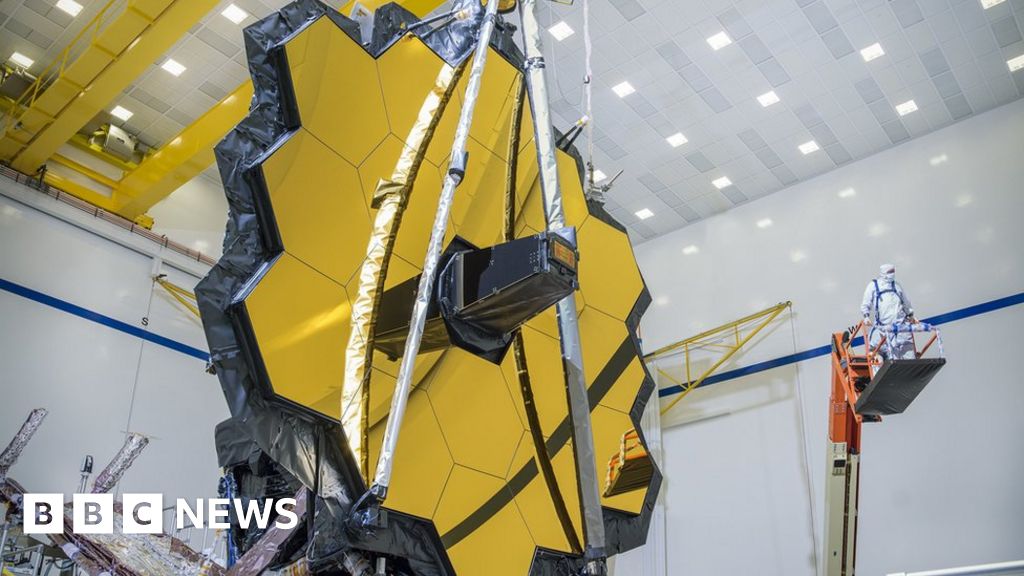
James Webb's mirror is revealed

_89452685_clnrmr.jpg

_84576408_jwst_labelled_624in.jpg


Revealed for the first time in all its glory - the main mirror of the James Webb Space Telescope, which will be launched in 2018.
JWST is regarded as the successor to Hubble, and will carry technologies capable of detecting the light from the first stars to shine in the Universe.
Paramount in that quest will be a large primary reflecting surface.
And with a width of 6.5m, JWST's will have roughly seven times the light-collecting area of Hubble's mirror.
It is so big in fact that it must be capable of folding. Only by turning the edges inwards will the beryllium segments fit inside the telescope's launch rocket.
The observatory is currently under construction at the US space agency's Goddard Space Flight Center in Maryland.
When in recent months engineers stuck down the segments to their support structure, each hexagon had a cover on it.
Only now, as the engineers prepare to move to the next stage of assembly, have those covers been removed to reveal the full mirror.

Shortly, the secondary mirror, which is at the top of the black extension poles will be collapsed into a flat configuration.
Then, the whole edifice will be flipped 180 degrees. This will permit the engineering team to attach JWST's instruments behind the main mirror.
These can be seen in a raised cage off to the left.
Leaving such a sensitive surface exposed even for a short time may appear risky. The fear would be that it might get scratched. But the European Space Agency's JWST project scientist, Pierre Ferruit, said that was unlikely.
"The main danger is to get some accumulation of dust. But it's a cleanroom so that accumulation is very slow," he told BBC News.
"They need to rotate the telescope to get access to the back, and the protective covers were only resting on the mirror segments, so they had to be removed before the rotation.
"When the mirror is upside down, the exposure to dust will be much less, and I doubt anyone will be allowed to walk underneath."

Once the integration of mirror and instruments is complete, the telescope will be sent for environmental testing. It will be shaken and blasted with sound to mimic the rough rocket ride to orbit.
Assuming that goes well, the whole train - mirror and instruments - will ship to Nasa's Johnson Space Center in Texas for some final deep-chill testing.
This will be conducted in the giant cryo-vacuum chamber built to accommodate the 1960s Apollo hardware.
Once that work is done, engineers must attach the spacecraft bus, which incorporates elements such as the flight computers and communications system. Finally, James Webb will be given an immense deployable visor - the structure that will shield its delicate observations from the Sun's light and heat.
JWST is a joint venture between the US, European and Canadian space agencies.
Each of the partners has supplied instruments for the observatory. A key additional role for Europe is to launch the telescope. An Ariane rocket will be used. It will be the launcher's most valuable ever payload.
The full life-cycle cost of the JWST project is expected to approach $10bn once all the partners' contributions are taken into account.

_84597247_jwst_primary_mirror_size_comp_624in.png

Source
 
jwst.jpg

Twenty years ago, scientists began assembling a next-generation telescope that would be the successor for the Hubble. Now, NASA engineers have announced that construction of the James Webb Telescope (JWST) is finally complete. The telescope, which is twice the size of Hubble with a 21-foot mirror, is ready for testing before its scheduled launch in October 2018.
"Today, we're celebrating the fact that our telescope is finished, and we're about to prove that it works," said John Mather, an astrophysicist and senior project scientist for the telescope at a news conference reported by Space.com.
Inspired by the success of the Hubble Space Telescope, NASA and its European and Canadian counterparts collaborated on the design and construction of the JWST. The resulting telescope is bigger and more powerful than the Hubble, giving it the ability to see the first galaxies born after the Big Bang. The observations it makes will not only help scientists understand the origins of the universe, but also search for signs of life on faraway planets.
By looking at infrared light given off by all objects in space, the unmanned telescope will pull back the curtains of the universe and see stars too distant even for the Hubble. Eighteen large hexagonal mirrors, made out of lightweight berylium and coated with gold will collect the infrared readings for the JWST. They’ll operate at close to absolute zero temperatures, from a point in space called the Lagrange Point 2, which is directly behind Earth from the sun's perspective.
Unlike with Hubble, astronauts won’t be able to reach the JWST to fix a problem after it launches.
But to ensure the telescope will work in space, NASA needs to put it through a series of rigorous tests.
First, scientists at the Goddard Space Center in Maryland will shake the vehicle and blast it with about 150 decibels of violent noise to simulate the rough conditions it’ll experience during launch. Then, the mirror and instruments will be shipped to the Johnson Space Center in Houston for some cryogenic testing, to ensure it can withstand the frigid conditions of space. Once that work is done, engineers will attach the telescope to the spacecraft bus, which incorporates elements such as the flight computers and communications system. Finally, James Webb will be given a tennis-court-sized shield to protect its delicate instruments from the Sun and undergo even more testing to make sure its measurements are not out of whack before it launches.
By the time the telescope is finally shipped to French Guiana for its launch on top of the European Ariane 5 rocket, the total cost is expected to reach $10 billion. So far, the telescope is on schedule and on budget, but each stage of the upcoming testing must go exactly according to plan. Unlike with Hubble, astronauts won’t be able to reach the JWST to fix a problem after it launches. The telescope will be stationed too far away for them to reach — about 930,000 miles from Earth.
Once it is in position, though, together the James Webb and Hubble will give scientists an unprecedented view of the universe.

Source
 
The James Webb Telescope Is Delayed. Again. Here Are 4 Things to Know About it

When you’re building the largest and most ambitious space telescope ever made, you have to expect that some things will go wrong.

At least, that seems to be the takeaway from a teleconference held by NASA today about the James Webb Space Telescope (JWST), a 6.5 meter (21 foot)-wide telescope that will observe distant space a million miles from the sun, all kept cool by an origami-folded sunshield the size of a tennis court.

That is, if it ever makes it off the ground.

[video=youtube;v6ihVeEoUdo]https://www.youtube.com/watch?v=v6ihVeEoUdo[/video]

When you’re building the largest and most ambitious space telescope ever made, you have to expect that some things will go wrong.

At least, that seems to be the takeaway from a teleconference held by NASA today about the James Webb Space Telescope (JWST), a 6.5 meter (21 foot)-wide telescope that will observe distant space a million miles from the sun, all kept cool by an origami-folded sunshield the size of a tennis court.

That is, if it ever makes it off the ground.


Based on information from the project’s Standing Review Board (SRB), NASA officials have decided to delay the telescope’s launch window to roughly May 2020. (In 2011, it was supposed to launch in 2018; in September, officials pushed that back to 2019)

Here are four new things you should know about this latest James Webb update, and why we’re going to have to wait a little longer to get its unprecedented new view of the universe. But stay tuned, because it’ll be worth it.

1. THE LAUNCH DELAY IS ABOUT “GETTING IT RIGHT”…
The primary cause of the delay: to ensure that NASA is as confident as possible before launch.

Since there will be no way of repairing the JWST if something goes wrong out in space, they want to ensure everything is in the best shape it can be before sending it adrift.

“Simply put, we have one shot to get this right before going into space,” Thomas Zurbuchen, Associate Administrator of NASA’s Science Mission Directorate (SMD), said during today’s press conference. “You’ve heard this before … failure is not an option.”

The recent SRB review evaluated whether JWST would be ready for a May 2020 launch. Its confidence level: 70 percent. That’s a normal level of confidence for a large NASA project, Zurbuchen and his colleagues said, but another upcoming Independent Review Board (IRB) will seek out additional ways to raise that number.

And yeah, potential budgetary issues are a concern, too.

2. …BECAUSE THINGS HAVE GONE WRONG.
Officials are afraid things will go wrong because, in the nearly twenty years that NASA and associated contractors have been building the James Webb, things have.

Some of the most recent delays were associated with errors. Like when they discovered that the sunshield’s tension-creating cables were too slack. This could have created a risk that the cables would snag on something as the sunshield unfolded, keeping it from deploying.

Contractor Northrop Grumman also accidentally put several small tears in the sunshield.

And during tests, scientists discovered that the propulsion system could allow leaks from the telescope’s thruster valves.

The telescope has already gone through considerable testing to make sure it can make it to its million-mile destination and start doing science once it’s there. This year, NASA is planning to do more tests, on individual pieces and the telescope as a whole (once it’s welded together), to ensure it can survive the traumatic journey from Earth to space.

More At: https://futurism.com/james-webb-telescope-delayed/
 
Top
Sign up to the MyBroadband newsletter
X