


Gordon_R
Honorary Master
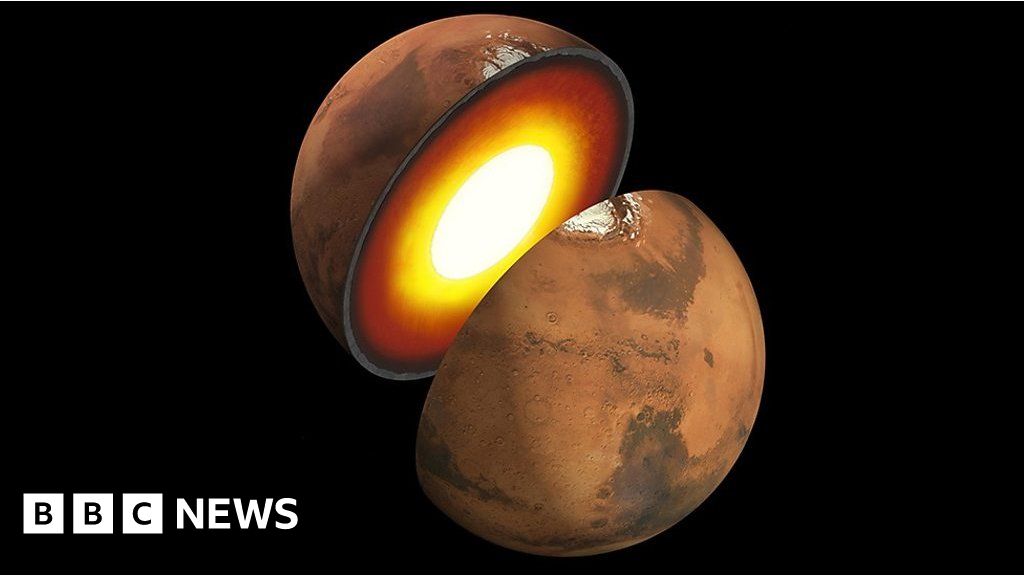
Nasa probe determines Mars' internal structure
Scientists now have absolute numbers for the thickness of the Red Planet's crust, mantle and core.
 www.bbc.com
The data comes from the InSight spacecraft, which has been sensing quakes on the planet since early 2019.
The Nasa-led mission reveals the average thickness of Mars' crust to be between 24km and 72km - somewhat thinner than had been expected.
But the key finding is the size of the planet's core. Its radius of 1,830km is at the top end of previous estimates.
This is the first time science has managed to directly map the internal layering of a planet apart from the Earth. It's been done also for the Moon, but Mars (total radius: 3,390km) is on a much larger scale.
Having this information allows researchers to better understand the formation and evolution of different planetary bodies.
The seismometer system deployed by the Nasa probe has observed hundreds of tremors, with a handful over the past two years having just the right properties to "image" Mars' interior.
The instrument team, which is led from France and the UK, determines the rigid outer part, or crust, of Mars to be either 20km or 39km thick directly under the probe (depending on the precise sub-layering that exists). Extrapolating to the known surface geology of the rest of the planet, this suggests an average thickness of between 24km and 72km. By contrast, Earth's average crustal thickness is 15-20km. Only in a continental region like the Himalayas can it reach 70km.
The really interesting number, however, is for the core. Signals from "Marsquakes" bouncing off this metal feature indicate that it starts nearly halfway down from the surface, at a depth of about 1,560km - and that it's in a liquid state. Most prior estimates called for a smaller core.