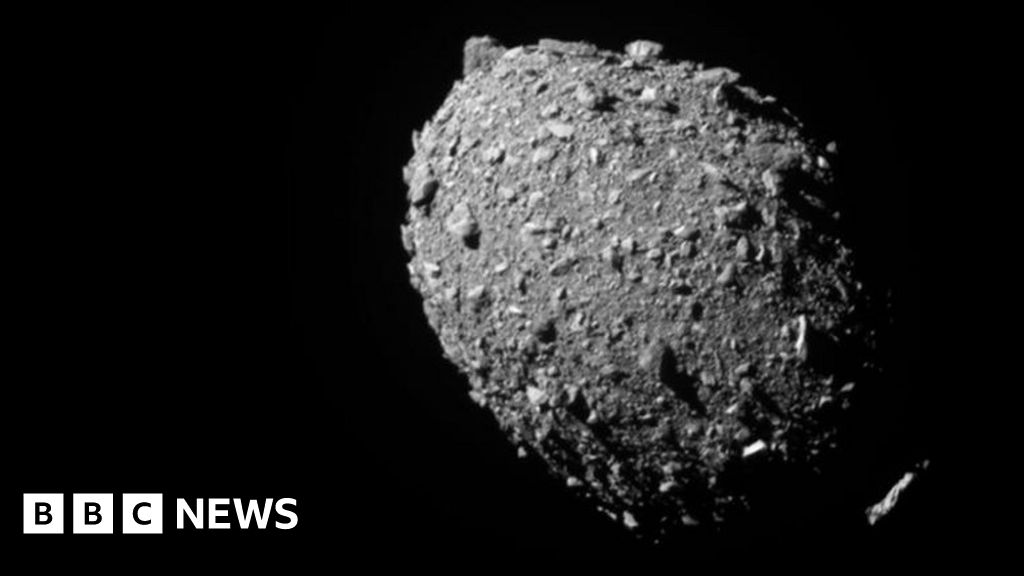
Nasa slams Dart spacecraft into asteroid

Hanno Labuschagne

Journalist
Staff member
Joined
Sep 2, 2019
Messages
4,122
Nasa slams Dart spacecraft into asteroid

A Nasa spacecraft successfully crashed into an asteroid approximately 6.8 million miles (10.9 million kilometres) from Earth in a test to determine if the impact can nudge the space rock slightly off course.

Nasa launched its Dart spacecraft in November 2021 with the express purpose of colliding with an asteroid about the size of a football stadium at 14,000 miles per hour.

[Bloomberg]
 

Itsa Trap

Expert Member
Joined
Jan 22, 2020
Messages
4,110
Humanity 1, Space rock 0...

I've read the work of a very wise author who once wrote:

“If complete and utter chaos was lightning, then he'd be the sort to stand on a hilltop in a thunderstorm wearing wet copper armour and shouting 'All gods are bastards!”​


However in this case I would equate this to human hubris, you know, the kind where you call a ship unsinkable.

Whomever came up with that 1-0 title, thank you for dooming the species. Gods bless.
 

ForceFate

Honorary Master
Joined
May 18, 2009
Messages
41,137
I mean honestly, if you kept score since the planet formed... errr, I think we're a bit late to the game of revenge strikes.
We were not part of the team that was utterly humiliated by space rocks. We're new. Our match has just kicked off.
 

heinrikur

Well-Known Member
Joined
Sep 7, 2018
Messages
177
They, they cost a quarter of a billion ZAR per frame at todays rate. Expensive game of darts. At least it hit!
They learned everything they know from Mark Rober


I wonder if they tracking the trajectory of the asteroid after the deflection?
 

Gordon_R

Honorary Master
Joined
Jul 5, 2009
Messages
20,815
The impact produced some extraordinary effects:
The extraordinary image was taken two days after the collision by astronomers in Chile, who were able to capture the vast trail using the Southern Astrophysical Research Telescope (Soar).

It stretches for more than 10,000km (6,200 miles), and is expected to get even longer until it disperses completely, and looks like other space dust floating around.

"It is amazing how clearly we were able to capture the structure and extent of the aftermath in the days following the impact," said Teddy Kareta, an astronomer involved in the observation.
 

Gordon_R

Honorary Master
Joined
Jul 5, 2009
Messages
20,815
NASA confirms a change in the asteroid trajectory:
The space rock orbits a much larger (780m wide) object called Didymos. Before impact, the time taken for Dimorphos to make one circuit of its sibling was 11 hours and 55 minutes.

The telescope evidence now indicates this orbital period has been reduced to 11 hours and 23 minutes - a change of 32 minutes.
 
Top