Newbie question re: inverter battery

Candystore

Expert Member
Joined
Jan 23, 2009
Messages
2,992
Reaction score
943
I was told that I shouldn't discharge the inverter battery more than 50%, preferably keep them around 70%.

So, in my case, my desktop PC and a desklamp are plugged into the inverter. So each and every time there is load-shedding, I should physically unplug them once the inverter battery drops to around 50%?

So looking at the inverter screen, what number constitutes 50% capacity? I bought a 2400va unit.
 
1 bar ~75% 2 bar ~50% (Well,not exactly but best reading you'll get from there)
 
50% = 0.5 = 1/2 = 2/4
You have 4 indicator bars of battery life
If you lose 1 bar, you have 3 bars left or 75% or 3/4
If you lose 2 bars, you have 2 bars left or 50% or 2/4
When the battery indicator is at 2 bars, switch off the inverter
 
1 bar ~75% 2 bar ~50% (Well,not exactly but best reading you'll get from there)
Well not exactly some of these indicators the moment you lose the third bar is when you dipped under 75%

So you are inbetween 50-75% with 2 bars on mine

And the moment you have one bar you dipped under 50%
ie 48% isn't 50%

Why they could not just do %

Now yes this varies from device to device

My battery indicator works like that so YMMV

I have coms to the battery on laptop hence why i know mine works like that

You need to check yhe manual of the specific device to see what it does
 
Last edited:
I was told that I shouldn't discharge the inverter battery more than 50%, preferably keep them around 70%.

So, in my case, my desktop PC and a desklamp are plugged into the inverter. So each and every time there is load-shedding, I should physically unplug them once the inverter battery drops to around 50%?

So looking at the inverter screen, what number constitutes 50% capacity? I bought a 2400va unit.
What batteries do you have? Pic?
 
Those bars will probably be based on voltage, so very imprecise.

You should go by the battery rated capacity, load, and time.

Assuming you have lead acid, 2 * 12 V * 100 Ah = 2 400 Wh. For a max depth of discharge of 50% you have 1 200 Wh to work with.

If your load is 170 W then you have 1 200 Wh / 170 W = 7 hours runtime to 50% (on new batteries).

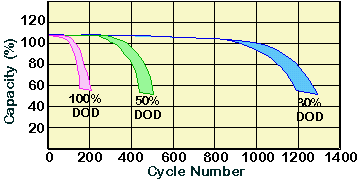
But even 50% DoD on lead acid is pushing it. You should aim for 30% or less if you want to get more than a year out of them under continuous stage 4+.

0.3 * 2400 = 720 Wh
720 / 170 = 4 hours
So you are probably alright.

capacity_vs_cycle.gif
 
Those bars will probably be based on voltage, so very imprecise.

You should go by the battery rated capacity, load, and time.

Assuming you have lead acid, 2 * 12 V * 100 Ah = 2 400 Wh. For a max depth of discharge of 50% you have 1 200 Wh to work with.

If your load is 170 W then you have 1 200 Wh / 170 W = 7 hours runtime to 50% (on new batteries).

But even 50% DoD on lead acid is pushing it. You should aim for 30% or less if you want to get more than a year out of them under continuous stage 4+.

0.3 * 2400 = 720 Wh
720 / 170 = 4 hours
So you are probably alright.

capacity_vs_cycle.gif
And thn add peukert losses and that is why the math is out and using 30% is actually more like using 50%

ie people think they use 50% because the math says they used 50%

But the moment you take peukert into account they actually used way more than 50%
 
The inverter will only be able to show you the voltage on your batteries. If they are lead, then there's a fairly well-defined voltage curve but it's not perfect. For lithium, they stay stable in output voltage over a fairly wide range and you need more sophisticated electronics to watch the state of charge.

It's a hard problem. Need more information than you've provided in your picture.
 
50% = 0.5 = 1/2 = 2/4
You have 4 indicator bars of battery life
If you lose 1 bar, you have 3 bars left or 75% or 3/4
If you lose 2 bars, you have 2 bars left or 50% or 2/4
When the battery indicator is at 2 bars, switch off the inverter
Switch off the inverter .... or simply unplug the devices that was hooked up to the inverter?
 
The inverter will only be able to show you the voltage on your batteries. If they are lead, then there's a fairly well-defined voltage curve but it's not perfect. For lithium, they stay stable in output voltage over a fairly wide range and you need more sophisticated electronics to watch the state of charge.

It's a hard problem. Need more information than you've provided in your picture.
Like what?
 
Like what?
You've given information about the inverter there.

The batteries are the important thing.

2x 100 Ah batteries (if I'm understanding you correctly) are probably lead-acid. So accurately determining your state of charge is going to be difficult, the four bars on your inverter are a thumb-suck at best.

@Tomtomtom did the maths a few posts above. The "Load" number is what you want to keep an eye on - keep it as low as possible during load-shedding and you should be good. If you stay within a reasonable discharge, good deep-cycle batteries can last 3 to 5 years. But if you push them hard or they're not good quality, then expect less lifespan, especially in the current load-shedding climate.
 
You've given information about the inverter there.

The batteries are the important thing.

2x 100 Ah batteries (if I'm understanding you correctly) are probably lead-acid. So accurately determining your state of charge is going to be difficult, the four bars on your inverter are a thumb-suck at best.

@Tomtomtom did the maths a few posts above. The "Load" number is what you want to keep an eye on - keep it as low as possible during load-shedding and you should be good. If you stay within a reasonable discharge, good deep-cycle batteries can last 3 to 5 years. But if you push them hard or they're not good quality, then expect less lifespan, especially in the current load-shedding climate.
Not sure if this is the info you need, but according to the supplier, this is a 2400 crystal xi, a 2 battery system with a 100amp battery.
 
You've given information about the inverter there.

The batteries are the important thing.

2x 100 Ah batteries (if I'm understanding you correctly) are probably lead-acid. So accurately determining your state of charge is going to be difficult, the four bars on your inverter are a thumb-suck at best.

@Tomtomtom did the maths a few posts above. The "Load" number is what you want to keep an eye on - keep it as low as possible during load-shedding and you should be good. If you stay within a reasonable discharge, good deep-cycle batteries can last 3 to 5 years. But if you push them hard or they're not good quality, then expect less lifespan, especially in the current load-shedding climate.
Thanks!
 
Top
Sign up to the MyBroadband newsletter
X