Nissan Sakura

FiestaST

Honorary Master
Joined
Aug 9, 2009
Messages
216,100
Reaction score
98,972
Location
CPT~ /\\/¯¯¯\\/\\ ~ZA
Nissan's new electric minivehicle in Japan./

Nissan Sakura

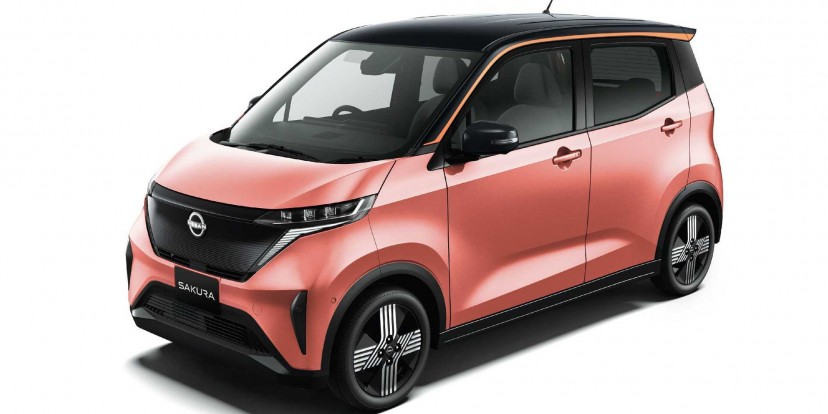
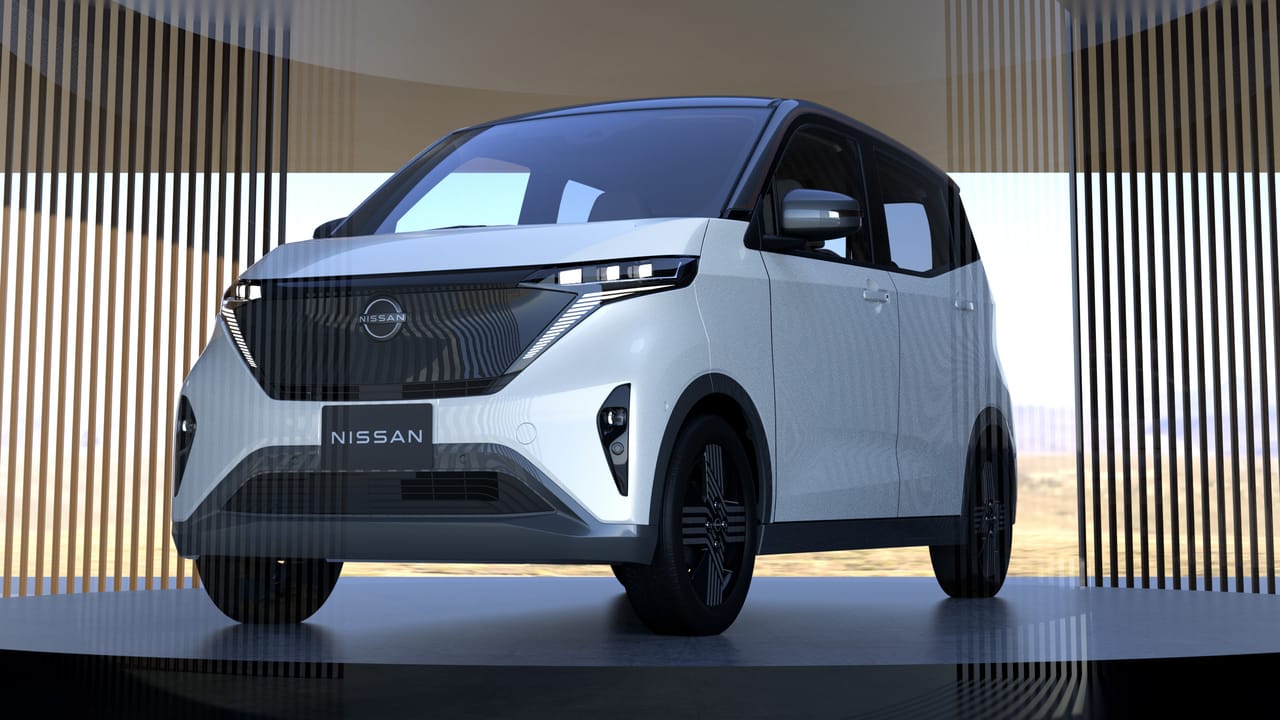
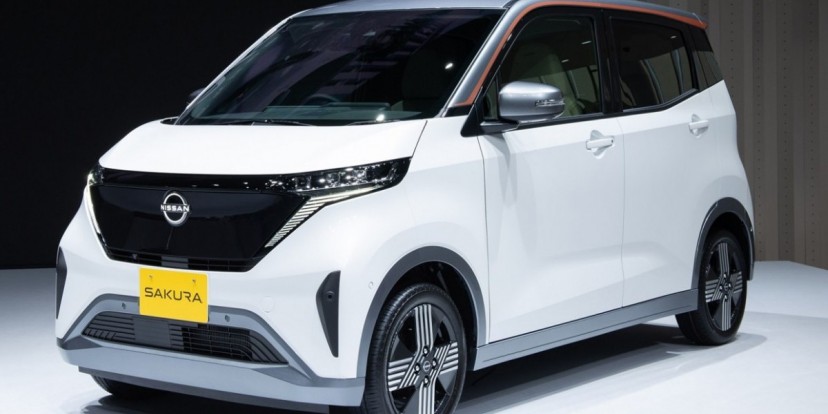
Nissan unveiled the all-new Sakura electric minivehicle in Japan. Sales of the newest addition to Nissan's EV lineup are scheduled to start in the market during summer 2022.

Named after the iconic Japanese cherry blossom, the Sakura's affordable price provides more consumer choice in the EV market. Nissan Executive Vice President Asako Hoshino says: "The all-new Sakura follows the LEAF and Ariya as a mass-market EV. We believe it will be a gamechanger for the Japanese market and will make EVs much more accessible to customers in Japan."

The Nissan Sakura EV takes the minivehicle class to the next level. Its nimble handling and 4.8 meter turning radius allows drivers to execute sharp maneuvers with ease. Despite its size, the Sakura has a spacious interior and an ample driving range, making it perfect for daily driving needs such as commuting and shopping. It also features ProPILOT Park, an automated system designed to make parking easier and driving more pleasurable.


Sakura 1.jpegSakura 2.jpegSakura 3.jpegSakura 4.jpegSakura 5.jpegSakura 6.jpegSakura 7.jpegSakura 8.jpegSakura 9.jpegSakura 10.jpeg
 
Nissan Sakura and Mitsubishi eK X unveiled - electric kei cars from Japan

Now Nissan and Mitsubishi become the first automakers to introduce electric versions of their Kei car, targeting what is arguably the most important segment of the automotive market in Japan.

Kei cars represent about a third of all new cars sold lately, while in 2018 7 out 10 best selling cars were kei car models. The distinctive “yellow plate” cars (thanks to - you guessed it - yellow number plates) are governed by very strict rules, the engine power is limited to 47kW and size is limited to 660cc. The cars cannot be longer than 3.4 m (11.2 ft) and wider than 1.48 m (4.9 ft) with maximum height set at 2 m (6.6 ft).

The cars are specific for Japan due to high traffic volumes in the cities, narrow streets and parking restrictions. You can only buy a car in Japan if you have a parking space for it, but the rule doesn’t apply to kei cars, nor does the requirement for driving license or yearly taxes. They are cheap to buy, cheap to run and cheap to look after. And they have a cult following all over the world.

Nissan and Mitsubishi teamed up to share development and manufacturing costs and the result is two almost identical looking cars built on a shared platform with identical performance figures. Nissan named its car Sakura - name of a huge significance for the brand. It means cherry blossom in Japanese, an item very important to Japanese culture signifying rebirth.

It is also a name that Nissan gave to its 200SX (S110) known as Nissan Silvia in the whole world apart from Mexico where it was sold as Datsun Sakura. Sakura was also what the Datsun 1000 Sedan was called when it took part in the Mobilgas Trial in Australia in 1958. That car came in 4th place after 16,000 km and 19 days of grueling adventure and brought the Datsun and Nissan to a global stage.

The Nissan Sakura is only intended for the Japanese market, but private imports will bring this car to countries like the UK or South Africa and Australia since it is only available as a right hand drive option. The car goes on sale in just a few months and it will cost 1.78 million yen after a 550,000 yen government subsidy (that’s $13,900 net price). The interior of the car is plush with room for 4 adults, clever materials are used everywhere and the car feels really spacious despite its miniscule dimensions.


1.png2.png
 
Nissan’s Japan-only Sakura is an £11k all-electric kei car for the masses

Clever packaging means the Sakura gets four seats, an 81mph top speed and 112 miles of range

Top Gear has long argued that car and lawmakers alike should introduce the brilliant kei car regulations to Britain. Sold almost exclusively in Japan, kei cars need to be narrower than 1.5 metres and shorter than 3.4 metres. They also usually need an engine that’s no bigger than 660cc, although that particular rule doesn’t apply to Nissan’s latest creation.

This is the Sakura – an all-electric kei car that’ll go on sale in its home country this summer.

Who needs a crossover or a full-size SUV in a city or a small UK village? What you really want is the dinky Sakura. It still seats four people with 107 litres of luggage space, has two massive screens inside (7.0-inches for the driver display and 9.0-inches for the infotainment) and costs from just £11,000 (1.78 million yen) after subsidies in Japan. Oh, and it’ll do 112 miles on a single charge.

 
Nissan stops taking orders for the Sakura because of huge wait times

Nissan's Sakura EV Kei car is apparently doing very well - so well, in fact, that the company was forced to stop offering it. Nissan has announced that it stopped taking orders for the Sakura in its home market of Japan, because it got to the point where it couldn't give its customers any delivery date estimates whatsoever.

Before that, lead times were over a year. It's unclear when people in Japan will be able to order the Sakura again. The car was popular from the get-go. It was introduced back in May, and by July it reached 23,000 orders. Clearly, Nissan wasn't expecting it to be this successful, and now it remains to be seen whether it can increase production capacity to actually meet the obviously large demand.

The blame, as always, falls onto the global chip shortage, according to a Nissan spokesperson talking to Reuters. That and "strong orders".

 
  • Like
Reactions: Shi
How Japan’s small Kei cars could thrive in Europe

Low-cost, low-emissions Japanese microcars could capitalise on market as European prices surge

If there was ever a time for kei cars to do well in the UK, it would be now.” That’s according to Torque GT, one of the UK’s leading importers of Japanese cars.

Demand for these microcars is growing, says the firm, driven by the arrival of “brilliant” new models coinciding with growing concerns about low-emissions zones such as London’s ULEZ.

Kei (short for keijidosha) cars are Japanese market models with government-regulated size and engine displacement limits, first introduced after the Second World War to help get the country moving again.

Tax and insurance benefits, as well as exemption from shako shomeisho rules – requiring motorists to prove they have off-street, overnight parking – eventually spurred on strong demand for these vehicles.

Despite swingeing cuts to monetary incentives, kei cars today remain among Japan’s most popular models. They accounted for more than one in three of the 4.2 million new cars sold in Japan last year, giving importers a huge stock to choose from in the coming years.

According to Torque GT, “demand [in the UK] is only increasing”. Although buyers have historically sought sporting models with a cult following – such as the Honda Beat, Honda S660 and Suzuki Cappuccino – their appetite for more mainstream models is growing. These include the Toyota Pixis Mega mini-MPV as well as the Honda Acty and Subaru Sambar pick-ups.

https://www.autocar.co.uk/car-news/new-cars/how-japan’s-small-kei-cars-could-thrive-europe
 
Top
Sign up to the MyBroadband newsletter
X