Rainwater harvesting and inline chlorination

frankvw

Well-Known Member
Joined
Aug 8, 2009
Messages
178
Reaction score
65
I'm at the south coast and we're lucky to have municipal water one day a week. But we have a lot of rain that is quite clean (compared to, say, the liquid industrial waste that falls in Gauteng) so harvesting rainwater is a no-brainer as far as I'm concerned. We already did that on a smaller scale (one tank) on our previous property and that worked fine, but I found that the biggest challenge was accurate chlorine dosaging. Rainwater is run-off from the roof, which means it picks up anything from bird dirt to monkey business, so it's not microbially safe unless you treat it. I've got leaf catchers, first flush diverters and inlet screens that stop 95+% of the solids, and I'm running the water out of the tank through a 5 micron polypropylene filters which leaves the water as clear as municipal water. (I've found that 1 micron filters clog up too quickly and are not really necessary in any case.) Which leaves antimicrobial treatment.

Previously I chlorinated all the water in the tank at once, first by adding Aquatabs (8.68 gram fizzy NaDCC tablets, two for a 5,000L tank), then with a pool floater filled with slow release sodium hypochlorite tablets. Both work, but the problem is that it's very hard to regulate the chlorine content in the water. The amount of water in the tank varies, and the amount of chlorine released from the pool floater is not constant. So 99% of the time there's either too much chlorine so that you've got swimming pool water coming out of your tap and the chlorine overwhelms the active carbon filter, or not enough so that the water smells musty due to decomposition of organic matter, which means that it's no longer microbially safe.

So I'm looking at in-line chlorination. And, since I'm doing this on a shoestring budget, ways to achieve that without breaking the bank.

We have four tanks: 3 x 5,000L that will store captured rainwater, and one 2,500L that is currently a municipal water backup tank. The idea is to pump water from the rainwater tanks through an inline chlorine dosage system into the 2,500 tank, so that the latter will act as a contact tank. Chlorine needs time to eliminate microbes, so you can't chlorinate water and then run it out of the tap immediately; it needs to sit for a certain amount of time before it can be used. So I'm thinking of running the water through the chlorinator into the holding tank in the middle of the night, using a simple timer to switch the transfer pump on and a float switch in the holding tank to switch if off when that tank is full.

Which leaves me with two challenges: finding an affordable inline chlorination unit, and an affordable pump with the right specs.

Starting with the chlorination unit: liquid dosing pumps are out. The few locally available pmodels are intended for much larger installations and well outside my budget, not to mention the challenges associated with liquid calcium hypochlorite or NaDCC (which is hazardous to store and handle). That leaves the simpler units using solid calcium hypochlorite tablets.

The main product on the SA is the Klorman in-line unit (e.g. here).

0004948_klorman-inline-chlorinator-click-for-more-info.jpeg


At R1,400 and up it's not cheap but it does seem to be the product of choice. However, there's an alternative for use with swimming pools, which is this one here:

in-line-chlorine-feeder-400x400-1.png

This one is about half the price of the Klorman unit. But the specs are a bit sketchy, so I'm not sure what chlorine tablets or flow rates this one is made for.

So I'm open to suggestions here. Are there any other affordable options that work well?

Second, the pump. I need a fairly low flow rate. Standard clean water pumps for Jojo-type tanks are centrifugal pumps starting at 375W and a flow rate of 30L/min which is higher than I'm looking at. (Around half that would be ideal.) But smaller pumps for this application are hard to find; all I can see are pond fountain pumps (unsuitable) or even smaller aquarium pumps.

So I can use some advice here. All suggestions would be greatly appreciated!

// FvW
 
Last edited:
I'm interested in what other people suggest - I dose my tanks every couple of weeks, or after any significant rain, with shock-it. 10g per 1000 litres.

We buy our drinking water from a shop so I'm not overly concerned about 100% efficacy.
 
Is chlorine the way to go ?

I would just add a pre-filter and then use an inline UV filter.
Chlorine is going to be harsh on whatever you are using it for.... washing etc.
I know someone who was using peroxide, but it did also stuff up all his clothes.
 
I'm interested in what other people suggest - I dose my tanks every couple of weeks, or after any significant rain, with shock-it. 10g per 1000 litres.

We buy our drinking water from a shop so I'm not overly concerned about 100% efficacy.
That's not a bad place to start. HTH Shock-it is (AFAIK) non-stabilised calcium hypochlorite, which is exactly what you want for water tanks. But once again getting the dosage right is a challenge. Too little and you're not safe; too much and you'll quickly saturate active carbon filters and you end up with swimming pool water. If you're not drinking it (as in your case) this is of course less critical, but still too much or too little chlorine is not ideal and the hassle of having to add it manually at the right time is also a bit of a pain (for me at least). Even after periods without significant rain the free chlorine will evaporate from the water which requires re-dosing.
 
Is chlorine the way to go ?

I would just add a pre-filter and then use an inline UV filter.
Chlorine is going to be harsh on whatever you are using it for.... washing etc.
I know someone who was using peroxide, but it did also stuff up all his clothes.
UV is an option. However, it does use a significant amount of electricity (more than we've got available from our PV panels) and you need one UV unit per tank, so I'd need three, and the average service life of the UV lamp is about one year. So that's a significantly more expensive option. (Update: you're looking at about R5k-R6k per tank initially and about R3k per year per tank for lamp replacements.)

I'm not using peroxide. Any oxidizing agent that bleaches textiles has been used in way too high a concentration, and peroxide is not stable enough so you would have to use a lot. And it's expensive.
 
Even after periods without significant rain the free chlorine will evaporate from the water which requires re-dosing.
You shouldn't be introducing further contaminants if it hasn't rained.

All the rainwater flows into one 5000l tank initially, before it is distributed to the supply tank, so this is the one I dose more frequently, as well as clean every couple of years.
 
UV is an option. However, it does use a significant amount of electricity (more than we've got available from our PV panels) and you need one UV unit per tank, so I'd need three, and the average service life of the UV lamp is about one year. So that's a significantly more expensive option. (Update: you're looking at about R5k-R6k per tank initially and about R3k per year per tank for lamp replacements.)
Oh wow, I had no idea the costs were that high. At those prices you may as well just buy the water.
I'm not using peroxide. Any oxidizing agent that bleaches textiles has been used in way too high a concentration, and peroxide is not stable enough so you would have to use a lot. And it's expensive.
Yes, agreed. But to me using peroxide, chlorine or fluoride are all going to have this issue.

I saw a recommendation that you just put a dash of bleach in a tank and that will be enough.
 
You shouldn't be introducing further contaminants if it hasn't rained.
Not quite. Consider the following scenario:
  1. Rain falls. Tank fills up.
  2. Chlorine is added and inactivates microbes. The water is now microbially safe.
  3. Over time the free chlorine evaporates. The water is still microbially safe.
  4. Now a small amount of rain water falls (say, and overnight drizzle) or the high humidity at the South Coast where we live results in significant condensation at night when the temperature drops. (Our wooden balustrade is frequently so wet that it actually has water standing on it!) This is enough to make some water drip into the roof gutters and eventually into the tank. This introduces a small amount of new microbes into the water.
  5. Organic matter is still present in the tank. The new microbes feast on this, multiply and are fruitful, causing the microbe count to shoot up.
  6. The water is now no longer microbially safe even though there has been no significant rain.
 
[...] to me using peroxide, chlorine or fluoride are all going to have this issue.

I saw a recommendation that you just put a dash of bleach in a tank and that will be enough.
No. Peroxide, chlorine and fluorine are all oxidizing agents (i.e. anti-microbial and acting as a bleaching agent, among other things) but they have quite different properties. Firstly, fluorine is not suitable for water treatment as it is harmful to the human body in sufficient quantities (fluorine salts such as fluoride are toxic) and it is corrosive. (Fluorine is used to etch glass.) The problem with peroxide is that it is far less stable than chlorine; hydrogen peroxide will turn into water over time and if you expose it to sunlight this can happen in a matter of hours. Also, there is no good way to test whether or not peroxides haven't degraded to the point of being useless short of adding reagents and essentially running a lab test on it.

Bleach is not recommended either. Bleach is sodium hypochlorite rather than calcium hypochlorite, which means it may significantly increase your sodium intake with potentially detrimental health effects. It's fine for emergencies and for occasional use, but it should not be considered for permanent applications.
 
UV is an option. However, it does use a significant amount of electricity (more than we've got available from our PV panels) and you need one UV unit per tank, so I'd need three, and the average service life of the UV lamp is about one year. So that's a significantly more expensive option. (Update: you're looking at about R5k-R6k per tank initially and about R3k per year per tank for lamp replacements.)

I'm not using peroxide. Any oxidizing agent that bleaches textiles has been used in way too high a concentration, and peroxide is not stable enough so you would have to use a lot. And it's expensive.

Those prices are way off.

The way to do this is have the rainwater stored in tank A, then pump it to tank B which is the drinking water tank (or gravity feed if you bury tank B).

Between tank A and B you have a filter and a UV light. That way you only need to run the light for as long as it takes to pump the water from one tank to another.

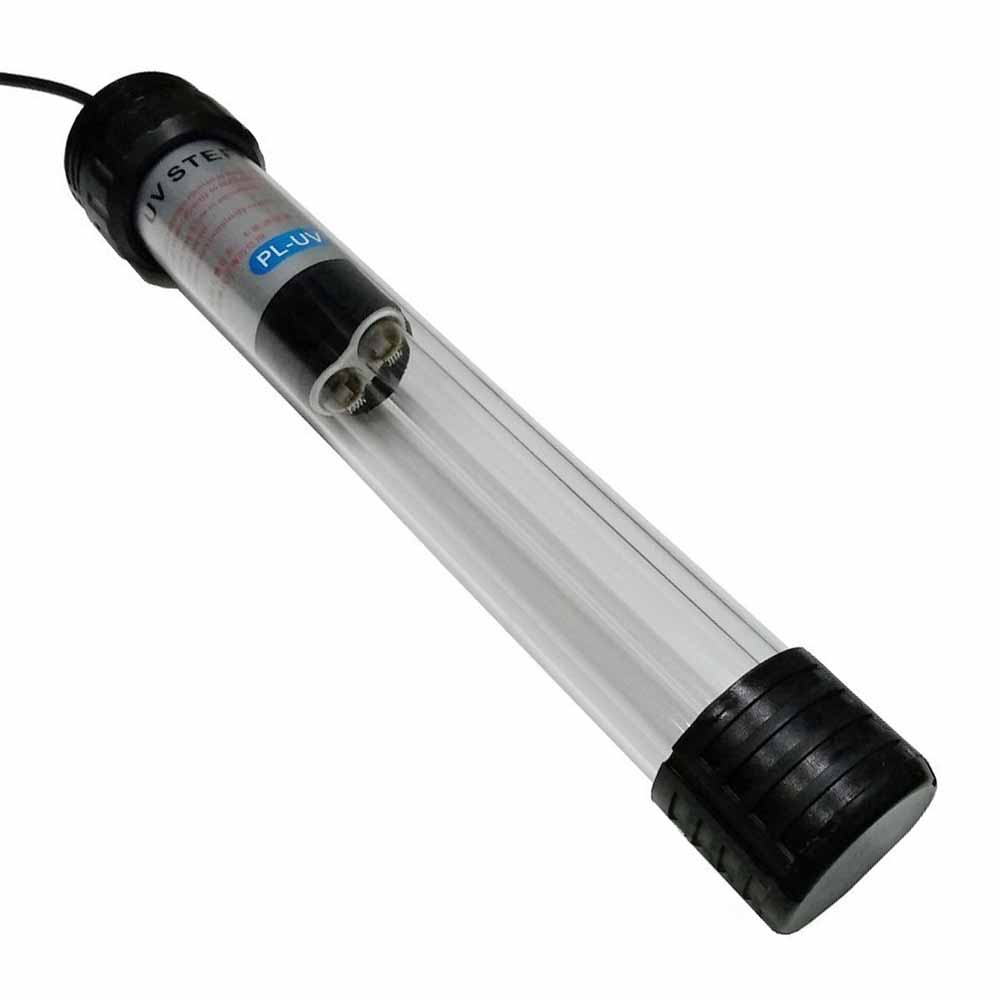
You can buy a 75W UV-C submersible sterilizer lamp, which is way overkill, for R1094.- . You place that into a vertical 110mm PVC pipe on the way to tank B.


This can all be automated using a float switch.

Don't put chemicals in your water.
 
Last edited:
My setup is like this:
Municipal feed -> 3-stage filter -> storage tanks -> booster-pump & pressure tank -> inline 55W UV-filter -> house.

The UV filter was about R1800 and I bought 3 replacement lamps for R450 each. There is a flow-sensor switch which starts the UV-filter as water flows.

The storage tanks are blackened on the inside as well.

The original UV filter bulb is still going 2 years in; the 3-stage filters have been replaced twice. Got to do another replacement somewhere in September.
I suppose one would have to replace them more frequently for rainwater.
 
Those prices are way off.

The way to do this is have the rainwater stored in tank A, then pump it to tank B which is the drinking water tank (or gravity feed if you bury tank B). Between tank A and B you have a filter and a UV light. That way you only need to run the light for as long as it takes to pump the water from one tank to another. You can buy a 75W UV-C submersible sterilizer lamp, which is way overkill, for R1094.- . You place that into a vertical 110mm PVC pipe on the way to tank B.
Hmm. That is an interesting idea. I'd want to make sure that the UV exposure time of the water is sufficient, of course, but that's a matter of doing my homework properly. :)

Thank you! You've given me something to think about.
 
Hmm. That is an interesting idea. I'd want to make sure that the UV exposure time of the water is sufficient, of course, but that's a matter of doing my homework properly. :)

Thank you! You've given me something to think about.

Already did the homework. ;)

For a system where the above mentioned 75W UV-C light is mounted at the center of a 110mm PVC pipe:

System dimensions:
Pipe inner diameter: 110 mm
UV-C tube outer diameter: 60 mm
UV-C tube length: 700 mm

Volume of water around the UV-C tube:
Cross-sectional area = π(R² - r²)where R = pipe radius (55 mm) and r = UV-C tube radius (30 mm)
Area = π(55² - 30²) = 6,597.34 mm² = 0.006597 m²
Volume = Area × Length = 0.006597 m² × 0.7 m = 0.004618 m³ = 4.618 liters

Required UV dose:
Typical required dose for water sterilization: 40 mJ/cm² (40,000 μWs/cm²)

Assume lamp output:
For a 75W lamp, let's assume about 25W of UV-C output (33% efficiency)
Surface area of UV-C tube = π × diameter × length= π × 6 cm × 70 cm = 1,319.47 cm²
UV intensity = 25 W / 1,319.47 cm² = 0.01894 W/cm² = 18,940 μW/cm²

Required exposure time:
Time = Required dose / UV intensity
Time = 40,000 μWs/cm² / 18,940 μW/cm² = 2.11 seconds

Maximum flow rate:
Flow rate = Volume / Time
Flow rate = 4.618 liters / 2.11 seconds = 2.19 liters/second
Convert to more common units: 2.19 L/s × 3600 s/hr = 7,884 L/hr = 7.884 m³/hr

Therefore, the maximum flow rate for effective sterilization is approximately 7.884 m³/hr or 131.4 liters per minute.

A standard 0.5 HP peripheral water pump maxes out at around 35 liters per minute.

So this setup is definitely overkill. But rather over-kill than under-kill for this application.
 
Already did the homework. ;)
Indeed. I am officially impressed. :) This sort of calculation is exactly what I'd want for an application like this.

Thank you for this! You've convinced me. This is a much better idea than chlorination with dry calcium hypochlorite. I'm going to go this route!
 
One last question: I can't find replacement UV tubes for this model. The only spares this supplier appears to stock are 5, 7, 9 and 11W. I can't find a spare 75W UV PL tube anywhere. Suggestions?

It looks like it uses a PL-L bulb, which uses a 2G11 base (will check mine over the weekend).

The closest wattage I can find online in SA are 55W and 60W by either Philips (currently sold out on this site):

Or Osram:

Though at R932,06 for a 60W replacement bulb from RS you might as well buy a whole new light...

You could also ask McMerve if they can order some replacement bulbs from their SOBO supplier. They will probably be a lot cheaper.

UV bulbs are usually rated for 7500-9000 hours so you have plenty time to shop around.
 
Top
Sign up to the MyBroadband newsletter
X