Telescope

1. I'm more familiar with the terms refractor and reflecting telescopes. The more affordable refractors will show a slight purple or yellow fringe around bright objects. Higher end refractors (apochromatic) use exotic glass, triple lenses etc. that more or less eliminate any of these problems, but are very expensive. Reflectors (Newts) don't have this problem, but they do require regular collimation for best views.

The solar system vs deep sky thing is debatable. Both can do pretty well on all objects, based on various other considerations. But it is somewhat complicated to directly compare them - read here. For feint deep sky objects aperture is king. The larger the aperture the more light it gathers and more details become visible in things like nebulae etc.

2. Depends. Do you want to learn to find objects for yourself? Would you have a way to power a computerised telescope? Do you have a large enough budget? They can be great, since you can just tell it to go to Mars, and automagically it goes there and you can look at it. It will also track the object. Downside is that you'll most likely never go to the trouble to actually learn the sky and for some that's half the fun and challenge.
3. Some objects are easy, others are extremely tough and frustrating. Moon, planets and bright nebulae can be easy to find with basic knowledge of the constellations using star hopping. Faint objects can be quite a challenge and learning the constellations can be tough to get to grips with. Are you actually looking at the right spot? It's daunting at first and gets easier with practice.
4. Yes. Depending on the size and complexity of the telescope they can become a chore to set up and you might lose interest as time goes by. I've hardly used my telescopes since a new house went up next to our backyard. Blocks most of the sky and constant light ruins the view.

Best advice is get a good pair of binoculars. Learn the constellations and see all the bright objects you can (binocs are good for star clusters etc.) If that keeps you interested you'll know you are ready for a telescope.

A 90mm refractor would make a nice first scope. It's easy to carry around and gives decent views of the planets and star clusters, although some viewing positions can be uncomfortable. If you stick with it after that you can move on to a larger scope such as the XT8 which should give you enough aperture to view most things for years to come.

Thank you for this very detailed and informative post.
 
I have bought the Celestron 90AZ which is a refractor telescope that uses an alt-azimuth mount. The alternative in store was the Celestron 130EQ which is a reflector telescope that uses an equatorial mount. My heart said "130EQ" (it looks so cool, like a "pro" telescope) but my head said "90AZ". I went with my head. Here are the reasons (some of them may be wrong because I'm a novice) I did not choose the 130EQ:

  • The 130EQ has a shorter focal length than the 90AZ hence lower magnification (65X for 130EQ, 100X for 90AZ). Its greater aperture (13cm for 130EQ, 9cm for 90AZ) still seems too low for proper observation of feint deep space objects. Between the greater magnification of the 90AZ and the greater aperture of the 130EQ, I decided the greater magnification of the 90AZ is more valuable for my purposes (I'd rather get a much better view of the planets than a slightly better but still poor view of nebulae and galaxies).
  • The equatorial mount of the 130 EQ has to be calibrated before each use. This seems a nontrivial task.
  • Reflector telescopes must be periodically collimated. When the telescope consultant explained what that entails to me, I thought, "hier kom groot moeilikeid". The 90AZ by contrast seems to require no maintenance.
  • The images on the 130EQ appear upside down and tilted, which I suspect will be a bit disconcerting.
  • Hence the 130EQ also cannot be used for terrestrial viewing (since everything is upside down).
  • On telescopes.com, the 90AZ had an average rating of 4.3 / 5 while the 130EQ had a slightly lower average rating of 4.2 / 5.

Last night I saw the craters of our moon, Jupiter and its moons, and Mars. I can't wait to see Saturn (according to the software I used to help me navigate, Saturn was not in our night sky when I did planet-gazing last night). So far my only complaint with the 90AZ is that its alt-azimuth mount is a bit unsteady and hard to do precision navigation with.
 
I've also got a 90mm Skywatcher refractor on an AZ3 mount and they are great for grabbing quick views, require no setup. I can carry out the scope and tripod in one hand.

The Alt-az mounts are easiest for beginners to get to grips with, I've actually never used an EQ mount, but know that they require quite a bit of effort setting up and polar aligning.

Some tips for getting the mount more stable:
Don't extend the legs all the way. The lower they are they more stable they'll be.
Make sure all the bolts are nice and tight.
You can hang a weight from the accessory tray. A bag with a rock or something similar (just don't use too much weight). This should add some stability and reduce scope shake.
If you can put the tripod on grass, that should also reduce shake when focusing.

I think the 90AZ is a great choice. Enjoy your scope!
 
My telescope has a focal length of 1000 mm and aperture of 90 mm (or 9 / 2.54 = 3.54 inches (approximately)). Every inch of aperture allows for 60X magnification. Hence the maximum theoretical magnification of my telescope is 3.54 x 60 = 212 (approximately). This corresponds to the figure of 213 given by the manufacturer.

The telescope comes with a 20 mm eyepiece and a 10 mm eyepiece.

The formula for magnification is: magnification = (focal length) / (eye piece length).

On a 10 mm eyepiece the telescope gives 1000 mm / 10 mm = 100X magnification.

  1. Should I use a 5 mm eyepiecee (if such exists) to get 200X magnification?
  2. If I use a 5 mm eyepiece, and add a 2X Barlow lense on top of that, will I get 400X magnification? Even though that exceeds the maximum theoretical magnification of the telescope?
 
  1. Should I use a 5 mm eyepiecee (if such exists) to get 200X magnification?
  2. If I use a 5 mm eyepiece, and add a 2X Barlow lense on top of that, will I get 400X magnification? Even though that exceeds the maximum theoretical magnification of the telescope?

1. I find 5mm eyepieces very difficult to use since the eye relief tends to be tiny. Much better to use a barlow with the 10mm.
2. You could, but I think the 5mm would be far finicky to use comfortably. With atmospheric conditions you are mostly limited to 200x magnification regardless of scope, so what you'll be able to see is a big question mark.

You could try getting a nice zoom eyepiece, which goes from 8-24mm. Quite nice to use without having to switch eyepieces.
 
Quick question to the guys in the know here. I've got a Geoptik 8" scope with an EQ5 mount (not goto), clock drive, zoom eye piece (8-24mm):

http://www.astroshop.eu/geoptik-telescope-n-200-1200-formula-ota/p,8481

How much would you say I should list this at if I wanted to sell it? Sorry OP for hijacking, but didn't want to start another telescope thread just to ask this.


I'm taking a wild guess here since I'm unfamiliar with that brand, but I'd say around R9k - R14k.
 
My telescope seems to have two teeth missing from its dovetail rail:

4udl.jpg


So far it has not been necessary to adjust the eyepiece tube as far as the missing teeth in order to focus the telescope. If I want to move the eyepiece tube beyond the missing teeth, I have to gently pull or push it until it makes contact with the teeth on the other side of the gap.

Are these teeth removed intentionally to prevent over-adjustment of the eyepiece tube, or is my telescope faulty?
 
I have a celestron nexstar 6SE. Works very well, easy to find starts and track them etc. Without the optional GPS device to pinpoint where you are, setting up is a bit tedious. Used it a couple of times when we went camping as it is too tricky in the suburbs. Seen all the stuff I wanted to but came a way a bit disappointed (suppose I didn't so enough research before I bought). Along with the fancy suitcase it cost me about R18k a few years ago, but now it is in a cupboard somewhere. Don't think I would buy it again if I had the chance but with no resale value I'm hoping that the bug will bite me again!!

http://www.celestron.com/astronomy/celestron-nexstar-6se.html
 
My telescope seems to have two teeth missing from its dovetail rail:

4udl.jpg


So far it has not been necessary to adjust the eyepiece tube as far as the missing teeth in order to focus the telescope. If I want to move the eyepiece tube beyond the missing teeth, I have to gently pull or push it until it makes contact with the teeth on the other side of the gap.

Are these teeth removed intentionally to prevent over-adjustment of the eyepiece tube, or is my telescope faulty?

First thing, it's not a dovetail rail. That's the track (think that's the term) of your rack & pinion focuser.

I see you posted this on Cloudynights too and I have to agree with their assessment. It's the first time I've seen that and I don't think that's intentional. I checked my Skywatcher and it doesn't have that problem. It only racks out until it can't any further.

If you bought the scope new I'd definitely return it for exchange. Perhaps visit the shop and check if a similar model has the same problem (just in case it is a design feature which is highly doubtful). You paid good money, so need to get a perfectly working one.
 
First thing, it's not a dovetail rail. That's the track (think that's the term) of your rack & pinion focuser.

I see you posted this on Cloudynights too and I have to agree with their assessment. It's the first time I've seen that and I don't think that's intentional. I checked my Skywatcher and it doesn't have that problem. It only racks out until it can't any further.

If you bought the scope new I'd definitely return it for exchange. Perhaps visit the shop and check if a similar model has the same problem (just in case it is a design feature which is highly doubtful). You paid good money, so need to get a perfectly working one.

I phoned the store where I bought it and they said I should bring it back to exchange it for another one which I did.
 
Last night I saw:

  1. Jupiter (I could make out the two biggest red cloud bands around its equator) and its moons;
  2. Mars (the view is a bit disappointing - just a small reddish circle; hopefully it will get better as Mars moves closer to Earth);
  3. Saturn and its rings (I had to stay up until 3:00 to see it);
  4. M42 (a.k.a. The Orion Nebula).

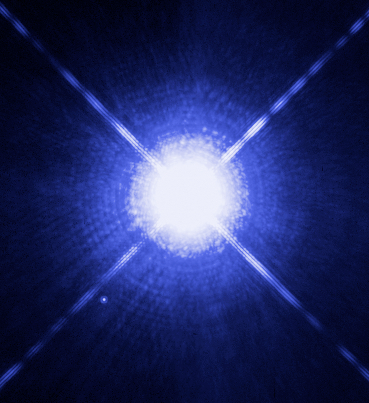
I also looked at Sirius (the brightest star in the night sky) through my telescope, hoping to see two stars. Sirius is part a binary star system. But I only saw one star. Having since read about Sirius on the internet, I think that Sirius B can be distinguished from Sirius A only by the most powerful observatory and space based telescopes. Here is a picture that was taken by the Hubble telescope (Sirius B can be seen as a small spot at 7 o'clock from Sirius A):

Sirius_A_and_B_Hubble_photo.jpg

Image: Wikimedia Commons

Along the way, I also saw two shooting stars, not through the telescope of course.
 
You should actually be able to split Sirius with a 4" scope under good seeing conditions and using high magnification. A much easier one to split is Alpha Centauri. Looks like 2 approaching headlights at high enough magnification, depending on where they are in relation to each other.
 
You should actually be able to split Sirius with a 4" scope under good seeing conditions and using high magnification. A much easier one to split is Alpha Centauri. Looks like 2 approaching headlights at high enough magnification, depending on where they are in relation to each other.

On the software (Starry Night Backyard) I'm using to navigate with, Alpha Centauri and Beta Centauri are quite far apart. It took me a while to find them because on Starry Night Backyard they are referred to as Rigil Kentauris and Hadar.
 
This thread is one of the best I have read on MyBB this year. Concise, accurate information from people who know what they are talking about
 
This thread is one of the best I have read on MyBB this year. Concise, accurate information from people who know what they are talking about

Bound to happen when there is a niche involved, one which is not open to certain individuals with no interest.
 
On the software (Starry Night Backyard) I'm using to navigate with, Alpha Centauri and Beta Centauri are quite far apart. It took me a while to find them because on Starry Night Backyard they are referred to as Rigil Kentauris and Hadar.

Yes, that's their common names. Most people just know them as the Pointers near the Southern Cross. Just to clarify that the binary star is Alpha Centauri (Alpha Centauri A & B), Beta Centauri is not part of the binary star but the second brightest star in the constellation.
 
Yes, that's their common names. Most people just know them as the Pointers near the Southern Cross. Just to clarify that the binary star is Alpha Centauri (Alpha Centauri A & B), Beta Centauri is not part of the binary star but the second brightest star in the constellation.

Thank you for the clarification. I was confusing A with Alpha, and B with Beta.

I succeeded last night in splitting Alpha Centauris.
 
For those of you with an Android device, the Amazon free app of the day, Distant Suns, may be of interest.
 
Last edited:
I got up early this morning and went outside before sunrise to planet gaze before going to work. My target: the elusive Venus, who only comes out for about an hour before sunrise. It was somewhat overcast but I waited my turn until she appeared for just a few minutes through a hole in the carpet of clouds, a beautiful crescent shape. I was surprised at how large she appears; Mars by contrast is a tiny red circle, and remains such even at high magnification.

I also saw Mars and the Moon. While looking about, I saw an Iridium flare and - what I suspect to have been - a satellite. I am surprised by how many satellites are actually visible to the naked eye; if one just bothers to move your gaze upwards, you see them all the time. But the Earth dwellers don't notice these things. It is like my telescope has opened up a new dimension to me.

Astronomy teaches one to be patient in this era of instant gratification. The planets, stars, galaxies and nebulae will appear when clockwork dictates that it is their time, and not a moment sooner, while the clouds will make a nuisance of themselves whenever they feel like it; there is nothing the astronomer can do about this, but to wait for another night.

Some part of me is looking forward to the night time loadshedding that will come this winter, though I suspect the light pollution may then be substituted by air pollution; the skies are much cleaner after a good thunderstorm.
 
Top
Sign up to the MyBroadband newsletter
X