The BYD (EV) Thread

The second-gen BYD Seagull grows up, but keeps its price under $10,000

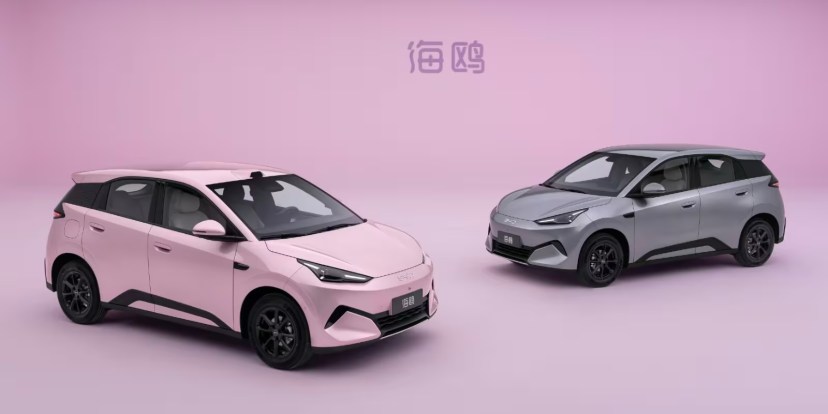
There's an obvious pattern whenever a carmaker releases a second generation of its cheap-n-cheerful city car. The original model hits the streets as a scrappy, compromised runabout with thin door cards, four seats, and just enough power to keep up with urban traffic. Then a rival builds something slightly bigger for the same money, buyers walk across the street, and the engineers have to go back to the drawing board. That is the exact story behind the second-generation BYD Seagull. The new version launched in Zhengzhou with a bigger footprint, a completely reworked rear-wheel-drive chassis, and a starting price that dips below the magic €9,000 mark.

BYD had no choice but to rework its entry-level hatchback, and the Chinese sales charts from the first nine months of 2026 explain why. Since the original Seagull debuted in April 2023, BYD has shifted around 1.55 million of them, including 529,537 units in 2025 alone. It has been a volume driver, known in overseas markets as the Dolphin Mini, Dolphin Surf, or Atto 1. But between January and September of this year, global Seagull deliveries dropped by 33% to 265,901 units, and domestic sales in China fell by a painful 66% to 83,600 cars. Monthly figures finally ticked upward again in August and reached 38,650 units in September, a modest 11.75% year-on-year recovery, but the underlying problem was obvious to everyone in Shenzhen.

That problem is called the Geely EX2, sold at home in China as the Geome Xingyuan. Between January and September, Geely handed over 310,000 units of the EX2, pushing it past the Tesla Model Y at 277,000 units to become the best-selling car in the country. Buyers were flocking to the Geely because it offered proper five-seat family practicality and rear-wheel drive in a package that made the old four-seat Seagull feel outdated. BYD decided that a mild facelift wouldn't simply do, and stretched the car in every direction to match the Geely millimeter for millimeter.

The new second-generation Seagull is 4,205 mm long, 1,810 mm wide, and 1,570 mm tall, riding on a 2,650 mm wheelbase. If you park it next to the outgoing first-generation car (3,780 mm long, 1,715 mm wide, and 1,540 mm tall with a 2,500 mm wheelbase), the new model is a full 425 mm longer with 150 mm extra between the axles. The Geely EX2 sits at 4,135 mm in length, 1,805 mm in width, 1,570 mm in height, and shares the exact same 2,650 mm wheelbase. The extra length brings the Seagull uncomfortably close to its bigger sibling, the BYD Dolphin, which is 4,290 mm long, 1,770 mm wide, and 1,570 mm tall, and has a 2,700 mm wheelbase.


1792647432874.png

1792647488782.png
 
The floating 1,197-HP Yangwang U8 now patrols the streets of Dubai

Once you've been driving for a few years, you start to recognize unmarked police cars from quite far away. In the UK, traffic officers usually spend their shifts in a Skoda Octavia vRS, waiting for someone to get a bit too optimistic in the outside lane. In Germany, the autobahn patrols rely on practical BMWs, Volkswagens, and a growing fleet of Stellantis products. Even in the US, where a few local sheriff departments have tried turning the Tesla Cybertruck into a cruiser, the vast majority of law enforcement work happens in a Ford Explorer with steel wheels and wipe-down vinyl seats.

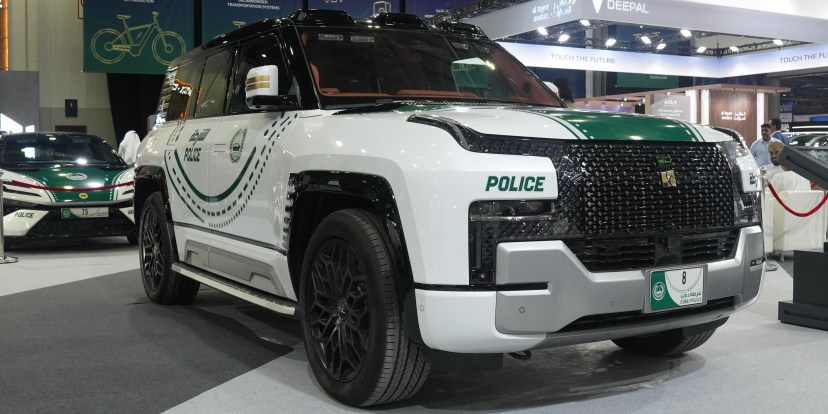
Dubai does not do steel wheels or vinyl interior. Over the past decade, the Dubai Police force has turned its tourist patrol division into the most recognizable PR machine on the planet. Their latest recruit is the Yangwang U8, a four-motor luxury SUV built by BYD that puts out 1,197 horsepower. Unveiled at the 2026 Water, Energy, Technology and Environment Exhibition at the Dubai World Trade Center through a partnership with local distributor Al-Futtaim Automotive Group, the U8 wears the famous dark green and white livery with confidence. The official press release talks about community engagement and environmental sustainability, but anyone who follows the car industry knows the real job description here: rolling public relations.

And it really is a smart bit of marketing for both the city and the carmakers. Rather than hiding behind radar guns on the highway, these patrol vehicles park outside the busiest shopping boulevards so visitors can take photos and chat with the officers. In recent years, that glamorous garage has shifted away from twelve-cylinder Italian exotics. Before the Yangwang arrived, the force already included a Lotus Eletre R, a Zeekr 001, a Lucid Air, a Tesla Cybertruck, and the giant Hongqi E-HS9. If you want the world to take notice of a new EV, putting a lightbar on the roof and parking it at the foot of the world's tallest building is more effective than buying a thirty-second TV commercial during a football final. At the rate Dubai is adopting new transport tech, it is probably only a matter of time before we see that same green-and-white graphic wrapped around a fleet of eVTOLs hovering over the Marina.

Under the tourist-friendly paintwork, the Yangwang U8 is a slightly absurd piece of modern engineering. Many people refer to it simply as an electric SUV, but it is technically an extended-range EV - under that long hood you will find a 2.0-liter turbocharged four-cylinder petrol engine which has no mechanical connection to the wheels, and it simply feeds a 49.05 kWh LFP Blade battery. The actual driving is handled by four electric motors - one positioned at each wheel - delivering a combined 880 kW (1,197 hp) and 1,280 Nm of torque. On battery power alone, it can cover up to 180 km on the Chinese testing cycle, while a full 75-l tank of fuel stretches the total driving range to roughly 1,000 km.

 
Interior of the new BYD Seal 07 reveals a grownup design

Here’s a simple fact about cars, electric or not - whenever you spend six or seven hours behind the wheel, you quickly forget about performance numbers and start caring about cabin layout. If you cannot put your phone on a charger without knocking a coffee cup, or if shifting into reverse means fighting with a fiddly dial while maneuvering into a tight parking bay, all the power and clever software count for nothing. BYD has learned its lesson, and with the second-generation Seal 07, the company is trading some of its earlier stylistic “novelties” for a cabin that takes ergonomics seriously.

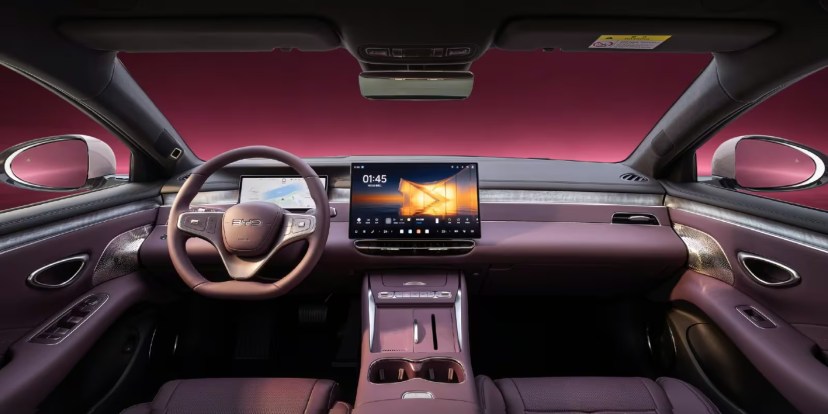
The clearest sign of this is the missing round crystal gear selector that used to sit on the center console. Selecting drive modes is now done with a neat stalk tucked behind the steering wheel. Moving that shifter clears out the transmission tunnel entirely, making room for two wireless charging pads, deep cup holders, and a row of physical metallic rocker switches that you can operate without taking your eyes off the road. The new three-spoke flat-bottom steering wheel sits in front of a digital instrument cluster, and a recessed head-up display hides out of the way. It is a mature, clean layout that swaps the clutter of early Seal for everyday usability.

Passenger comfort also shifts upmarket. The front seats are zero-gravity units with ventilation, heating, and pneumatic massage. The rear bench gets longer seats and deeper backrest contours. BYD has fitted a 20-speaker Devialet sound system with swanky laser-etched metal grilles decorating the door cards, replacing the Dynaudio setups used in earlier models. Twenty speakers can sometimes feel like spec-sheet inflation, but a well-tuned acoustic profile combined with double glazing should keep wind noise and tire rumble at bay.

To make all of that interior space work, the second-generation Seal 07 has gone through a growth spurt. Chinese regulatory filings reveal that the new car stretches to 5,080 mm in length, is 1,960 mm wide and 1,495 mm tall, with a 2,960 mm wheelbase. Compared to the outgoing Seal 07 EV, that is an increase of 85 mm in bumper-to-bumper length, 50 mm in width, and 60 mm between the axles. Those aren’t small differences - they push what was once a midsize sedan into full-size executive territory.

 
Top
Sign up to the MyBroadband newsletter
X