The BYD (EV) Thread

BYD officially unveils the 3000-horsepower Yangwang U9 Xtreme

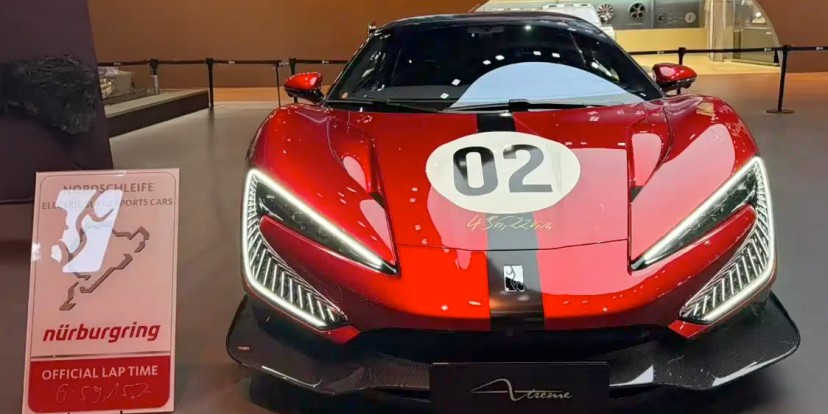
BYD officially launched its wildest creation yet: the Yangwang U9 Xtreme. This is a limited-edition track machine designed to push automotive limits, with the Chinese automaker planning to build only 30 units of this exclusive model. The U9 Xtreme represents the absolute peak of BYD’s engineering know-how, packaging nearly 3,000 horsepower into a machine purpose-built for the world’s toughest circuits.

The numbers associated with the Yangwang U9 Xtreme are staggering. This EV has a total output of 2,220 kW, which translates to a phenomenal 2,977 horsepower. This colossal power output is why the car achieved a confirmed top speed of 496.22 km/h - nearly half the speed of sound. Even more impressive is its official Nürburgring Nordschleife lap time, stopping the clock at 6 minutes, 59.157 seconds. That time instantly places the U9 among the fastest vehicles ever to tackle the famous German track.

The U9 Xtreme uses BYD’s e⁴ intelligent all-wheel-drive system. This advanced setup has four electric motors, allowing for precise wheel-end torque vectoring - meaning the car can instantly and exactly control how much power goes to each of the four wheels. The entire system runs on a 1,200V ultra-high-voltage platform, essential for moving this amount of energy efficiently. All this intense engineering results in a power-to-weight ratio of 1,217 horsepower per ton.

Keeping the car stable at its extreme speeds is the job of the DiSus-X intelligent active body control technology. This system uses an external dual-valve structure that gives the car lightning-fast control over its own height and firmness. It features separate valves that specifically control the upward and downward movement of the suspension, allowing the U9 Xtreme to make quick, independent vertical adjustments at all four wheels.

1763802153882.png

1763802163195.png

1763802174577.png
 
BYD Sealion 5 launching in early December as SA’s most affordable plug-in hybrid

Plug-in hybrids (PHEVs) are seen as an ideal bridge between internal combustion and electric motoring, particularly for countries such as South Africa, where long-distance driving is the norm and range-anxiety is a real concern.

Although they do have smaller and cheaper batteries than traditional electric vehicles, the cost of incorporating electric and petrol engines means they aren’t necessarily cheap to produce and, at this stage, all PHEVs cost more than R600,000 in South Africa.

That’s set to change with the BYD Sealion 5, which is set to reach local showrooms in early December. Although pricing and specifications have yet to be confirmed, it will almost certainly come in comfortably beneath the R600,000 mark, given that the larger Sealion 6 currently costs from R639,900.

It is also expected to undercut the newly introduced Geely E5 EM-A, which costs R599,999, and the Chery Tiggo 7 CSH PHEV, which retails at R619,900.

In overseas markets, the Sealion 5 is offered in two battery variants, with the 12.9 kWh battery option allowing an electric-only range of up to 71km on the NEDC cycle and the 18.3 kWh version covering up to 100km, according to official claims. Official combined fuel consumption is as low as 1.3 litres per 100km, but that would of course depend on owners charging their batteries regularly.

The vehicle’s Dual-Mode Intelligent hybrid system pairs a 1.5-litre normally aspirated petrol engine with an electric motor for a combined output of 156kW.


1763978835560.png
 
BYD leads the global EV race as Tesla slips away

The world's shift to battery power is accelerating, and the fight for supremacy in the EV market is tighter than ever. New figures show global sales of New Energy Vehicles (NEVs), which include all battery-powered and plug-in hybrid models, hit 5.39 million units in the third quarter of this year. This is an impressive 31% increase from the same time last year. At the head of this accelerating pack are the two giants: China's BYD and the American powerhouse, Tesla.

In the pure Battery Electric Vehicle (BEV) category, BYD holds the current crown, but just barely. The brand captured 15.4% of the global market share, maintaining its spot as the top seller. But BYD's lead showed a small crack - the company moved 582,522 passenger BEVs in the three-month period, which was a remarkable 31.37% jump compared to last year's sales, but a 4.03% decline from their own performance in the previous quarter.

Right on BYD's tail is Tesla, which is clearly finding a second wind. The American automaker landed in second place with 13.4% of the worldwide market. Tesla posted a giant surge in sales compared to the three months before, growing by 29.41%. This big push resulted in 497,099 vehicle deliveries globally in the third quarter. This impressive boost came from two key areas: US buyers rushing to meet subsidy deadlines, and renewed growth for the brand in the Chinese market.

But the real story of disruption is taking place just below the two leaders, where several smaller, fast-moving brands are stealing market share from established players. Geely Auto showed strong growth, grabbing 6% of the BEV market, followed closely by Leapmotor, which secured 4.1%. These two quickly growing challengers have now surpassed XPeng, which holds 3.1% of the market.

Even tech giants are getting into the game, with Xiaomi securing 2.9% and ranking eighth overall. Unfortunately, many legacy automakers are struggling to keep up. Volkswagen slipped to seventh place, unable to offset major declines in China despite better sales in Europe and the US. BMW's BEV sales are declining as well, putting pressure on its full-year goals.

The plug-in hybrid segment, which includes cars that use a battery and a gasoline engine (PHEVs), tells a similar story of BYD domination mixed with intense competition. BYD remains the leader here, too, with an enormous 27.9% market share. But even this segment reveals how tough the market is becoming. Despite a tiny bump in sales compared to the previous quarter (up 0.56%), BYD's total PHEV sales of 523,069 units were down sharply by 23.73% year-over-year.


1763982511191.png
 
BYD Sealion 5 (2025) Price & Specs

The BYD Sealion 5 is officially South Africa’s most affordable plug-in hybrid SUV. Here’s how much you can expect to pay, plus a look at the features.

New-energy brand BYD will launch its new Sealion 5 before the end of 2025 and thanks to a helpful BYD dealer, we’ve uncovered some specifications as well as a launch price.

In terms of size, the BYD Sealion 5 measures 4 738 mm long, 1 860 mm wide and has a height of 1 710 mm. A wheelbase of 2 712 mm is claimed and these figures make it a little bigger than the Toyota Corolla Cross, Kia Seltos and Chery Tiggo 7 Pro.

Powertrain

The BYD Sealion 5 is powered by a plug-in hybrid petrol engine. The 1.5-litre naturally-aspirated petrol motor makes 72 kW and 122 Nm, and that is complemented by an electric motor which makes 145 kW and 300 Nm. BYD claims a system total max power figure of 156 kW.

There’s a 12.96 kWh battery which offers around 50 km of pure electric driving, and the vehicle is front-wheel driven via a CVT. It also features Vehicle-to-Load (V2L) tech to power accessories.

Trim Levels

The Sealion 5 will be offered in two trim levels, Comfort and Dynamic. Customers have the choice of one interior colour and four exterior colours; Atlantis Grey, Obsidian Black, Snow White, Time Grey.

Comfort

NFC key access
Four airbags
ADAS suite (FCW, LDW, ELKA, adaptive cruise control, traffic sign recognition, auto emergency brake etc)
Stability control, anti-lock brakes, hill descent control, blind spot detection
Tyre pressure sensors
Rear parking sensors
18-inch wheels
Reverse camera
Auto LED headlights
Auto wipers
12.8 inch infotainment screen
Android Auto/Apple CarPlay
6-speakers
Two front USB ports (Type A & C)
Two rear USB ports (Type A & C)

Dynamic (The above content plus:)

Full 360-degree camera
Front parking sensors
6-way electric adjustment for driver’s seat
Heated & Ventilated seats for driver
4-way adjustment for front passenger
Electric sunroof
Front 15W wireless phone charger
Roof rack
Electric tailgate
Electric folding mirrors

How much does the BYD Sealion 5 cost in South Africa?

While warranty and service plan has yet to be confirmed, we reckon it’ll follow the rest of the BYD PHEV range aftersales package, which is a 5-year/100 000 km vehicle warranty, 8-year/150 000 km battery warranty, and a 5-year/100 000 km maintenance plan.

Comfort R499 900
Dynamic R550 000 (estimated, TBC)


1764326275061.png

1764326416023.png

1764326487360.png
 
Global sales surge saves BYD from domestic trouble

Few EV companies are watched as closely as BYD. As the leader in the New Energy Vehicle (NEV) market, every month it releases a flurry of numbers that automotive journalists and investors dissect. November’s sales figures from the Chinese giant tell a story of two different markets, showing both impressive resilience and some surprising slowdowns right where the company is strongest.

The total number of vehicles sold set a record for the year, but a closer look reveals that BYD’s domestic sales dipped year-over-year. The overall sales were saved largely by a massive surge in international demand for BYD’s electric cars and hybrids.

In November, BYD moved a total of 480,186 NEVs. This was actually the company’s highest monthly sales number for the entire year. But this shiny achievement comes with a huge asterisk: sales were down by 5.25% compared to November of last year. November was the third straight month that BYD saw a year-over-year contraction in total sales, a sign of growing competition or possibly even worse - market saturation at home.

Despite the annual slide, the company did manage an increase of 8.71% compared to October’s performance, showing it still had momentum month-to-month. The company’s passenger NEVs made up the bulk of the sales, with 474,921 units sold, following a similar trend with a 5.77% year-over-year decline but an 8.71% monthly boost.

The true powerhouse of BYD’s November performance was its export business. BYD set a new record by shipping 131,935 NEVs overseas - a number nothing short of explosive, a 325.91% increase compared to the same month last year. Month over month, exports jumped by 57.25%, confirming the company’s aggressive push into new international markets is paying off handsomely.

 
Top
Sign up to the MyBroadband newsletter
X