The evolution of the cricket bat

MickeyD

RIP
Joined
Oct 4, 2010
Messages
139,095
Reaction score
432
Location
Nelson Mandela Bay
Barry Richards holds the bat with which he made 325 in a day at the WACA in 1970 in his right hand, and David Warner's modern-day weapon in his left. [Australia v New Zealand, 3rd Test, Adelaide, November 27, 2015]

I'm not going to resize it - want to retain the perspective!


227831.jpg
 
In case some folks are not aware of it....


[video=youtube;VVjA9vI-i18]https://www.youtube.com/watch?v=VVjA9vI-i18[/video]
 
His face says it all.
I wonder how today's cricketers would do with the older bats
 
awesome find Mickey, thanks for that :)
 
Wow looked so simple. That stance and technique won't stand the test of modern armchair critics.

Thanks nice find.

I had the pleasure of growing up and watching stars like Barry Richards, Graeme Pollock, Eddie Barlow, Mike Procter, Lee Irvine, Ken McEwan, etc... I would bunk school to watch them bat at St George's park !!
 
I had the pleasure of growing up and watching stars like Barry Richards, Graeme Pollock, Eddie Barlow, Mike Procter, Lee Irvine, Ken McEwan, etc... I would bunk school to watch them bat at St George's park !!

Legends all, not surprised you bunked. Awesome thread Mickey.
 
Article on bat making...

http://www.espncricinfo.com/magazine/content/story/787773.html

Chris King sighs. "The average pro bat now lasts between 200 and 1000 runs. You can get lucky, but that's an average life."

It's why King groans inwardly when amateur cricketers ask for a pro bat. "It's like buying a Formula One car and using it to drop the kids off at school."
Every cricket bat is dying, just at different speeds. When the face is pressed, the fibres of the willow are crushed together. About a centimetre of unpressed wood is compacted down to a couple of millimetres to make it hard enough to resist the repeated impact of a fast-moving, hard leather ball. The process of pressing hasn't changed significantly. Modern bats are pressed just slightly less. As the bat is used, the fibres that have been pushed together begin to separate in a process called delamination. In the early stage of delamination the bat reaches its peak, when the ball will feel as though it is trampolining from the face. Cook and Ramprakash, the last generation to have grown up with their bats pressed slightly harder, still prefer to play a bat in themselves in the nets, where they feel the delamination begin. It's an unfamiliar concept now, when bats are effectively already beginning to delaminate before a ball has struck the face, and no longer need as much "knocking in"', the age-old job that used to start the process.

Last summer, Sky Sports asked King to make a series of replica bats for an experiment conducted by Mike Atherton and Andrew Strauss. King made five, each one echoing a different era of cricket, from the days of Grace to the present season. Atherton and Strauss discovered that the performance when the ball was struck in the centre of the bat was almost the same. The differences came when the connection was less good, made low down or high up or towards one or other of the edges. While older bats demanded purity, the bats of the 21st century were far more forgiving.

In this, there is a parallel with golf, where older, bladed clubs required a precise strike, while the more modern cavity-backed irons were designed to eliminate an amateur's mistakes yet found their way into the professional game. It would be easy to draw a line through the evolution of bats to the increased dominance of batsmen, especially in white-ball cricket. Those in the commentary box, with the benefit of super slo-mo and Hot Spot, see a ball hit off-centre and still fly over the boundary and give credit to the maker.

Yet as in golf, to attribute the advancement of a sport to an advancement in the gear it's played with is a reductive argument. Once Tiger Woods had begun dismantling the world's best courses by driving the ball more than 300 yards, a new generation of players grew up watching him and began to do the same. Cricket too had its outliers: Gayle, Virender Sehwag and others, men who compiled huge scores faster than ever before by striking boundary after boundary.

Cricketers hit the gym. They got muscle. What had changed was intent, the intent to hit the ball harder and further and more often. Intent fed batsmanship, which fed the change in bats and so on in an endless upward spiral.
 
The greatest cricket bat controversy of all time dates back tot he 1770s when a batsman used a bat that was the same width as the wickets!!

This caused a Law change that is still applicable today... the width of the bat may not be more than four and a quarter inches.

Here's a great (long-ish) read on the incident and the impact of it. --> http://web.archive.org/web/20100119...o.uk/stampsite/cricket/histories/monster.html

In his Young Cricketers Tutor (1833), John Nyren refers to the incident by saying: "Several years since (I do not recollect the precise date) a player, named White, of Ryegate (sic), brought a bat to a match, which being the width of the stumps, effectually (sic) defended his wicket from the bowler : and, in consequence, a law was passed limiting the future width of the bat to 4ÂĽ inches". In a footnote, Nyren adds that: "I have a perfect recollection of this occurrence; also, that subsequently, an iron frame of the statute width, was constructed for, and kept by the Hambledon Club; through which any bat of suspect dimensions was passed, and allowed or rejected accordingly".
 
My weapon of choice in the 80s - loved this baby!! At the time it was as groundbreaking as the Gray Nichols "scoop". That extra chunk of wood on the back gave it a very different feel to the standard bats of the time.

SS_Jumbo1.jpeg
 
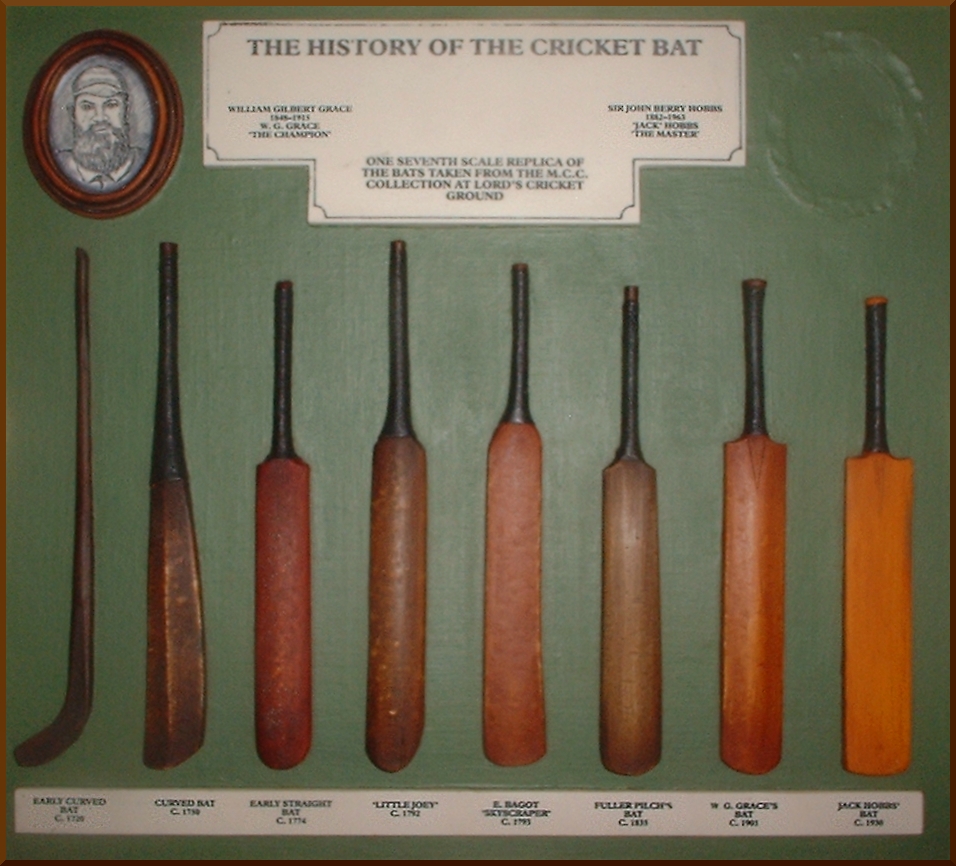
Why does the first one look like a hockey stick?

The standard ball rolled most of the way down the pitch (pre-1760s) so it was easier to sweep it away for runs - similar to a hockey stroke.

It's only after they started bowling over arm (late 1760s ?) and pitching the ball (on the bounce) that the shape of the bat changed.

You can see by the second bat (curved) that it was a multi-purpose bat... for the underarm and over-arm bowlers!!
 
My weapon of choice in the 80s - loved this baby!! At the time it was as groundbreaking as the Gray Nichols "scoop". That extra chunk of wood on the back gave it a very different feel to the standard bats of the time.

View attachment 319629

I had one in high school. It was a beast and I could barely lift it, but when you hit a ball, it stayed hit! :)
 
Top
Sign up to the MyBroadband newsletter
X