The Ford Ranger (T6) Thread

Mysterious new Ford Ranger ‘Bushtrak’ for SA?

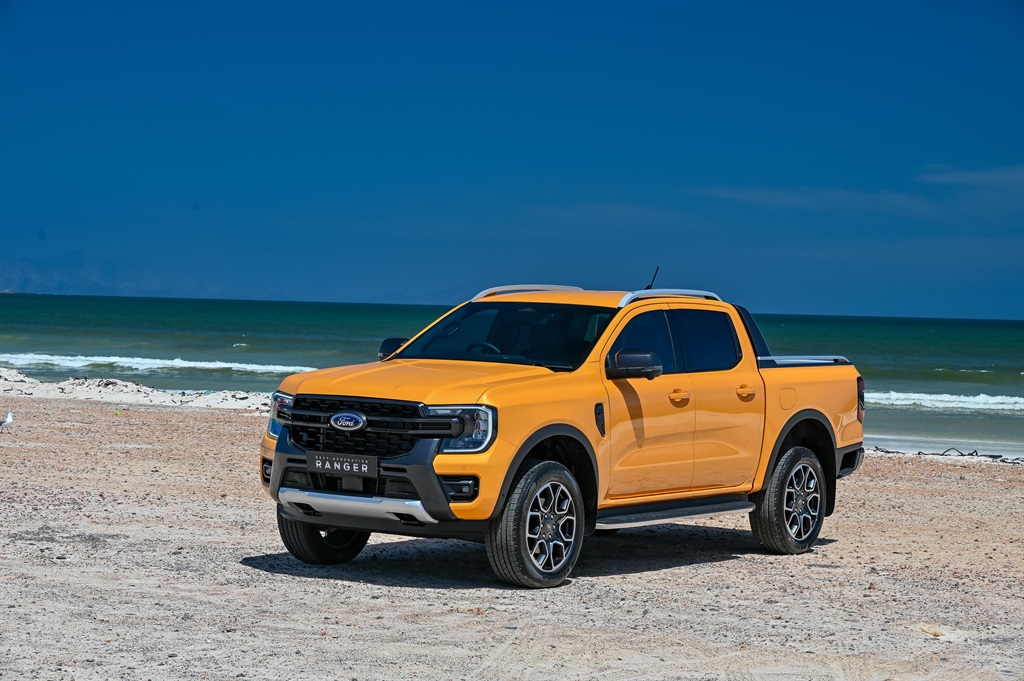
Ford’s pending application to trademark the Ranger “Bushtrak” badge in South Africa potentially hints at a mysterious new (local?) version of the Silverton-built bakkie…

Ford has a habit of punctuating its Silverton-built Ranger bakkie line-up with special derivatives (think Tremor, Wildtrak X and the like). Now, based on trademark filings unearthed by Cars.co.za, another new derivative may well be on the cards for South Africa: the Ranger Bushtrak.

Yes, the Blue Oval brand filed to trademark both the “Bushtrak” and “Ranger Bushtrak” badges in South Africa back in December 2021. The former was officially registered in September 2023, while the latter is currently pending registration (though it should be registered within the next few months).

Of course, Ford already holds the rights to the “Wildtrak” and “Wildtrak X” nameplates in Mzansi, along with “Wolftrak” (registered in September 2023, though not yet used locally, despite featuring on the previous-gen Ranger in certain overseas markets). The company also applied to trademark “Stormtrak” and “Thunder” – badges likewise used on the P375-gen model – in South Africa, though these have technically yet to be officially registered.

What makes the “Ranger Bushtrak” filing particularly interestingly, however, is that we can find no record of applications to trademark this badge in any country other than South Africa. That’s not the case with the other nameplates mentioned above, which are all used (or once were used) in various other markets around the world.
 
Mysterious new Ford Ranger ‘Bushtrak’ for SA?

Ford’s pending application to trademark the Ranger “Bushtrak” badge in South Africa potentially hints at a mysterious new (local?) version of the Silverton-built bakkie…

Ford has a habit of punctuating its Silverton-built Ranger bakkie line-up with special derivatives (think Tremor, Wildtrak X and the like). Now, based on trademark filings unearthed by Cars.co.za, another new derivative may well be on the cards for South Africa: the Ranger Bushtrak.

Yes, the Blue Oval brand filed to trademark both the “Bushtrak” and “Ranger Bushtrak” badges in South Africa back in December 2021. The former was officially registered in September 2023, while the latter is currently pending registration (though it should be registered within the next few months).

Of course, Ford already holds the rights to the “Wildtrak” and “Wildtrak X” nameplates in Mzansi, along with “Wolftrak” (registered in September 2023, though not yet used locally, despite featuring on the previous-gen Ranger in certain overseas markets). The company also applied to trademark “Stormtrak” and “Thunder” – badges likewise used on the P375-gen model – in South Africa, though these have technically yet to be officially registered.

What makes the “Ranger Bushtrak” filing particularly interestingly, however, is that we can find no record of applications to trademark this badge in any country other than South Africa. That’s not the case with the other nameplates mentioned above, which are all used (or once were used) in various other markets around the world.

a ranger for every day of the week hey
 
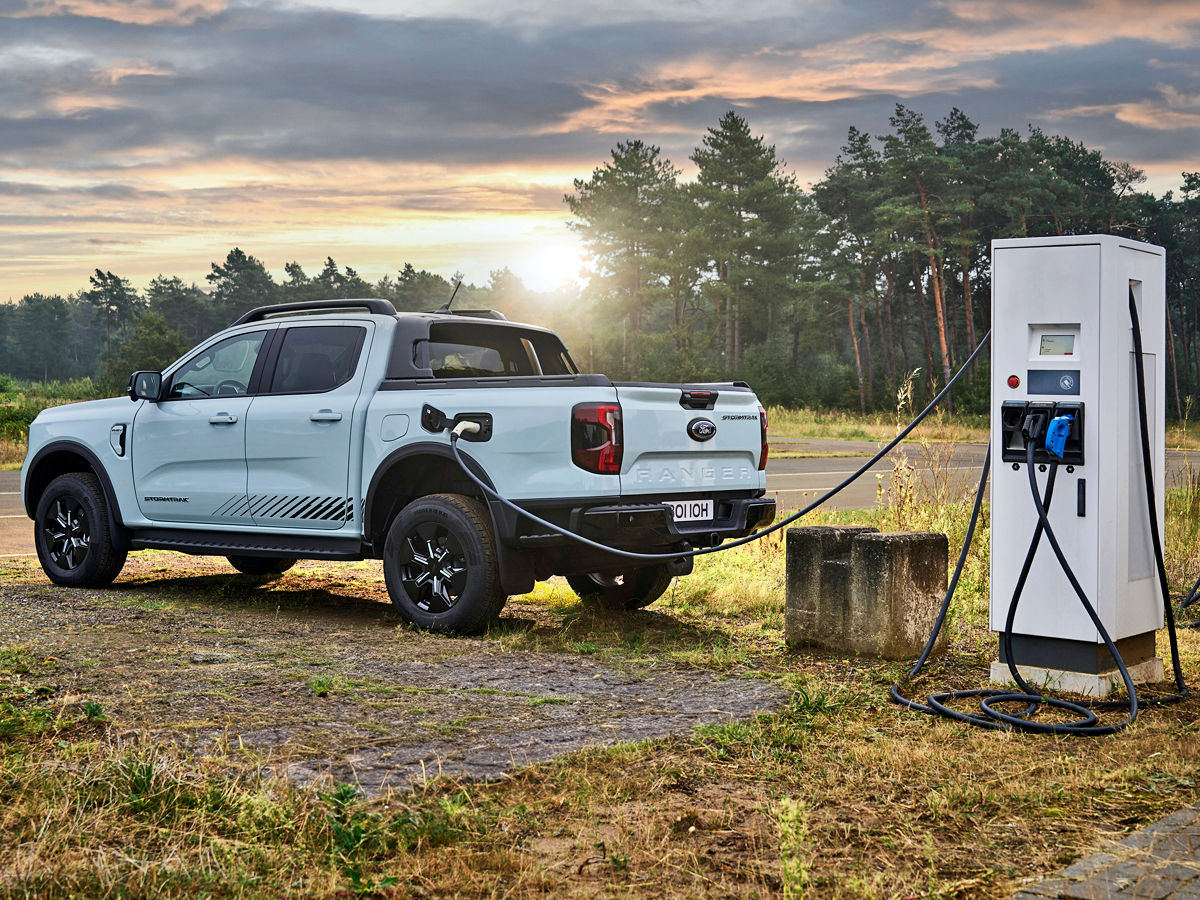
You can now have the Ford Ranger pickup with PHEV power

Ford pairs a 2.3-litre EcoBoost with an electric motor and an 11.8kWh battery for 275bhp and 27 miles of EV range

Well, this was inevitable – Ford has finally electrified the Ranger pickup truck. It hasn’t gone full EV like it did with the F-150 Lightning though. Instead, Europe’s best-selling pickup will be getting a plug-in hybrid powertrain that pairs a 2.3-litre EcoBoost four-pot with a 10-speed auto gearbox, an electric motor and an 11.8kWh battery.

That PHEV powertrain will result in outputs of 275bhp and 509lb ft of torque. Not bad. In fact, that actually makes this the torquiest Ranger of all – the petrol V6 Raptor gets 362lb ft, while the twin-turbo 3.0-litre diesel V6 in the standard Ranger makes 443lb ft.

The electric motor is integrated into the bellhousing, while the battery is packaged in between special frame rails. Said battery should provide up to 27 miles of all electric range and it’ll take just under four hours to charge from 0-100 per cent.

It also means that (like on hybrid and electric Transits) Ford can now offer its Pro Power Onboard system on the Ranger. Essentially that means if the right boxes are ticked on the configurator, drivers can power two tools at once, each with 3.45kW of power directly from the battery – negating the need for a generator. Neat.

 
New SA-built Ford Ranger PHEV: peak outputs revealed

Key figures for the new Ford Ranger PHEV – a plug-in bakkie to be produced at the Silverton plant in SA – have been revealed. Meet the torquiest Ranger yet…

Unveiled a year ago, the Ford Ranger PHEV has finally made its show debut at the IAA Transportation event in Germany, with the Blue Oval brand also using the occasion to release key information (including power and torque figures) for this plug-in hybrid bakkie.

As a reminder, the Ranger PHEV will be built at the Silverton assembly plant in South Africa (the only plant worldwide handed this task) following a R5.2-billion investment announced in November 2023. Though Ford SA has yet to officially confirm this electrified derivative for our market, it seems only a matter of time.

According to the Dearborn-based automaker, the new plug-in hybrid electric double-cab bakkie is a “no-compromise new model” that offers “full Ranger towing, payload and off-road performance, with electric-only driving ability”.

The PHEV powertrain combines Ford’s turbocharged 2.3-litre, 4-cylinder petrol engine and 10‑speed automatic transmission with a 75 kW electric motor and an 11.8 kWh (usable capacity) battery pack. Peak system outputs stand at 205 kW and 690 Nm, with this torque figure described as the “highest of any production Ranger ever” (eclipsing even the high-performance Raptor’s 583 Nm).

The electric motor is integrated into the transmission bellhousing, while the battery takes “less than 4 hours to charge using a single-phase 16-amp charger”, according to Ford. Interestingly, the company has still not provided a confirmed single-charge electric-only range, saying only that it has a target of “over 45 km”.

Ford adds that buyers can expect a payload of “up to 1 tonne” and a braked towing capacity of 3 500 kg. The Ranger PHEV employs a new “e-4WD” system along with a dual-range transfer box and rear differential lock. The traction battery, meanwhile, is packaged between “specially engineered” frame rails.

 
New SA-built Ford Ranger PHEV: peak outputs revealed

Key figures for the new Ford Ranger PHEV – a plug-in bakkie to be produced at the Silverton plant in SA – have been revealed. Meet the torquiest Ranger yet…

Unveiled a year ago, the Ford Ranger PHEV has finally made its show debut at the IAA Transportation event in Germany, with the Blue Oval brand also using the occasion to release key information (including power and torque figures) for this plug-in hybrid bakkie.

As a reminder, the Ranger PHEV will be built at the Silverton assembly plant in South Africa (the only plant worldwide handed this task) following a R5.2-billion investment announced in November 2023. Though Ford SA has yet to officially confirm this electrified derivative for our market, it seems only a matter of time.

According to the Dearborn-based automaker, the new plug-in hybrid electric double-cab bakkie is a “no-compromise new model” that offers “full Ranger towing, payload and off-road performance, with electric-only driving ability”.

The PHEV powertrain combines Ford’s turbocharged 2.3-litre, 4-cylinder petrol engine and 10‑speed automatic transmission with a 75 kW electric motor and an 11.8 kWh (usable capacity) battery pack. Peak system outputs stand at 205 kW and 690 Nm, with this torque figure described as the “highest of any production Ranger ever” (eclipsing even the high-performance Raptor’s 583 Nm).

The electric motor is integrated into the transmission bellhousing, while the battery takes “less than 4 hours to charge using a single-phase 16-amp charger”, according to Ford. Interestingly, the company has still not provided a confirmed single-charge electric-only range, saying only that it has a target of “over 45 km”.

Ford adds that buyers can expect a payload of “up to 1 tonne” and a braked towing capacity of 3 500 kg. The Ranger PHEV employs a new “e-4WD” system along with a dual-range transfer box and rear differential lock. The traction battery, meanwhile, is packaged between “specially engineered” frame rails.


Whats the advantage of going PHEV vs the hilux 48V closed hybrid system ?
 
Sounds like a terrible idea. All that extra weight for 27 miles?
 
Top
Sign up to the MyBroadband newsletter
X